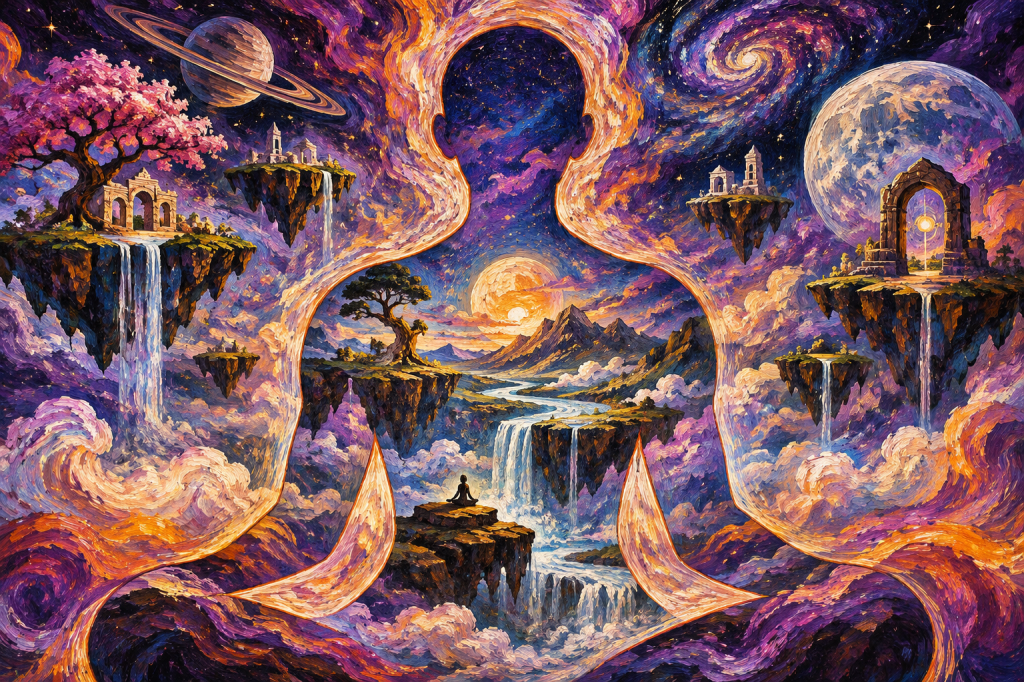
We spend much of our lives trying to fill things. We fill our schedules with responsibilities, our homes with possessions, our minds with information, and our silence with conversation. Somewhere along the way, we have come to associate fullness with fulfillment and emptiness with something that needs to be corrected.
But what if emptiness is not a problem to be solved? What if the absence of something is equally as meaningful as its presence?
In art, this concept is known as negative space—the empty area surrounding a subject that gives it definition, balance, and perspective. Beyond the canvas, however, negative space offers a profound philosophical lesson about the nature of existence and how we experience it.
The Wisdom of the Empty Vessel
In the Tao Te Ching, Lao Tzu illustrates the importance of emptiness through ordinary objects. A clay vessel is useful because of the hollow space within it. A room serves its purpose because of the space between its walls. A wheel functions because of the opening at its center.
What exists gives these things their form, but what does not exist gives them their usefulness.
This ancient wisdom challenges our conventional understanding of value. We tend to appreciate what is tangible, measurable, and visible while overlooking the invisible conditions that make those things possible.
Perhaps emptiness is not the opposite of existence but an essential component of it.
The Beauty of What Is Missing
Consider music. A composition consisting of uninterrupted sound would lose much of its emotional depth. The pauses between notes create rhythm, anticipation, and atmosphere. Silence is not separate from the music; it participates in its creation.
The same principle appears throughout nature. The vastness of the night sky gives the stars their brilliance. The distance between mountains creates the beauty of a valley. The space between words allows us to understand a sentence.
Negative space provides contrast, and contrast allows us to recognize what might otherwise go unnoticed.
Life is not composed solely of what happens. It is also shaped by the intervals between experiences—the quiet mornings, the unplanned afternoons, and the moments when nothing particularly extraordinary occurs.
Our Obsession With Filling Everything
Modern society often treats empty space as wasted potential. An open schedule becomes an opportunity to accomplish more. A moment of silence becomes an invitation to check our phones. An unanswered question becomes something we feel compelled to resolve immediately.
We have become so accustomed to constant stimulation that spaciousness can feel uncomfortable.
Yet when everything demands our attention, very little receives it fully. When every moment is occupied, we leave ourselves little room for curiosity, contemplation, or spontaneous discovery.
A painter understands that covering every inch of a canvas does not necessarily make the painting more beautiful. Perhaps we could approach our lives with the same understanding.
More is not always an improvement. Sometimes, it obscures what was already beautiful.
The Art of Intentional Subtraction
Personal growth is often presented as a process of accumulation: acquiring knowledge, developing habits, gaining experiences, and becoming more accomplished.
But growth can also occur through subtraction.
What happens when we remove an expectation that no longer serves us? When we release an unnecessary obligation? When we stop trying to explain ourselves to everyone?
We create space.
Practicing intentional subtraction does not mean abandoning ambition or withdrawing from the world. It means becoming more conscious of what deserves a place in our lives.
We can begin by allowing moments of silence without reaching for distractions, leaving portions of our day unplanned, listening without preparing a response, and resisting the impulse to fill every uncertainty with an explanation.
These seemingly insignificant choices allow life to breathe.
Making Room for the Unknown
Negative space also reminds us that not everything needs to be defined.
There is something beautiful about leaving certain questions unanswered, allowing experiences to unfold naturally, and accepting that the future does not need to be completely understood before we can appreciate the present.
An empty canvas contains possibility. An unwritten page contains countless stories. An uncertain future contains opportunities that our current imagination may not yet be capable of recognizing.
Emptiness, from this perspective, is not merely an absence. It is an opening.
Final Thoughts
Perhaps the art of living is not about filling every available space but understanding which spaces are worth preserving.
We do not need to turn every moment into an achievement, every silence into a conversation, or every uncertainty into an answer.
Like a beautifully composed painting, life requires balance between presence and absence, movement and stillness, substance and space.
The next time you encounter emptiness, resist the immediate temptation to fill it. Observe it. Appreciate it. Consider what its presence makes possible.
Sometimes, the most meaningful thing we can add to our lives is nothing at all.