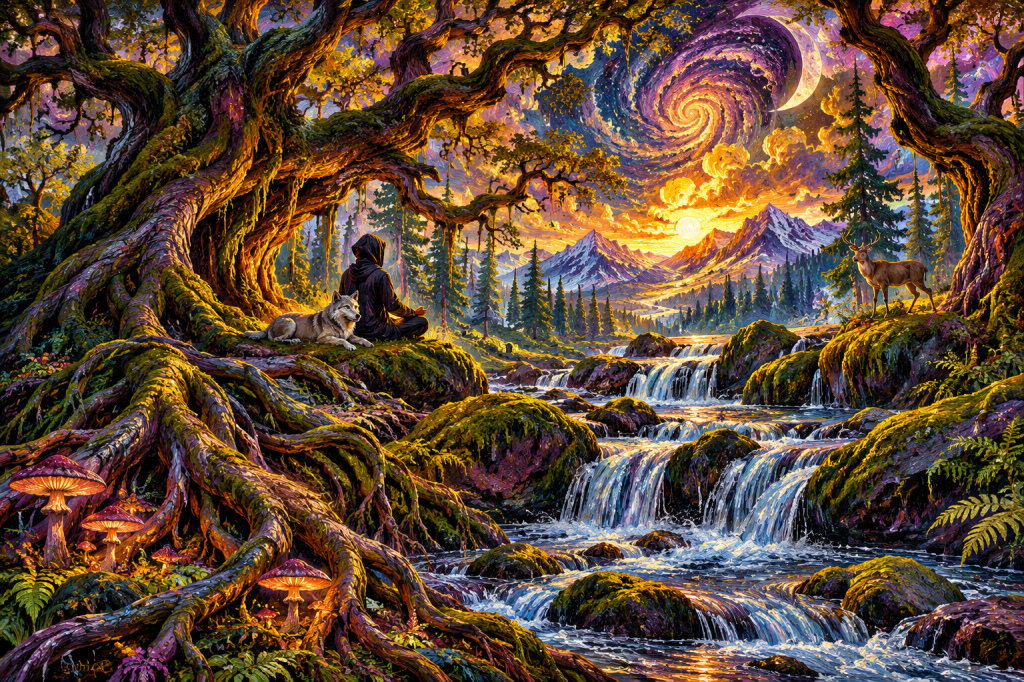
We live in a world that constantly encourages us to want more. More accomplishments, more possessions, more experiences, and more recognition. We are taught to associate progress with accumulation, rarely stopping to question whether everything we pursue actually enriches our lives.
Nature, however, offers a different perspective.
A forest thrives not through endless expansion but through a delicate balance of resources, relationships, and natural cycles. Trees grow, leaves fall, and seasons change. Growth is accompanied by periods of rest, renewal, and decay. There is no expectation that every season must produce more than the last.
Perhaps there is something profound to learn from this natural rhythm.
The Human Obsession With More
Modern society often treats satisfaction as a lack of ambition. The moment we achieve something, our attention shifts toward the next milestone. What once seemed like enough becomes ordinary, and the cycle begins again.
There is nothing inherently wrong with ambition. The desire to grow, create, and explore is a beautiful part of being human. The problem arises when our pursuit of more prevents us from appreciating what already exists.
When satisfaction is always somewhere in the future, the present becomes little more than a stepping stone toward another destination.
We become so occupied with improving our lives that we forget to experience them.
Nature’s Wisdom of Balance
Within nature, limitations serve a purpose. Ecosystems depend on the availability of resources, the changing seasons, and the relationships between living organisms. Unchecked growth can disrupt the very conditions that make life possible.
Human beings are not exempt from this principle.
Our minds need rest. Our bodies need recovery. Our relationships need attention. Our creativity needs space to breathe.
Yet we frequently disregard these natural limitations, treating exhaustion as evidence of productivity and constant stimulation as a necessary part of existence.
Nature reminds us that rest is not the opposite of growth. It is often an essential part of it.
The Taoist Art of Living Naturally
In Taoist philosophy, the concept of Wu Wei, often translated as effortless action or non-forcing, encourages us to live in harmony with the natural unfolding of life.
Rather than constantly attempting to control circumstances, we learn to recognize when action is necessary and when restraint is wiser.
Water offers a beautiful illustration of this principle. It adapts to its surroundings, moves around obstacles, and gradually shapes even the hardest stone without relying on constant force.
Imagine approaching life with that same flexibility.
Not every opportunity needs to be pursued. Not every silence needs to be filled. Not every moment needs to be productive.
Sometimes, wisdom lies in recognizing when we have done enough.
Redefining Abundance
What if abundance had less to do with accumulation and more to do with our capacity to appreciate?
A meaningful conversation, a quiet morning, a walk beneath the trees, or an uninterrupted moment of creativity can offer a richness that possessions alone cannot guarantee.
The philosophy of enough is not about abandoning our dreams or settling for less. It is about developing the awareness to distinguish between genuine desires and the expectations we have unconsciously inherited.
Consider asking yourself:
- What am I pursuing, and why?
- What do I already have that I rarely appreciate?
- Where would simplicity bring greater fulfillment?
- What would my life look like if I stopped measuring its value through constant achievement?
These questions invite us to reconsider our relationship with desire rather than eliminate it altogether.
Finding Freedom in Enough
There is a quiet freedom in realizing that life does not always need something added to it.
We can remain ambitious without becoming consumed by ambition. We can pursue growth without rejecting who we are today. We can welcome abundance without becoming dependent on accumulation.
Nature does not offer us a perfect existence, but it reminds us of the importance of balance, adaptation, and renewal.
Perhaps the greatest luxury is not having everything we could possibly desire, but possessing the awareness to recognize when what we have is enough.
And perhaps true abundance is not measured by how much we can take from life, but by how harmoniously we can participate in it.