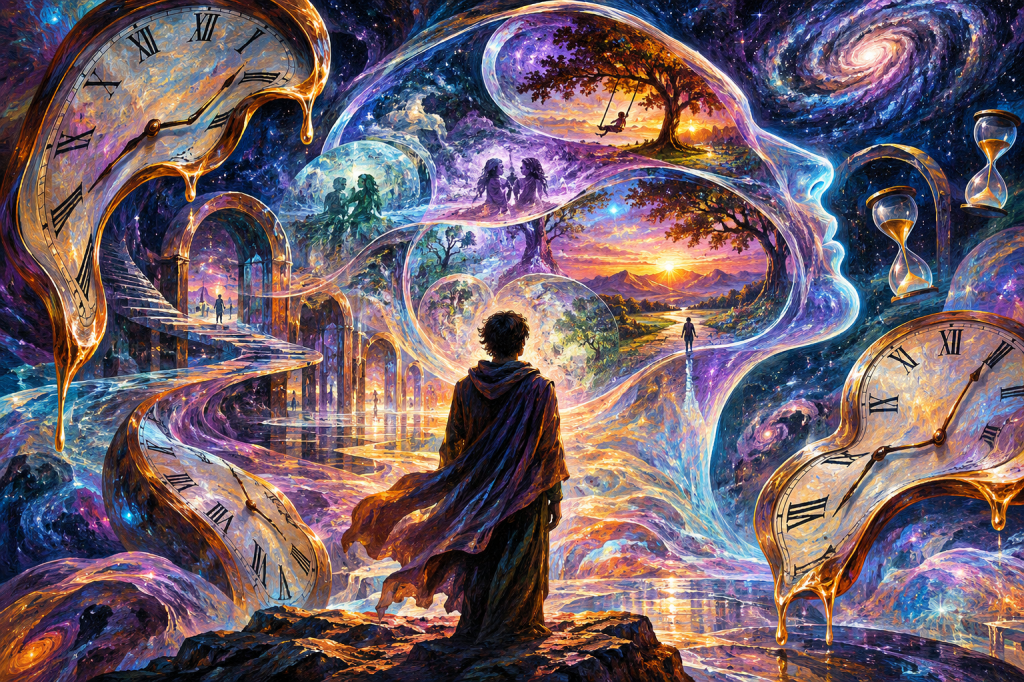
Have you ever stopped to wonder if you’re truly experiencing life as it happens, or if everything you perceive has already occurred by the time you’re aware of it?
It’s a fascinating question that challenges our understanding of consciousness, time, and the nature of reality. We often assume that what we see, hear, and feel is happening in the exact moment we experience it. But the truth is, our minds are constantly processing information, interpreting sensations, and constructing our perception of the world.
What we call the present may be more complicated than we realize.
The Mystery of the Present Moment
Every experience begins with information traveling through our senses and being processed by the brain. Light reaches our eyes, sound travels to our ears, and sensations move through our nervous system before becoming part of our conscious awareness.
All of this takes time, even if only fractions of a second.
This raises an interesting possibility: what we experience as the present is actually our brain’s interpretation of events that have already begun unfolding.
We aren’t necessarily witnessing reality in its rawest form. We’re experiencing a carefully constructed perception of it.
And perhaps that’s what makes consciousness so extraordinary.
The Mind as an Interpreter of Reality
Our experiences aren’t shaped by sensory information alone. Memories, expectations, emotions, and past experiences all influence how we interpret the world around us.
Two people can witness the same event and walk away with entirely different understandings of what happened.
Neither person has necessarily experienced a completely different external reality. Instead, their minds have interpreted that reality through different perspectives.
This reminds us that our perception of the world isn’t always the world itself.
The stories we carry, the beliefs we’ve formed, and the memories we’ve collected become filters through which we experience existence.
And sometimes, what we believe we’re seeing says just as much about our own minds as it does about the world around us.
Is Time Really Moving the Way We Think?
We divide existence into three familiar categories: past, present, and future.
The past exists in our memories. The future exists in our imagination and expectations. But the present seems to be the only place where life actually unfolds.
Yet even this present moment is difficult to define.
By the time we recognize an experience, our brains have already performed countless processes to make that awareness possible.
Does that mean we’re always experiencing a version of the immediate past? Or is the present simply the continuous process through which consciousness organizes reality?
These questions don’t have simple answers, but they invite us to examine something we normally take for granted.
Maybe time isn’t something we experience as directly as we imagine. Maybe our awareness of time is inseparable from the way our minds organize change.
Becoming Curious About Consciousness
Understanding that perception is an interpretation doesn’t make life any less real or meaningful.
If anything, it makes existence even more remarkable.
Every conversation, every sunset, every passing thought is part of an extraordinary relationship between the external world and the consciousness experiencing it.
We may never know what reality looks like completely independent of perception. But we can become more aware of how our minds participate in creating our experience of it.
Rather than assuming we understand everything we perceive, we can approach existence with a greater sense of curiosity.
We can question our assumptions, observe our reactions, and recognize that there’s always more happening beneath the surface of our awareness.
Final Thoughts
Perhaps the greatest mystery isn’t whether we’re experiencing reality or remembering it.
Perhaps it’s the fact that we’re conscious enough to ask the question at all.
Life continues unfolding whether we understand every process behind it or not. And within that unfolding, we have the remarkable ability to observe, question, reflect, and experience.
The present moment may not be as simple as we once believed, but that doesn’t make it any less precious.
Sometimes the most profound discoveries begin when we stop taking ordinary experiences for granted and start wondering about the extraordinary mystery behind them.
Because the deeper we look into consciousness , the more we realize how much there still is to discover.