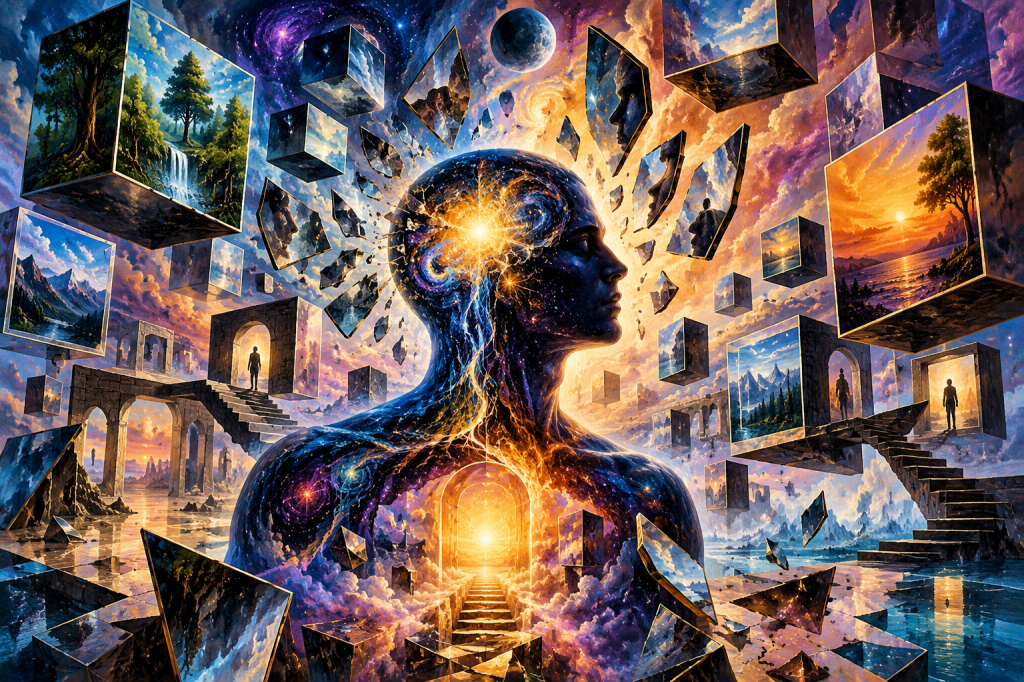
Have you ever stopped to question how much of your reality is shaped by what you believe?
We often move through life assuming that what we see, feel, and experience is simply the way things are. But beneath our everyday experiences lies an invisible framework of beliefs, expectations, and assumptions quietly influencing how we interpret the world.
The fascinating part is that most of this happens without us even realizing it.
Our minds don’t just observe reality. They interpret it.
The Mind as an Architect
Imagine two people experiencing the exact same situation. One sees an opportunity, while the other sees an obstacle. One feels excitement, while the other experiences fear.
The situation itself hasn’t changed, but their interpretation of it has.
Our minds constantly filter information through what we already believe to be true. Past experiences, emotions, and expectations influence what we notice, what we overlook, and the meaning we attach to events.
Over time, these interpretations become the foundation of our personal reality.
We begin to see the world not necessarily as it is, but as we’ve learned to understand it.
The Beliefs We Never Chose
Not every belief we carry was consciously created.
Many were inherited long before we developed the awareness to question them.
Our families, communities, cultures, and childhood experiences helped establish our earliest understanding of ourselves and the world.
Perhaps you grew up believing that success requires constant struggle, that vulnerability is weakness, or that certain dreams are simply unrealistic.
These ideas can become so familiar that we mistake them for universal truths.
But familiarity doesn’t make something true.
Sometimes, the limitations we experience aren’t walls built by reality itself. They’re boundaries created by assumptions we’ve never examined.
And until we begin questioning those assumptions, we may continue living within them.
Questioning the Invisible Framework
Awareness creates an opportunity to examine the beliefs operating beneath our thoughts.
Instead of immediately accepting every interpretation that enters our minds, we can become curious about where it came from.
Why do I believe this?
Is this something I’ve personally discovered, or something I’ve been taught?
Does this belief reflect reality, or does it reflect a past experience I’ve continued carrying?
These simple questions can create profound changes in perspective.
The goal isn’t to replace every uncomfortable belief with a positive one. It’s to develop the ability to distinguish between what we know, what we assume, and what we have yet to understand.
This is where genuine inner freedom begins.
Reality Beyond Our Interpretations
There’s something humbling about recognizing that our perception is incomplete.
We experience only a fraction of what’s happening around us, and our minds construct meaning from that limited information.
What feels absolutely certain today may look entirely different through the wisdom of tomorrow.
This doesn’t mean the external world is imaginary or that believing something makes it physically true. It means our experience of reality is influenced by the mental framework through which we encounter it.
And that framework can change.
When we loosen our attachment to rigid interpretations, we create room for possibilities we might have previously dismissed.
We become more curious, more understanding, and more willing to experience life without constantly forcing it into familiar categories.
Final Thoughts
The invisible architecture of belief is something we carry everywhere.
It influences our decisions, relationships, fears, ambitions, and understanding of who we are.
But perhaps the most powerful realization is that we are not required to remain confined within the beliefs we’ve inherited or accumulated.
We can question them. We can examine them. We can allow them to evolve.
And sometimes, the greatest transformation doesn’t come from changing the world around us.
It comes from recognizing that the lens through which we’ve been viewing it was never the only one available.
You may not control everything that happens in reality, but you can become more conscious of the meaning you give to what you experience.