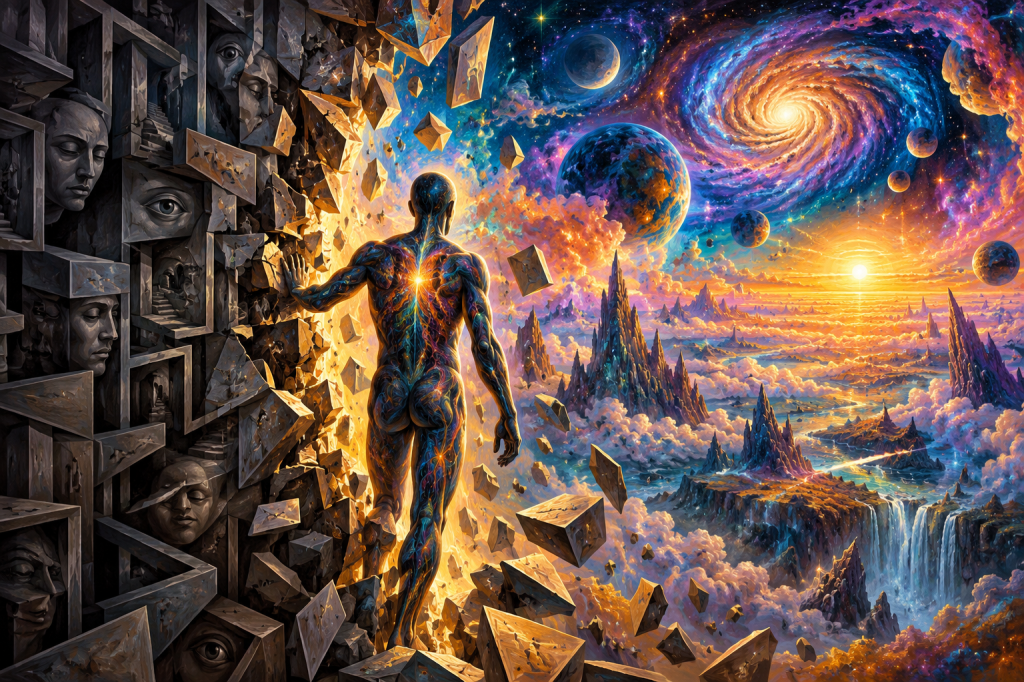
Have you ever stopped to consider how much of your reality exists within your own mind?
Two people can experience the exact same situation yet walk away with completely different interpretations. One sees an obstacle, while the other sees an opportunity. The event itself hasn’t changed, but the meaning attached to it has.
Our minds are constantly constructing stories about the world around us. These stories are shaped by memories, beliefs, fears, and experiences we’ve collected throughout our lives. Over time, they become so familiar that we rarely question whether they’re true.
We begin to mistake our interpretation of reality for reality itself.
A belief formed years ago can quietly influence the decisions we make today. Something we once experienced as rejection might cause us to avoid opportunities. A fear we’ve carried since childhood might convince us that certain possibilities are beyond our reach.
But what happens when we begin questioning these invisible boundaries?
Awareness creates space between what happens and how we interpret it. Instead of automatically accepting every thought as truth, we can observe it with curiosity.
This doesn’t mean we control everything that happens in our lives. The external world exists beyond our personal perceptions. However, we have the ability to examine the meaning we give our experiences.
Perhaps spiritual growth isn’t always about discovering something new. Sometimes it’s about recognizing the mental structures we’ve lived inside for years and realizing we no longer have to remain confined by them.
The world may not always change when we change our perspective, but the way we experience it certainly can.
And maybe that’s where freedom begins: not in creating a perfect reality, but in learning to see beyond the limitations of our own minds.