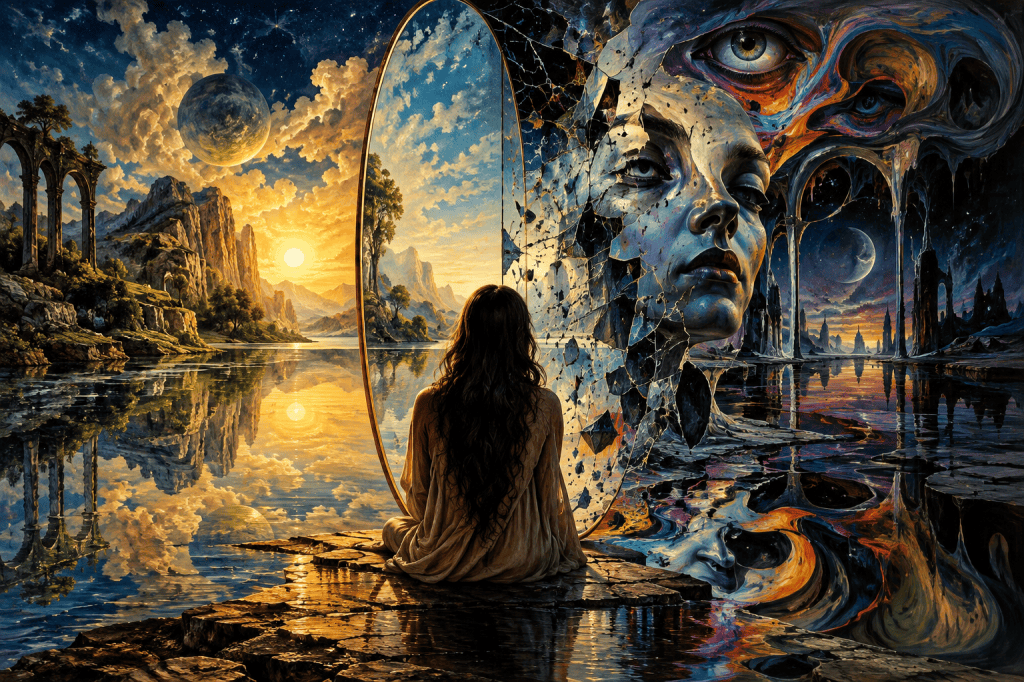
There is a peculiar thing about being human: we can experience the same moment as someone else and walk away with entirely different understandings of what occurred.
A conversation, a passing glance, a moment of silence. To one person, it means nothing. To another, it carries an entire story.
But somewhere between the event itself and our understanding of it, something happens. The mind begins interpreting, connecting memories, assigning meaning, and filling in the spaces where certainty doesn’t exist.
And before we realize it, an interpretation becomes our reality.
The Stories We Mistake for Reality
Consider how quickly the mind responds to something unexpected.
Someone speaks to us in an unfamiliar tone. Almost immediately, we begin searching for an explanation. Are they upset? Did we say something wrong? Is something happening that we don’t understand?
Yet the only thing that actually occurred was a change in someone’s tone of voice.
Everything that follows is an interpretation.
This doesn’t mean our interpretations are always incorrect. Our minds recognize patterns, draw from experience, and help us navigate an uncertain world. But there is a difference between recognizing a possibility and accepting it as an unquestionable truth.
We rarely notice when we cross that line.
What begins as a thought can become a feeling. That feeling can strengthen a belief. Eventually, the belief influences how we remember the original experience.
A story has formed, and we may never stop to question who wrote it.
Memory Is Not a Perfect Record
We often treat memories as though they are recordings stored somewhere inside us, waiting to be replayed.
But memory is far more complicated.
Each time we remember something, we reconstruct an experience through the perspective of who we are now. Emotions, expectations, and information we’ve learned since the event can influence how we recall it.
Two people can remember the same conversation differently without either deliberately being dishonest.
Perhaps one remembers the words. The other remembers how those words made them feel.
Neither perspective necessarily captures the entire experience.
This raises an interesting question: How much of what we believe about our past comes from what happened, and how much comes from the meaning we’ve assigned to it afterward?
We may never know completely.
And perhaps recognizing that uncertainty is more valuable than pretending it doesn’t exist.
The Mind’s Discomfort With Not Knowing
Human beings are naturally drawn toward explanations.
An unanswered question can feel more uncomfortable than an unpleasant answer. We want events to make sense, people to behave predictably, and experiences to fit into recognizable patterns.
When information is missing, the mind often attempts to complete the picture.
But not every silence contains a hidden message. Not every coincidence carries significance. Not every uncomfortable feeling reveals something true about the world around us.
Sometimes, we simply don’t know.
There is something fascinating about our resistance to those three words.
I don’t know.
They can feel like an admission of weakness, when in reality, they may be one of the most accurate statements we can make about an experience.
Acknowledging uncertainty doesn’t erase what happened. It simply prevents us from confusing what we know with what we imagine.
What Exists Before Interpretation?
Imagine observing a moment without immediately deciding what it means.
A bird lands on a windowsill. Rain moves across the pavement. Someone passes you on the street without acknowledging your presence.
For a brief instant, there is simply an experience.
Then thought arrives.
We identify, compare, remember, judge, and interpret. These processes are natural parts of consciousness. We cannot entirely separate ourselves from them, nor do we necessarily need to.
But we can become curious about them.
We can notice the difference between what our senses reveal and what our thoughts contribute.
This is not about achieving a perfectly objective view of reality. Even perception itself is shaped by the brain, and no human being observes the world from a completely neutral position.
Rather, it is about recognizing that our experience of reality is not necessarily the whole of reality.
There may always be something beyond the story we tell.
The Mystery of Another Perspective
Every person we encounter carries an inner world we can never fully access.
Their memories, fears, associations, and experiences influence how they interpret the same world we inhabit.
What seems obvious to us may appear entirely different to someone else.
And what we consider insignificant may hold enormous meaning for another person.
This doesn’t mean every interpretation is equally accurate. Evidence matters, and some explanations are better supported than others.
But it does suggest that our individual perspective, however convincing it feels, remains incomplete.
There is a certain humility in recognizing this.
Not the humility of believing we know nothing, but the humility of understanding that knowing something does not mean knowing everything.
The Space We Rarely Notice
Perhaps one of the strangest aspects of consciousness is how seamlessly thought becomes experience.
We don’t always notice ourselves constructing meaning. We simply find ourselves living inside the meaning we’ve constructed.
An event occurs. A thought follows. An emotion emerges. A conclusion settles into place.
And suddenly, what we believe happened feels indistinguishable from what actually happened.
Yet somewhere within that process is a space worth exploring.
A space where observation and interpretation are not quite the same thing.
Where certainty can be questioned without dismissing experience.
Where a thought can exist without immediately becoming a fact.
We may never experience reality entirely free from interpretation. The human mind is not a transparent window through which the world passes unchanged.
But perhaps we can become more aware of the window itself.
Because sometimes the most profound question isn’t whether our understanding of an experience is right or wrong.
It’s whether we’ve ever considered that there might be more to the experience than the story we’ve told ourselves.
And if our understanding of reality is constantly being shaped by the mind, how often do we mistake the meaning we’ve created for the truth we’ve discovered?