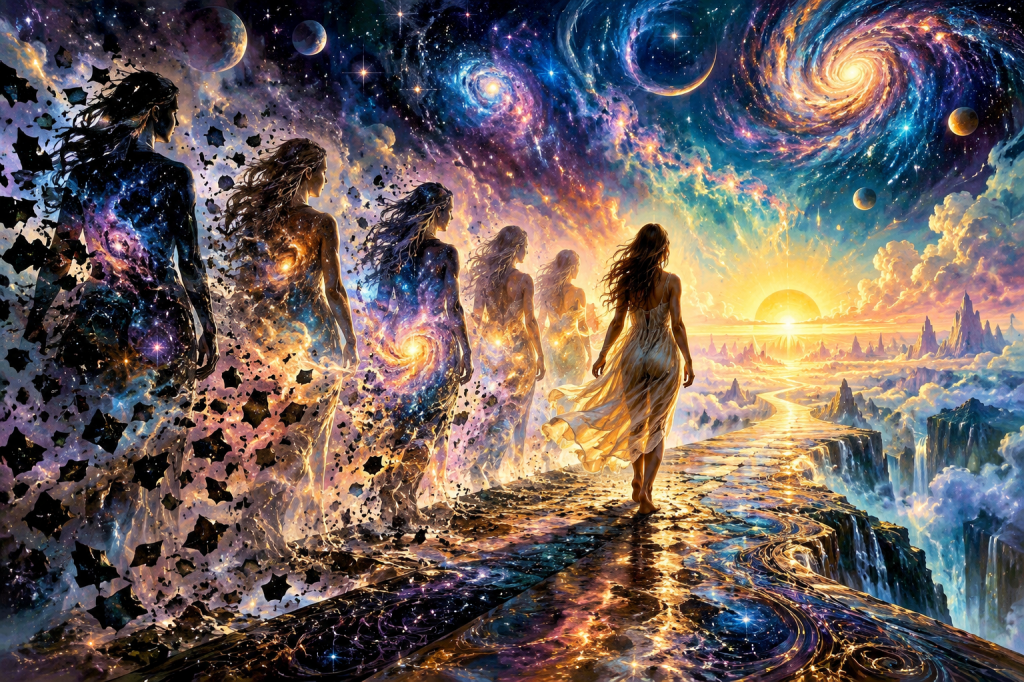
We often think of ourselves as something permanent. We say, “This is just who I am,” as though there is a finished version of us somewhere beneath everything else. But if you look closely at your own life, that idea becomes harder to hold onto.
Are you really the same person you were yesterday?
Your name may be the same. Your face may look mostly the same. You wake up carrying many of the same memories. Yet something has already changed. You have experienced another day, had new thoughts, felt different emotions, learned something, forgotten something, or seen an old situation from a slightly different perspective.
The person reading these words has never existed at any other moment exactly as they do right now.
The Self May Be a Process
We usually imagine identity as a solid object: me. But perhaps the self is closer to a river. We give the river one name even though the water flowing through it is constantly changing.
Our identities may work in a similar way.
Our beliefs change. Our bodies change. Relationships with the world change. Things that once seemed incredibly important can eventually mean very little. Experiences we barely noticed at the time can unexpectedly shape who we become years later.
Yet through all of this movement, we continue calling ourselves the same person.
This raises an interesting metaphysical question: If nearly everything about us can change, what exactly is the “I” that remains?
The Story We Carry
Part of our identity comes from memory. We construct a story about ourselves using everything we remember experiencing.
This happened to me.
I made this mistake.
I succeeded at this.
People see me this way.
Eventually, these memories become more than memories. They become evidence for who we believe ourselves to be.
But a story isn’t necessarily the same thing as the person experiencing it.
You can remember an old version of yourself without continuing to be that version.
This distinction matters because sometimes we remain loyal to identities we’ve already outgrown. We continue describing ourselves according to old fears, failures, habits, or expectations simply because they are familiar.
Growth can feel strange because the mind wants continuity. It wants yesterday’s explanation of who you are to still make sense today.
Sometimes it doesn’t.
Who Is Watching the Change?
There is another layer to this question.
If you can notice that your thoughts are changing, then what is noticing the thoughts?
If you can observe your emotions coming and going, are you identical to those emotions?
Meditation often brings us face-to-face with this mystery. Thoughts appear and disappear. Feelings rise, stay for a while, and eventually pass. Memories suddenly surface and fade again.
Yet awareness seems capable of witnessing all of it.
Perhaps this is why so many spiritual traditions distinguish between the personality we construct and the awareness underneath it. We spend so much time trying to define ourselves that we rarely investigate the consciousness doing the defining.
Maybe the deepest part of knowing yourself isn’t finding the perfect description of who you are.
Maybe it’s discovering what remains when you stop describing yourself altogether.
Give Yourself Permission to Become
There is freedom in recognizing that identity doesn’t have to be permanent.
You don’t have to spend your entire life defending an outdated version of yourself simply because other people recognize you that way. You can change your mind. You can abandon beliefs that no longer make sense. You can forgive yourself for choices made by someone who understood the world differently at the time.
Yesterday’s version of you brought you here, but it doesn’t get to decide everything that happens next.
Perhaps we aren’t meant to discover one final answer to the question, Who am I?
Perhaps we’re meant to keep asking it.
Because every morning, life quietly gives us another opportunity to answer differently.