You’re sitting somewhere you’ve never been before.
Maybe you’re having a conversation with someone. A song is playing quietly in the background. They say something, you look toward the window, and suddenly something inside you stops.
I’ve been here before.
Not somewhere similar.
Here.
This exact moment.
You know what they’re about to say. The room feels strangely familiar. Even the smallest details seem like pieces of a memory you can’t quite reach.
And then, almost as quickly as it appeared, the feeling disappears.
We call it déjà vu.
Most of us have experienced it, shrugged it off, and continued with our day. There are neurological explanations for why déjà vu may happen, involving the brain’s systems for familiarity and memory.
But the experience itself raises a fascinating philosophical question.
What if memory doesn’t always feel backward?
We Assume Memory Belongs to the Past
Our understanding of time feels obvious.
Yesterday happened.
Today is happening.
Tomorrow hasn’t happened yet.
Memory belongs behind us because we can only remember things we’ve already experienced.
At least, that’s how consciousness normally seems to work.
But déjà vu temporarily disrupts that feeling.
You encounter something new while simultaneously experiencing the unmistakable sensation that it is old.
It’s almost like your brain stamps:
REMEMBERED
onto something happening for the first time.
And that contradiction is what makes déjà vu so strange.
Maybe the interesting part isn’t whether déjà vu proves anything supernatural. It doesn’t.
Maybe the interesting part is simply recognizing how dependent our reality is on the way consciousness organizes experience.
What If Time Isn’t Experienced as Cleanly as We Think?
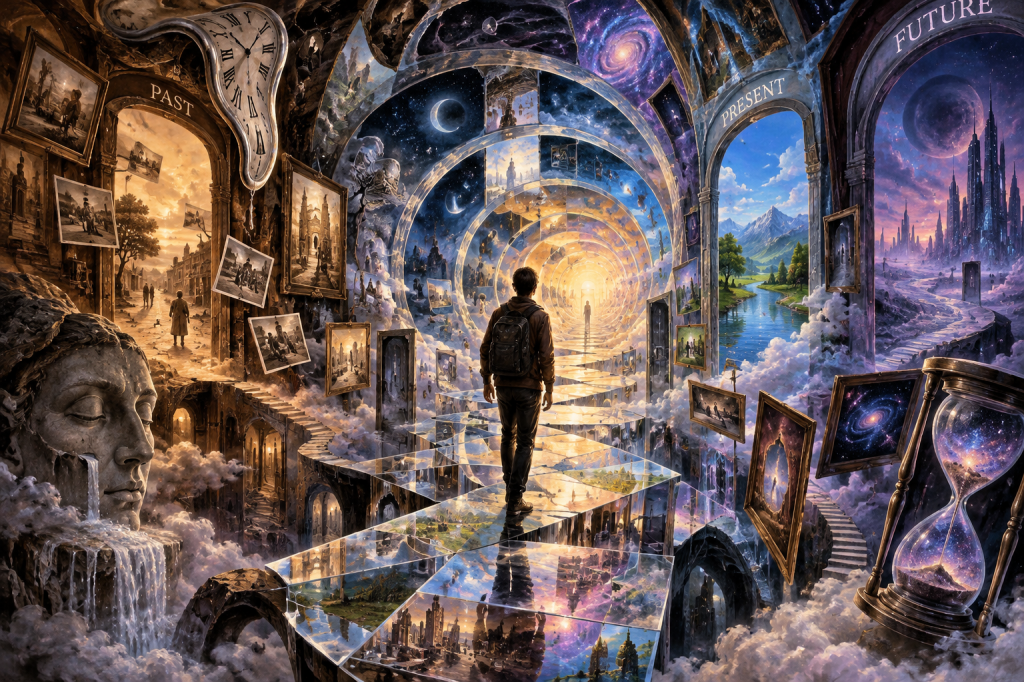
Imagine time as a road.
We experience ourselves traveling down it one mile at a time. Behind us is the past. Underneath us is the present. Ahead is the future.
But that’s our experience of time.
It doesn’t necessarily tell us everything about the nature of time itself.
Physics and philosophy have long produced complicated questions about whether our intuitive sense of a universal “now” accurately describes reality.
And spiritually, humans have gone even further.
Different traditions have imagined time as cyclical, interconnected, predetermined, or somehow accessible beyond ordinary waking consciousness.
None of this means déjà vu is evidence that you’re remembering the future.
But it’s interesting to entertain the possibility.
What if consciousness occasionally creates an experience that feels less like:
“This happened before.”
and more like:
“Some part of me already knew this moment.”
Dreams Make It Even Stranger
Sometimes déjà vu becomes especially unsettling when a person believes they dreamed about the moment beforehand.
You’re somewhere unfamiliar when suddenly you remember:
Wait… I dreamed this.
Maybe you remember the room.
The person.
The conversation.
Or just the atmosphere.
Of course, our memories aren’t perfect. Dreams are especially slippery, and the brain is incredibly good at finding similarities and reconstructing memories after something happens.
But even knowing that doesn’t completely remove the mystery of the experience.
Because consciousness is strange enough without needing a supernatural explanation.
Every night, your mind generates places you’ve never visited, people who don’t exist, conversations that never happened, and entire realities that disappear when you wake up.
Then occasionally, waking life resembles one of those worlds.
Coincidence?
Probably, sometimes.
But coincidence itself can still make us wonder.
Maybe Intuition Is Part of the Same Mystery
There are moments when you know something without knowing exactly why you know it.
You feel like you shouldn’t go somewhere.
You suddenly think about someone before they contact you.
You make a decision that doesn’t completely make sense logically, only to understand later why it felt right.
We call some of this intuition.
Psychologically, intuition can come from subconscious pattern recognition. Your brain processes enormous amounts of information without presenting every calculation to your conscious mind.
That alone is incredible.
Your conscious self may essentially receive the final answer without seeing all the work that produced it.
But that raises another interesting question.
How much does your mind know before “you” know that you know it?
Perhaps déjà vu, intuition, dreams, and synchronicities feel spiritual because they expose the limits of conscious awareness.
They remind us that the voice narrating our lives may not have access to everything happening beneath it.
Maybe We’re Asking the Wrong Question
When déjà vu happens, our first question is usually:
“Have I experienced this before?”
But perhaps that’s not the most interesting question.
Maybe we should ask:
“Why does consciousness occasionally feel like it already knows where it’s going?”
We don’t need to immediately turn that mystery into a belief.
We don’t need to decide that déjà vu proves reincarnation, alternate timelines, destiny, psychic abilities, or anything else.
Sometimes mystery deserves to remain mystery.
There is something beautiful about admitting that we don’t completely understand consciousness.
We wake up inside this strange experience called existence, carrying memories of yesterday, imagining tomorrow, dreaming entire realities at night, and somehow experiencing all of it through a tiny moving window we call the present.
And every once in a while, that window glitches.
The present feels remembered.
For a few seconds, yesterday, today, and tomorrow don’t seem quite as separate.
Then the feeling disappears.
Life continues.
But maybe the next time déjà vu hits, instead of immediately brushing it away, stay with it for a second.
Look around.
Notice the moment.
Not because you’ve necessarily lived it before.
But because, for reasons we still don’t completely understand, something inside you briefly feels like it already knew you would arrive here.