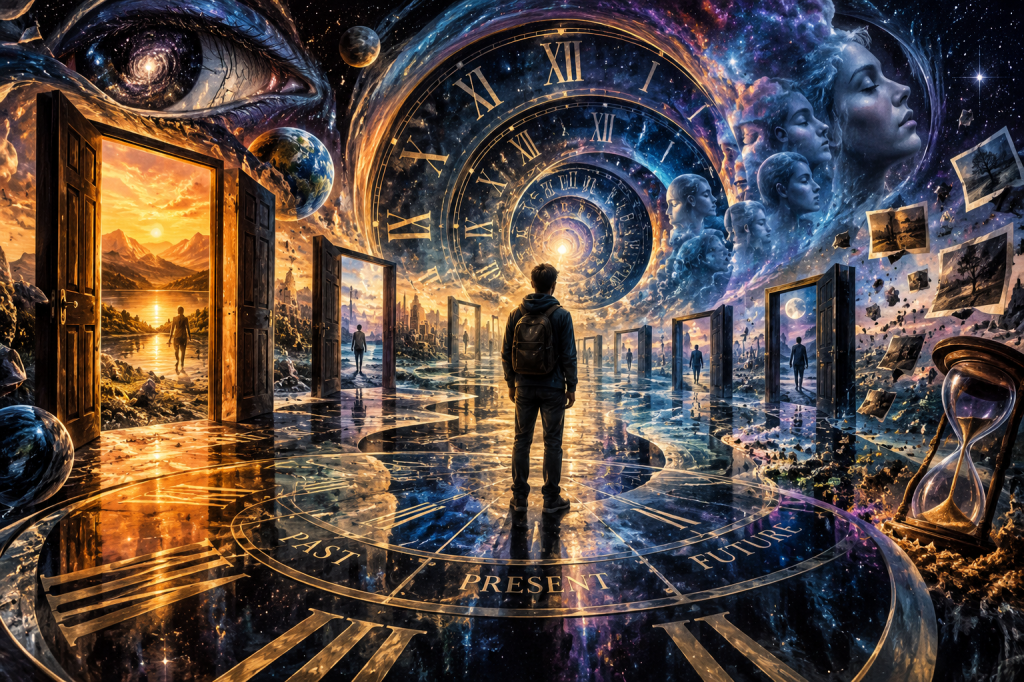
You’re walking into a room you’ve never entered before.
Someone says something. You turn your head. The light hits the wall a certain way.
And suddenly—
You’ve been here before.
Not just somewhere similar. Not just something vaguely familiar. For a few strange seconds, it feels as if this exact moment has already happened.
That feeling has a name: déjà vu, French for “already seen.”
Most of us brush it off almost immediately. The feeling disappears, reality continues, and within a few minutes we’re thinking about something completely different.
But what if the most interesting question about déjà vu isn’t:
“Why does this remind me of the past?”
What if it’s:
“Why did my experience of time suddenly feel different?”
When the Present Feels Like a Memory
Scientifically, déjà vu doesn’t require anything supernatural.
Researchers have connected the experience to processes involving memory, familiarity, and recognition. Our brains constantly compare what is happening now with enormous amounts of stored information. Sometimes the feeling of familiarity may appear even when we can’t identify an actual memory responsible for it.
That alone is fascinating.
Because during déjà vu, nothing necessarily changes about the world around you.
What changes is your relationship with the moment.
The present suddenly feels remembered.
And that raises a deeper philosophical question: How much of what we call “time” is actually our experience of time?
We divide existence into three neat categories:
Past.
Present.
Future.
The past is gone. The future hasn’t happened. The present is where we exist.
At least, that’s how it feels.
But consciousness is constantly mixing these categories together.
A smell can transport you twenty years backward.
Anxiety can make you mentally experience a future that hasn’t happened.
A dream can compress what feels like hours into minutes.
And déjà vu can make the present briefly feel like the past.
Maybe consciousness doesn’t experience time as cleanly as the clock on the wall suggests.
What If We Recognize Patterns Before We Understand Them?
There’s another possibility that doesn’t require predicting the future.
Human beings are incredible pattern-recognition machines.
We recognize faces, rhythms, emotional tones, environments, behaviors and social situations—often without consciously analyzing them.
You might walk into a situation and immediately feel that something is “off” before you can explain why.
Perhaps déjà vu sometimes touches something similar.
Maybe your brain recognizes a pattern before your conscious mind understands what it has recognized.
The layout of a room.
The rhythm of a conversation.
Someone’s expression.
A combination of tiny details resembling hundreds of previous experiences.
Your conscious mind says:
“I’ve never experienced this.”
While another part of you responds:
“I know this.”
That gap between knowing and understanding might be where some of the mystery lives.
Why Humans Keep Looking for Something More
Of course, people have offered much stranger explanations.
Past lives.
Premonitions.
Parallel realities.
Destiny.
Dreams predicting future events.
A universe where past, present and future somehow exist simultaneously.
There is no solid scientific evidence that déjà vu proves any of these ideas.
But I think our fascination with those possibilities tells us something important.
Human beings have always felt that time is mysterious.
We invented clocks to measure it, calendars to organize it, photographs to preserve it and stories to remember it.
Yet none of those things completely explain what it feels like to exist inside time.
Meditation makes this especially noticeable.
Sit quietly long enough and you begin noticing how rarely the mind actually remains where the body is.
It revisits yesterday.
Rehearses tomorrow.
Rewrites conversations.
Imagines possibilities.
Replays memories.
Then occasionally, there are moments where all of that disappears and you simply experience now.
Déjà vu almost feels like the opposite.
Instead of becoming completely present, the present itself becomes strangely displaced.
For a second, now feels like then.
Maybe Mystery Is Enough
I don’t think we need to turn déjà vu into proof of something supernatural for it to be profound.
Maybe the experience isn’t revealing a past life.
Maybe you aren’t remembering the future.
Maybe another version of you isn’t living the same moment in a parallel universe.
Or maybe reality contains mysteries we haven’t learned how to describe yet.
I don’t know.
And sometimes “I don’t know” is the beginning of exploration rather than the end of it.
There’s something beautiful about encountering an ordinary experience that reminds us how strange consciousness actually is.
We wake up every day inside a mind that remembers things that no longer exist, imagines things that don’t exist yet, dreams entire realities while we sleep and occasionally looks at the present moment and whispers:
I’ve been here before.
Maybe déjà vu isn’t interesting because it tells us something about the past.
Maybe it’s interesting because, for just a few seconds, it exposes how mysterious our relationship with time really is.
And perhaps the strangest thing about déjà vu isn’t that the moment feels familiar.
It’s that, for a moment, time itself doesn’t.