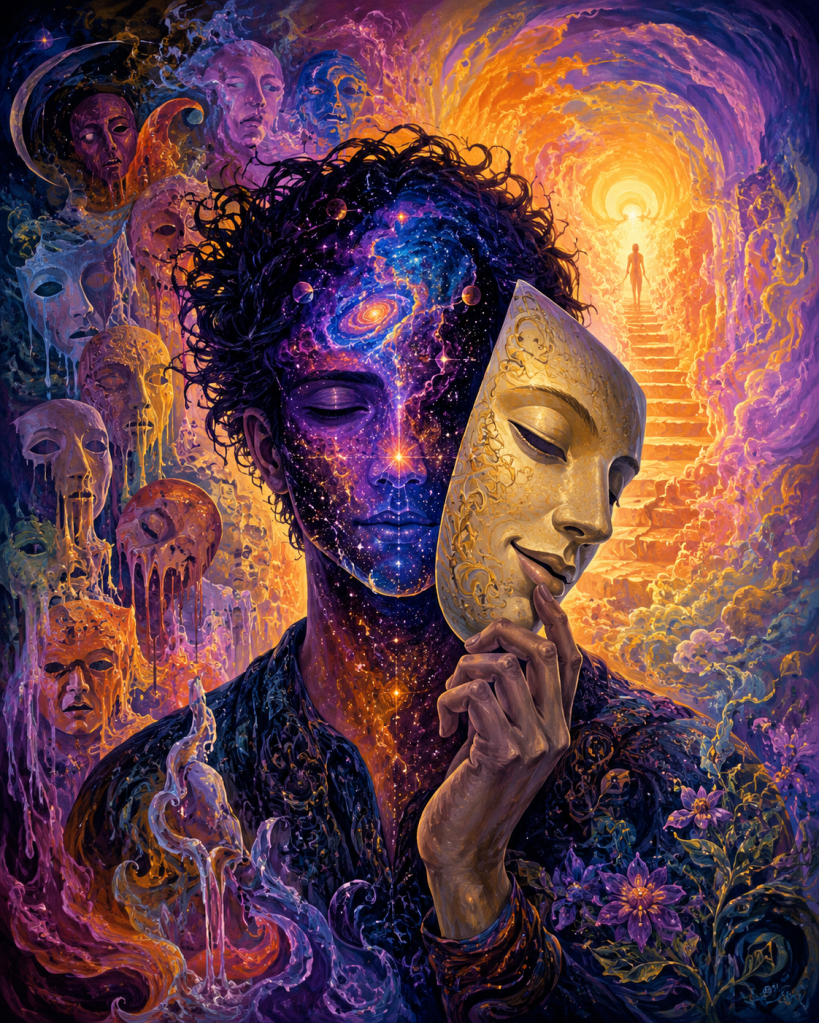
We hear it all the time: “I’m trying to find myself.”
Maybe you’ve said it after a breakup. After leaving a job. During a period where everything that once felt familiar suddenly feels distant. We imagine there is some hidden, authentic version of ourselves buried underneath everything, waiting to be discovered.
But lately, I’ve wondered if finding yourself is really the problem.
Maybe you were never lost.
Maybe you’ve just spent so much time performing different versions of yourself that you’ve forgotten what it feels like to exist without an audience.
The Versions of Us
Most of us learn how to perform long before we realize we’re doing it.
There’s the version of you that exists at work.
The version around your family.
The version around strangers.
The version around someone you’re attracted to.
The version you present online.
And then there’s the person sitting alone in a quiet room when nobody is watching.
These versions aren’t necessarily fake. Human beings naturally adapt to different environments. The problem begins when adapting becomes performing—when your choices start being shaped more by how you want to be perceived than by what you actually feel.
You start asking:
Does this make me look successful?
Will they think I’m interesting?
Should I be farther ahead by now?
What will people think if I change?
Eventually, you can become so concerned with maintaining your identity that you stop experiencing your life.
Identity Can Become a Cage
There is comfort in knowing who you are.
“I’m the funny one.”
“I’m the strong one.”
“I’m independent.”
“I’m spiritual.”
“I’m successful.”
“I don’t care what people think.”
Even positive identities can become cages when we feel obligated to protect them.
Imagine identifying as the person who always has everything together. What happens when you don’t?
You might hide your struggles because struggling contradicts the character you’ve created.
Or maybe you’ve always considered yourself independent. Then suddenly you deeply need another person. Instead of simply experiencing that need, you judge yourself for having it.
That’s where identity becomes interesting.
We don’t only perform for other people.
Sometimes we perform for ourselves.
We maintain an image of who we believe we’re supposed to be, even when we’ve already outgrown that person.
Social Media Turned Identity Into Something We Maintain
Social media intensified something humans were already doing.
Now we don’t simply experience things—we can immediately turn them into evidence of who we are.
A concert becomes a story.
A vacation becomes a post.
A new outfit becomes a photograph.
A relationship becomes a status.
A hobby becomes part of our personal brand.
There’s nothing inherently wrong with sharing your life. The strange part begins when you catch yourself thinking about how an experience will appear while you’re still experiencing it.
Instead of asking, “Am I enjoying this?”
We sometimes unconsciously ask, “Does it look like I’m enjoying this?”
Those are completely different questions.
And the more we live through the imagined eyes of other people, the harder it becomes to hear our own voice.
Losing Yourself Might Actually Be Growth
There will probably be periods in your life when you don’t recognize yourself.
Those moments can be frightening.
You might lose interest in things you once loved. Certain friendships might stop making sense. Goals you’ve chased for years might suddenly feel empty. You might even question beliefs you once considered fundamental.
Our instinct is often to panic.
What’s happening to me?
But perhaps nothing is wrong.
Maybe an identity has simply expired.
A snake doesn’t have an identity crisis when it sheds its skin.
It simply outgrows what once contained it.
Maybe human beings aren’t so different.
There are versions of yourself that were necessary for certain chapters of your life but aren’t meant to follow you forever.
You don’t have to hate those versions.
You don’t have to be embarrassed by them.
You can simply thank them and continue.
Stop Trying to Become Someone
Spirituality often gets presented as another form of self-improvement.
Become more peaceful.
Become enlightened.
Become disciplined.
Become positive.
Become your “highest self.”
But even spirituality can become another performance if we’re constantly chasing an idealized version of ourselves.
Maybe the deeper practice isn’t becoming someone better.
Maybe it’s learning to sit with yourself without immediately trying to modify what you find.
Your sadness doesn’t automatically need fixing.
Your uncertainty doesn’t automatically need an answer.
Your loneliness doesn’t automatically mean something has gone wrong.
Sometimes the most honest thing you can do is experience what is actually happening without turning it into a story about who you are.
Who Are You Without the Audience?
Imagine nobody could see your life for an entire year.
No posts.
No likes.
No compliments.
No one comparing themselves to you.
No one disappointed in you.
No one impressed by you.
What would you wear?
What would you create?
Where would you go?
Who would you spend time with?
What would you stop doing?
What would suddenly become important?
Those questions might reveal more about you than another personality test ever could.
Because underneath all the identities, expectations, labels and performances, there is something much simpler:
Awareness.
The quiet part of you experiencing all of it.
Maybe you don’t need to spend your entire life searching for yourself.
Maybe the person you’ve been searching for appears naturally when you stop trying so hard to be somebody.
So instead of asking:
“Who am I supposed to become?”
Try asking something different:
“Who am I when I have nothing to prove?”