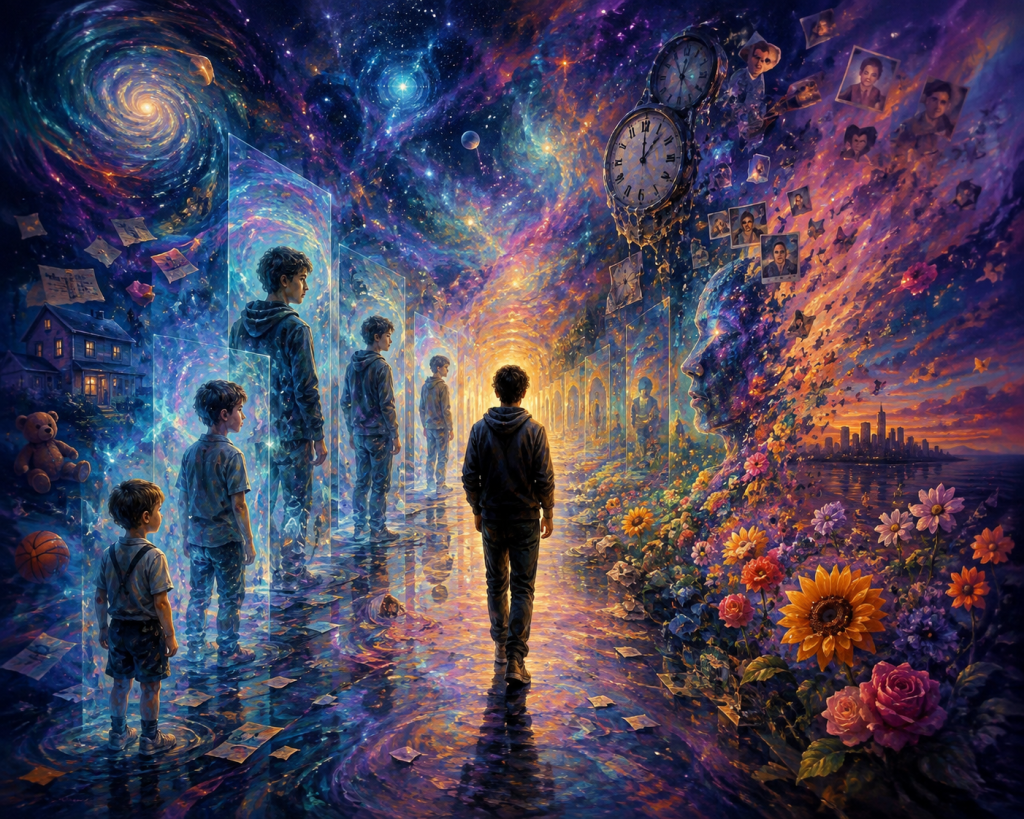
There is a strange experience that happens when you find an old photograph of yourself.
Maybe you’re eight years old, standing somewhere you haven’t visited in decades. Maybe you’re sixteen, surrounded by people whose names barely cross your mind anymore. Maybe the photograph is only five years old.
You look at the person in the picture and immediately know:
That’s me.
But is it?
You know what happened to that person. You possess their memories. You recognize their face. Yet you can’t completely return to their consciousness.
You can remember being them.
You cannot fully be them again.
And that raises a strange possibility:
Maybe you haven’t lived one life as one person. Maybe you’ve already lived thousands of smaller lives as thousands of versions of yourself.
The Worlds That Disappeared
Think about your childhood bedroom.
At one point, that room wasn’t nostalgic.
It was simply home.
The objects scattered around it mattered. The view outside the window was normal. The people living nearby formed part of your universe.
You had worries that probably seem insignificant now and dreams that may have completely disappeared.
Most importantly, you had absolutely no idea what was coming.
The person you are today existed somewhere in the future, but that younger version of you couldn’t imagine them.
Then life moved.
The room changed.
People left.
Relationships ended.
New people arrived.
Your beliefs changed.
Your fears changed.
Your definition of happiness changed.
And eventually that entire world became something you call the past.
Psychologists studying autobiographical memory have long connected our memories of personal experiences with our sense of identity. Rather than simply functioning like a perfect recording of everything that happened, autobiographical memory helps us organize experiences into a larger story about who we are. (Annual Reviews)
That means the story of “you” is constantly being assembled.
You Don’t Remember Everything About Being You
Here’s an experiment.
Think about yourself exactly ten years ago.
You can probably remember major events.
Where you lived.
Who you spent time with.
Maybe what music you listened to.
Maybe who you loved.
But try remembering an ordinary Tuesday.
What were you thinking while brushing your teeth?
What did you believe your future would look like?
What tiny problem had been bothering you all week?
What joke were you obsessed with?
What did loneliness feel like to you?
What did love mean?
What did success mean?
You probably can’t completely access that world anymore.
There are pieces.
Snapshots.
Stories.
Feelings.
But the entire consciousness of that person is gone.
And perhaps that’s one of the strangest parts of being human.
We continually change while experiencing ourselves as continuous.
Research into autobiographical memory suggests that memory and identity actually influence each other: how we see ourselves today affects how we interpret our former selves, while what we remember about our past helps construct who we believe ourselves to be today. (PubMed)
In other words, you’re not simply carrying your past.
You’re continually reinterpreting it.
Every Version Thought It Was Permanent
This is where the idea becomes almost funny.
Think about how many previous versions of you believed:
This is my life.
This relationship is everything.
These people will always be around.
I’ll always live here.
I’ll always think this way.
I’ll never get over this.
I’ll never change.
And then you did.
Something that once consumed your entire consciousness eventually became a sentence:
“Yeah, that happened a few years ago.”
Someone you once couldn’t imagine living without became someone you haven’t spoken to in years.
A place that once contained your entire existence became somewhere you occasionally drive past.
A dream you desperately wanted became something you no longer want at all.
We rarely notice transformation while it’s happening because we experience life frame by frame.
But look backward far enough and the transformations become enormous.
The Ghosts Inside You
Maybe those previous selves aren’t completely gone.
Maybe they’re layered inside you.
The child who learned something about kindness.
The teenager who experienced rejection.
The person who fell deeply in love.
The person whose heart was broken.
The person who discovered something they loved creating.
The person who made a terrible decision.
The person who survived something they once believed they couldn’t.
Each disappeared, but each left something behind.
A preference.
A fear.
A scar.
A song.
A lesson.
A habit.
A memory.
Maybe that’s what a personality partly is:
the archaeological remains of everyone you’ve ever been.
You carry ruins.
And This Version Will Disappear Too
Here is the uncomfortable part.
The person reading this right now isn’t the final version either.
We naturally experience the present self as the main character.
Past-you feels unfinished.
Future-you feels hypothetical.
Present-you feels real.
But ten years from now, today will exist in exactly the same category as all those other periods.
You might remember the room you’re sitting in.
You might remember the problems you’re currently dealing with.
You might see a photograph of yourself from this year and stare at it longer than expected.
And perhaps you’ll think:
I remember them.
You might wish you could tell this version of yourself something.
Stop worrying about that.
Call that person.
Go on that trip.
Make the thing.
Tell them you love them.
Enjoy this more.
You’re going to be okay.
Or maybe:
You have absolutely no idea what’s coming.
So What Do We Do With This?
Maybe realizing how temporary each version of ourselves is shouldn’t make life feel meaningless.
Maybe it should make life feel precious.
You don’t need to desperately preserve who you are right now.
You are allowed to outgrow yourself.
You’re allowed to abandon beliefs that once defined you.
You’re allowed to stop wanting things you once begged the universe for.
You’re allowed to become unfamiliar to your former self.
Because change doesn’t necessarily mean you’ve betrayed who you were.
Sometimes change is how you honor them.
Every previous version of you carried you as far as they could.
Then another version took over.
And another.
And another.
Until eventually, somehow, they delivered you here.
Maybe the goal isn’t to finally discover the permanent, finished version of yourself.
Maybe there isn’t one.
Maybe being alive means continually meeting yourself, losing yourself, remembering yourself, and becoming someone new.
So look around for a second.
Notice the room.
Notice what you’re worried about.
Notice what you’re excited about.
Notice the people you love.
Notice the music you’re listening to.
Notice the strange little details that don’t seem important enough to remember.
Because you’re inside one of those lives right now.
One day, this chapter will become a memory.
And one day, the person reading these words will become someone you used to be.