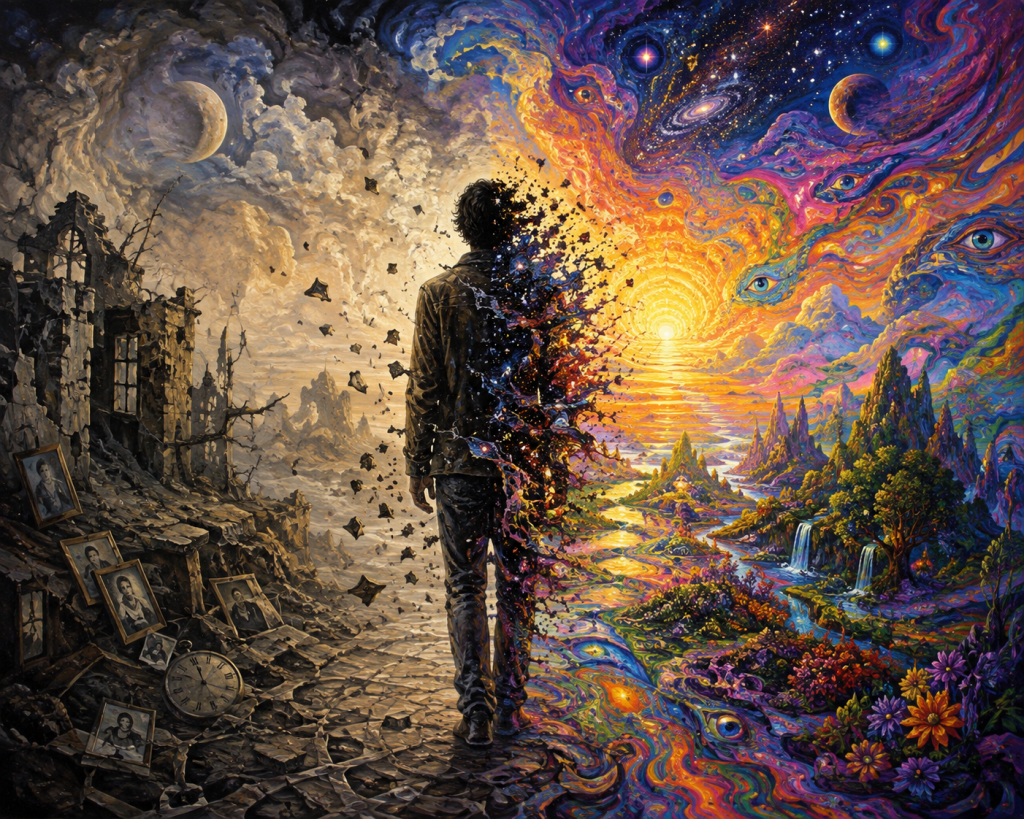
There are moments in life when the question “Who am I?” becomes surprisingly difficult to answer.
Not because you’ve completely lost yourself.
But because the person you used to be doesn’t quite fit anymore.
Maybe a relationship ended. Maybe you left a job. Maybe you stopped believing something you once built your life around. Maybe the people surrounding you changed. Or maybe nothing dramatic happened at all—you simply woke up one day and realized that the life you were living no longer felt like yours.
The strange part is that the next version of you might not have arrived yet.
So where does that leave you?
Somewhere in between.
The Space Between Identities
There is a word for this experience: liminality.
The idea originally comes from anthropology and describes the threshold between one state of being and another. Today, researchers also use liminality to discuss periods when people find themselves between identities—separated from an older sense of self without having completely formed the next one. (ASME)
It is a strangely accurate description of certain chapters of life.
You aren’t who you were.
But you aren’t quite who you’re going to be.
And because human beings love certainty, this space can feel terrifying.
We want definitions.
We want to be able to say:
This is who I am.
This is what I’m doing.
This is where my life is going.
But sometimes there isn’t an answer yet.
Sometimes the most truthful answer is simply:
I don’t know.
We Rush to Become Someone Again
The world doesn’t make this uncertainty any easier.
Whenever something ends, we’re encouraged to immediately begin something else.
Relationship ends?
Find someone new.
Lose your job?
Figure out your next career.
Feel lost?
Discover your purpose.
Outgrow your old life?
Reinvent yourself.
There is always pressure to turn transformation into another project.
But perhaps we rush through the in-between because sitting there forces us to encounter something uncomfortable:
What remains when our familiar identities disappear?
Imagine removing the labels you normally use to explain yourself.
Your career.
Your relationships.
Your accomplishments.
Your mistakes.
Your hobbies.
Your social status.
Your plans.
Your past.
Who are you underneath all of it?
That question can be frightening precisely because there may not be one neat answer.
Maybe Confusion Isn’t Failure
We often interpret confusion as evidence that something has gone wrong.
But what if confusion sometimes means something is changing?
Research into subjective liminality describes this feeling of being suspended between states as something that can involve uncertainty, doubt, confusion and anxiety, particularly while someone’s internal story about their past, present and future self is changing. (ScienceDirect)
Think about renovating a house.
There is a stage when the old room has already been torn apart, but the new room hasn’t been built.
During that stage, everything looks worse.
There is dust everywhere.
Pieces are missing.
Nothing seems finished.
If you walked into the house without knowing it was being renovated, you might assume something had been destroyed.
But destruction and reconstruction can temporarily look very similar.
Maybe people aren’t so different.
There are chapters where your internal world looks messy because something is being rebuilt.
The Loneliness of Becoming
These periods can also feel incredibly lonely.
People around you may still interact with an older version of you.
They remember what you liked.
What you believed.
How you behaved.
What you wanted.
And meanwhile, internally, something has shifted.
You may even find yourself wanting more solitude.
Not because you suddenly dislike everyone around you, but because solitude gives you something the outside world often doesn’t:
permission to exist without performing an identity.
When you’re alone, nobody needs an explanation.
You don’t have to know what comes next.
You don’t have to convince anyone that you’re doing well.
You can simply exist.
And perhaps that emptiness isn’t actually empty.
Maybe it is space.
You Don’t Need to Name the Next Version Yet
One of the strangest things about personal growth is that we often understand it only afterward.
While you’re living through it, it may simply feel confusing.
Years later, you’ll look backward and connect everything.
You’ll recognize why certain relationships ended.
Why certain interests disappeared.
Why you suddenly wanted something different.
Why being alone became necessary.
Why the life you desperately tried to preserve eventually had to change.
But while standing inside the transition, you don’t have that perspective.
That’s why there is something powerful about resisting the urge to immediately define yourself again.
Instead of asking:
“Who am I supposed to become?”
Maybe ask:
“What no longer feels true?”
Start there.
You don’t need the complete blueprint.
Sometimes knowing what you’re leaving behind is enough.
Becoming Nobody for a While
There is something strangely freeing about allowing yourself to become nobody for a while.
Not literally nobody.
But nobody that needs to be explained.
No polished identity.
No dramatic reinvention.
No pressure to announce a new chapter.
Just awareness.
Curiosity.
Observation.
You begin noticing what naturally returns when nobody is telling you who you should be.
What music do you reach for?
What ideas fascinate you?
Where does your mind wander?
What makes you feel alive?
Who do you miss?
What don’t you miss?
What suddenly seems meaningless?
What suddenly matters?
These small observations might be the earliest pieces of whoever you’re becoming.
And you don’t have to force them together.
Let them accumulate.
The Threshold
Maybe life isn’t a straight line of finished identities.
Maybe we’re constantly crossing thresholds.
Becoming someone.
Outgrowing them.
Becoming uncertain.
Discovering something new.
Then eventually outgrowing that too.
The mistake is believing every stage of life needs to have a name.
Some chapters aren’t destinations.
They’re hallways.
And hallways aren’t meant to be homes—but that doesn’t make them meaningless.
They connect one room to another.
So if you currently feel like you don’t recognize the person you used to be, while also having no idea who you’re becoming, maybe you don’t need to solve that immediately.
Stay curious.
Pay attention.
Let some things disappear.
Let others emerge.
There will eventually be another version of you who looks backward and understands this chapter much better than you can understand it right now.
Until then, perhaps it’s okay to be unfinished.
Perhaps it’s okay to stand at the threshold.
Perhaps becoming isn’t always about finding yourself.
Sometimes, you have to become nobody for a while.