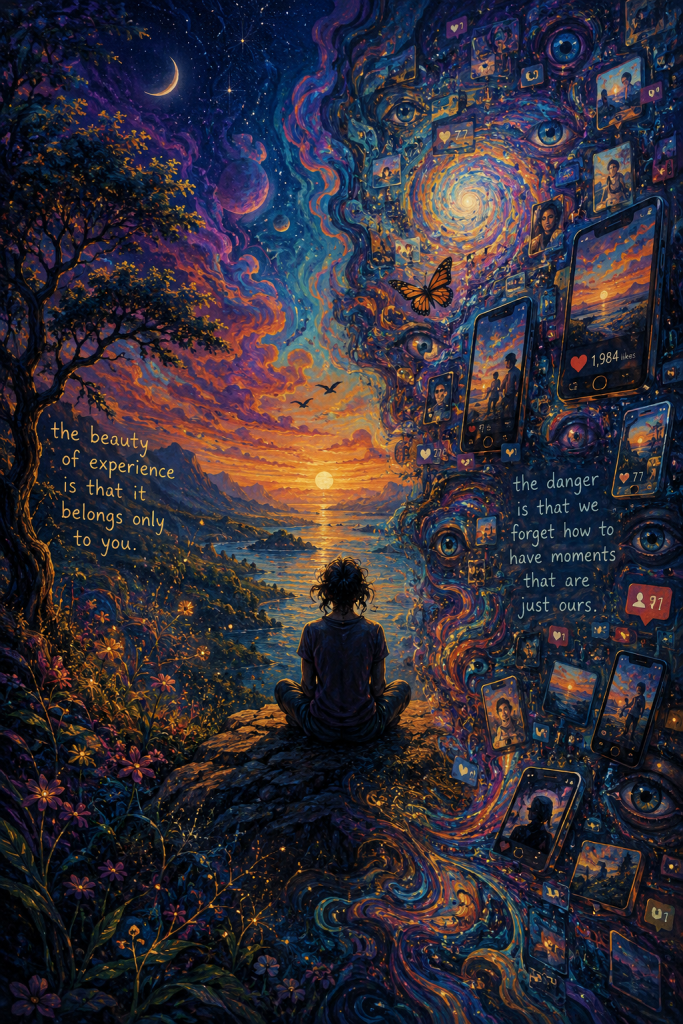
There was once a version of you that nobody knew existed.
A thought you never shared. A song you listened to alone. A walk you took without taking a picture. A moment when the sky looked incredible, and instead of reaching for your phone, you simply stood there.
Nobody liked it.
Nobody commented on it.
Nobody even knew it happened.
And somehow, it still mattered.
Today, that kind of experience is becoming strangely rare.
We live in a world where almost anything can become something to share. A beautiful meal becomes a picture. A concert becomes a story. A new relationship becomes a post. A vacation becomes a collection of highlights. Even our sadness, healing, spirituality, opinions and personal growth can become content.
There is nothing inherently wrong with sharing our lives. Humans have always told stories about themselves. But there is a question worth asking:
What happens when we become so accustomed to being seen that we forget how to exist unseen?
When Experience Becomes Performance
Think about the last time something beautiful happened.
Maybe you saw an incredible sunset.
Maybe your favorite song came on while you were driving home.
Maybe you accomplished something you had quietly been working toward.
How quickly did the thought appear:
I should post this.
It’s such a normal impulse that we barely notice it anymore.
But something subtle happens in that moment. Instead of simply experiencing what is happening, part of our attention steps outside of the experience and begins imagining how it will appear to someone else.
Which angle looks best?
What should the caption say?
Who will see it?
Will a certain person see it?
Suddenly, there are two versions of the moment happening simultaneously.
There is the experience itself.
And there is the story of the experience we are preparing to show other people.
Research into online identity has explored this complicated relationship between our private self, self-concept and the way we monitor and present ourselves online. Researchers have even described online meaning-making as something that can become partially “outsourced” to a digital audience. (PubMed)
That raises an uncomfortable possibility.
If an audience is always somewhere in the back of our minds, are we still discovering ourselves—or are we slowly designing ourselves?
Who Are You When Nobody Is Watching?
There is a version of yourself that your friends know.
Another version your coworkers know.
Another your family knows.
Another exists online.
But beneath all of them is someone much harder to describe:
the person you are when there is absolutely nobody to impress.
What music do you actually enjoy when nobody can judge your taste?
What clothes make you comfortable when nobody will see you?
What do you believe when you don’t have to defend it?
What makes you laugh when there is nobody beside you?
What would you create if you knew nobody would ever applaud it?
Those questions matter because the private self doesn’t receive much external reinforcement.
There are no likes for sitting quietly and thinking.
No follower count for changing your mind.
No views for forgiving someone privately.
No applause for becoming slightly kinder.
Some of the most important changes in a human being are almost invisible.
The Sacredness of Things Nobody Knows
Maybe privacy isn’t simply about hiding things.
Maybe some things become meaningful precisely because they aren’t shared.
There is something sacred about doing a good deed and telling nobody.
About watching the sunset without photographing it.
About writing something that stays in your journal.
About having a realization during meditation that never becomes a quote.
About loving someone without needing the world to witness the love.
These moments belong entirely to you.
And perhaps we need more of them.
Not because technology is evil or because sharing is shallow. Sharing can create connection, preserve memories and allow us to express parts of ourselves that otherwise might remain hidden.
The danger comes when being witnessed becomes necessary for something to feel real.
Psychological research has long suggested that self-presentation isn’t merely something we display outwardly; under certain circumstances, the identities we publicly perform can influence how we later understand ourselves. (Sage Journals)
Which makes protecting some portion of ourselves from constant observation feel increasingly important.
Try Living Something Nobody Will Ever See
There is a simple experiment worth trying.
Do something beautiful and don’t tell anybody.
Go somewhere.
Create something.
Help somebody.
Watch something incredible.
Take yourself somewhere you’ve wanted to go.
And deliberately leave no digital evidence.
No picture.
No story.
No location tag.
No message announcing what you’re doing.
Allow the experience to exist for absolutely no reason other than the fact that you were alive to experience it.
At first, it might feel strangely incomplete.
You may instinctively reach for your phone.
But resist that impulse for a moment.
Look around.
Notice where you are.
Notice what you’re feeling.
Because there is something incredibly freeing about realizing that a moment doesn’t need witnesses to become part of your life.
Protect a Piece of Yourself
Maybe the private soul isn’t disappearing.
Maybe we simply have to protect it more intentionally now.
Keep some dreams secret while they’re growing.
Keep some victories for yourself.
Let some thoughts remain unfinished.
Have conversations that disappear after they’re spoken.
Create things nobody sees.
Visit places nobody knows you visited.
Allow yourself to have an inner world that cannot be completely reconstructed from your digital history.
Because you are more than everything you’ve shown people.
You are also every quiet thought you’ve never explained, every moment you’ve experienced alone, every private transformation nobody noticed and every version of yourself that existed without an audience.
And maybe one of the strangest spiritual practices of modern life is also one of the simplest:
Live parts of your life without proving that you lived them.