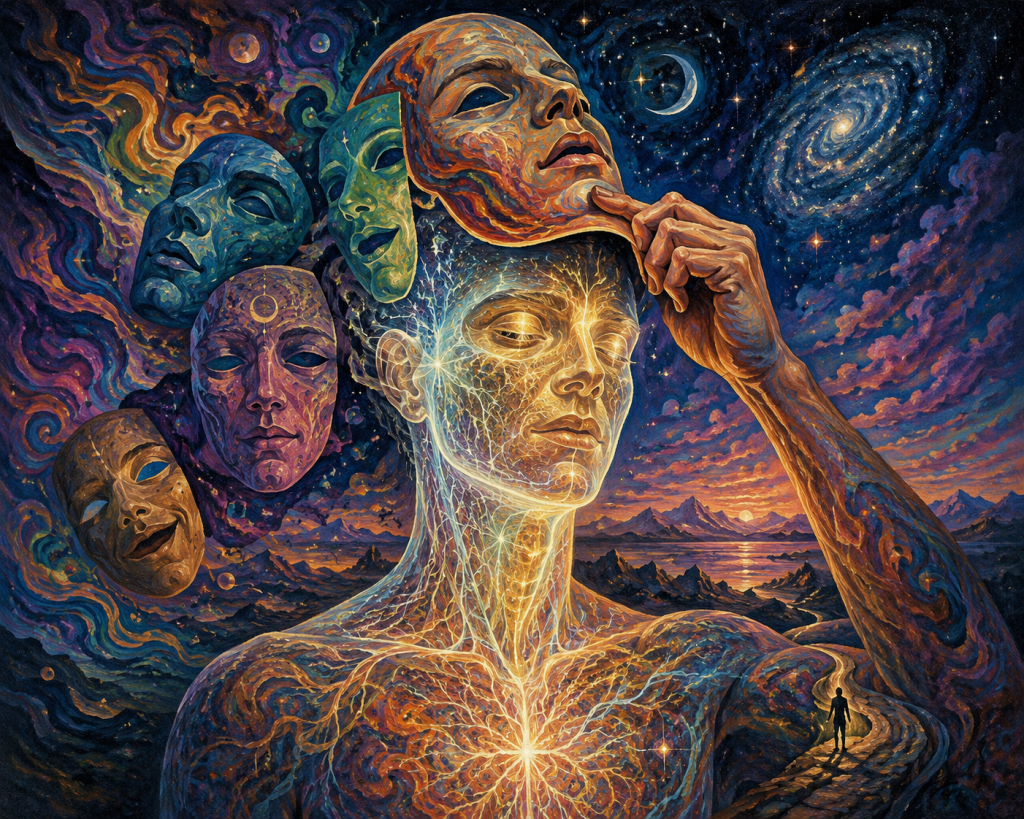
We hear it constantly:
“I’m trying to find myself.”
Maybe that means traveling somewhere new, changing careers, ending a relationship, starting a spiritual practice, deleting social media, or completely reinventing who we are.
There’s an assumption underneath all of it—that somewhere inside us is a hidden, finished version of ourselves waiting to be discovered.
But what if you were never lost?
What if the real problem is that you’ve spent so much time performing who you think you’re supposed to be that you’ve forgotten what it feels like to simply exist?
The Person We Create for Other People
From a young age, we learn that certain versions of ourselves receive different reactions.
Be funny and people laugh.
Be successful and people respect you.
Be attractive and people notice you.
Be agreeable and people accept you.
Over time, we naturally begin adjusting ourselves around those reactions.
None of this necessarily means we’re being fake. Humans are social creatures. We want connection, belonging, love, and recognition.
But eventually, something strange can happen.
Instead of expressing ourselves and allowing people to react, we begin anticipating the reaction first—and then constructing ourselves around it.
We stop asking:
“What do I actually want?”
And unconsciously begin asking:
“What version of me will be accepted?”
That difference seems small.
It isn’t.
Social Media Made the Performance Visible
Social media didn’t invent this behavior. It simply gave us a stage where we could watch it happening.
Now our identities can have aesthetics.
We curate photographs, music, clothes, opinions, hobbies, relationships, lifestyles, and even philosophies.
And sometimes the performance goes deeper than looking successful.
You can perform being mysterious.
You can perform being different.
You can perform not caring what anyone thinks.
You can even perform spirituality.
Meditation, crystals, philosophy, psychedelics, journaling, manifestation, mindfulness—all of these things can genuinely help us understand ourselves.
But they can also become costumes.
There is a difference between being spiritual and wanting to be perceived as spiritual.
And the ego is clever enough to wear either one.
Who Are You When Nobody Is Watching?
There’s a question worth sitting with:
If nobody could ever know about it, would you still want it?
Would you still wear those clothes?
Listen to that music?
Go to that place?
Buy that thing?
Have that opinion?
Follow that dream?
Would you still meditate if you couldn’t tell anyone you meditate?
Would you still create something if you couldn’t post it?
Would you still pursue success if nobody could see the result?
Not every answer needs to be yes.
Other people influence us. That’s part of being human.
But noticing where the answer becomes no can reveal something important.
It shows us where expression may have quietly turned into performance.
Maybe There Is No Final Version of You
Another problem with “finding yourself” is the assumption that there is some permanent version of you to find.
But think about who you were five years ago.
Your beliefs changed.
Your relationships changed.
Your interests changed.
Things that once seemed incredibly important may barely matter anymore.
And five years from now, you’ll probably look back at today’s version of yourself the same way.
Maybe that’s not something to resist.
Maybe a human being isn’t supposed to become a finished product.
We are experiences constantly becoming something else.
You don’t need to build an identity so rigid that you have to defend it forever.
You’re allowed to contradict your old self.
You’re allowed to abandon interests you’ve outgrown.
You’re allowed to change your mind.
You’re allowed to become someone you couldn’t have imagined becoming.
Stop Trying So Hard to Be Someone
There is an incredible amount of energy spent maintaining identity.
We defend our labels.
We protect our image.
We compare ourselves with other people.
We wonder whether we’re successful enough, attractive enough, interesting enough, spiritual enough, productive enough, or different enough.
Maybe freedom isn’t finally becoming the perfect version of yourself.
Maybe freedom is needing a version of yourself less and less.
You wake up.
You experience something.
You love people.
You lose people.
You make things.
You fail.
You learn.
You change.
You continue.
And somewhere inside all of that, something much more authentic appears—not because you successfully constructed it, but because you stopped constantly trying to control it.
So perhaps the next time you feel like you need to “find yourself,” don’t immediately search for another identity.
Get quiet.
Remove the audience for a moment.
Forget who you’re supposed to be.
And ask yourself:
Who am I when there’s nobody here to impress?
You might discover that you weren’t missing.
You were underneath the performance the entire time.