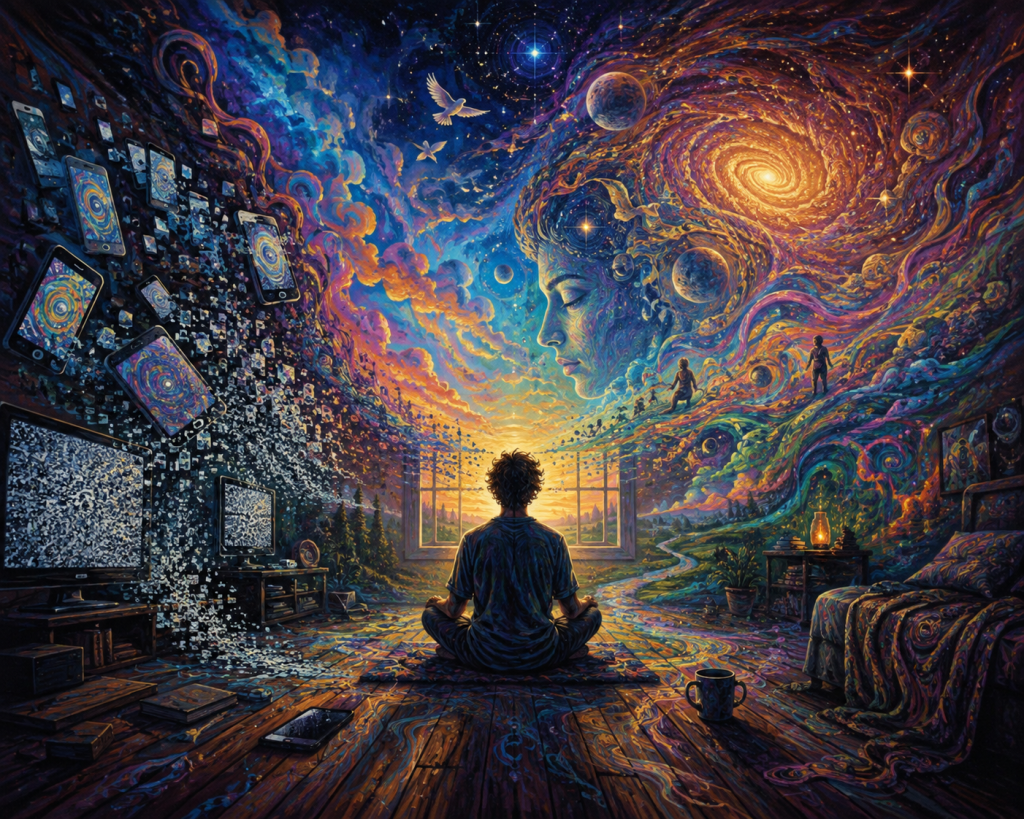
When was the last time you were truly bored?
Not bored while watching a show with your phone in your hand. Not bored while waiting for a video to load. Not bored while scrolling through the same three apps hoping something new appears.
I mean actually bored.
Sitting somewhere with nothing happening. No music. No notifications. No entertainment. No immediate escape from the silence.
For most of human history, boredom was simply part of being alive. People waited. They walked places. They stared out windows. They sat on porches. They spent long stretches of time alone with their thoughts.
Today, boredom feels almost like a problem that needs to be solved.
The second an empty moment appears, we reach for something.
Standing in line? Phone.
Eating alone? Video.
Walking somewhere? Headphones.
Five minutes before leaving the house? Scroll.
Even going to the bathroom has somehow become an opportunity to consume information.
We have become incredibly good at escaping empty space.
But what if that empty space was doing something important?
Boredom Is Where the Mind Wanders
There is something strange that happens when you have nothing immediately demanding your attention.
Your mind begins wandering.
At first, it might be uncomfortable. Random thoughts appear. Memories surface. You start thinking about conversations from three years ago or wondering why you suddenly want to completely reorganize your life.
But eventually, something deeper can happen.
Ideas appear.
Questions appear.
You notice feelings that were hiding underneath all the noise.
Some of our most interesting thoughts don’t arrive because we deliberately searched for them. They arrive while we’re walking, showering, staring at the ceiling, driving without anything playing, or sitting somewhere with absolutely nothing to do.
Creativity needs room to breathe.
When every empty moment is immediately filled, the mind rarely gets that room.
Constant Stimulation Can Keep Us From Ourselves
There is another side of boredom that might be even more important.
Silence makes it harder to run from yourself.
When there is nothing distracting you, you begin noticing what is actually happening inside.
Maybe you’re unhappy with something.
Maybe you miss someone.
Maybe you’re worried about the direction your life is going.
Maybe you’re excited about something you’ve been afraid to pursue.
Maybe you’re simply exhausted.
None of those thoughts necessarily appear when your attention is constantly occupied.
And perhaps that’s part of why constant stimulation is so attractive.
Sometimes we aren’t reaching for our phones because we’re interested.
We’re reaching because we don’t want to sit with whatever appears when nothing else is there.
The Spiritual Value of Doing Nothing
Meditation has taught versions of this lesson for thousands of years.
Sit.
Observe.
Don’t immediately react.
Let thoughts come and go.
There is nothing particularly exciting about it from the outside. That’s almost the point.
When you remove stimulation, you begin noticing how desperately the mind searches for it.
You suddenly want to check something.
You remember something you “need” to look up.
You wonder how much time has passed.
The mind starts throwing little escape routes at you.
But if you remain there long enough, something changes.
You realize that not every thought requires action.
Not every uncomfortable feeling needs to disappear.
Not every second needs to be productive.
And not every moment needs entertainment.
Sometimes existence itself is enough.
We May Be Losing Something Important
Technology has given us extraordinary access to information, entertainment, people, music, knowledge, and experiences.
The problem isn’t that these things exist.
The problem begins when we become incapable of existing without them.
If silence immediately feels uncomfortable, that’s worth noticing.
If standing in line for three minutes without checking your phone feels impossible, that’s worth noticing.
If you can’t take a walk without needing something playing in your ears, that’s worth noticing too.
Not because these things are inherently bad.
But because attention is part of your life.
Where your attention continuously goes is, in a very real sense, where your life goes.
Try Being Bored Again
You don’t need to disappear into the mountains or throw your phone into a river.
Just leave some spaces empty.
Take a short walk without headphones.
Eat something without watching anything.
Sit outside for ten minutes.
Look out the window while you’re waiting instead of immediately reaching into your pocket.
Let yourself experience that strange itch telling you that you should be doing something.
Then don’t.
See what happens after the discomfort passes.
Maybe nothing happens.
Maybe you notice the wind.
Maybe an idea appears.
Maybe something you’ve been avoiding finally surfaces.
Maybe you simply sit there.
That’s okay too.
We’ve spent years building a world where almost every second can be filled.
Perhaps one of the most rebellious things we can do now is leave a few of those seconds completely empty.
Because boredom isn’t necessarily the absence of something.
Sometimes it’s the space where something begins.