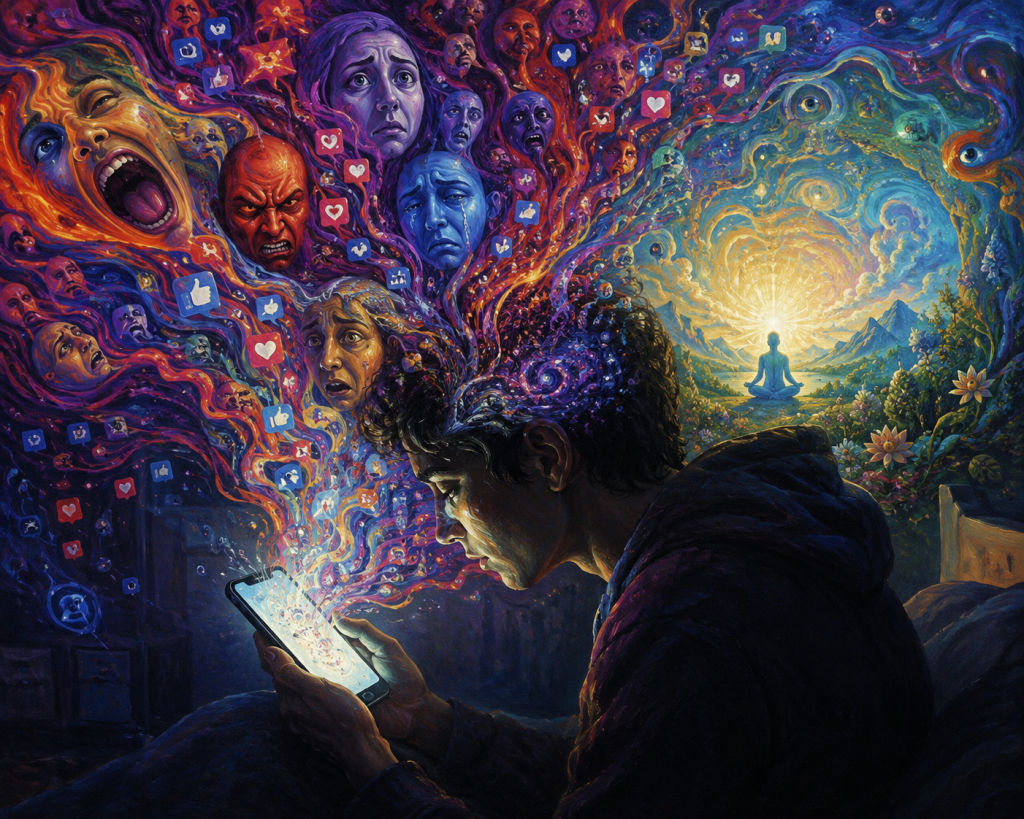
Have you ever felt anxious without knowing what you’re anxious about?
Maybe you woke up feeling perfectly fine. You grabbed your phone, checked a few notifications, opened social media, watched a couple videos, read some comments—and suddenly your mind felt heavier.
Nothing actually happened to you.
Yet somehow, your emotional state changed.
We talk constantly about what we consume physically. We pay attention to our food, our water, caffeine, alcohol, and sometimes even the ingredients printed on the back of a package.
But we rarely question what we are consuming emotionally.
And we are consuming other people’s emotions all day long.
Emotional Secondhand Smoke
Think about your average scroll through social media.
Within ten minutes, you might encounter someone furious about politics, someone grieving a relationship, someone showing off an incredible vacation, someone arguing in the comments, someone warning that the world is falling apart, and someone displaying a seemingly perfect life.
You haven’t actually experienced any of those situations.
But your nervous system doesn’t walk away completely untouched.
It’s almost like emotional secondhand smoke.
You didn’t create the anger, fear, jealousy, insecurity, or outrage—but you were standing close enough to breathe some of it in.
Then something strange happens.
We carry it with us.
We close the app and wonder:
Why am I irritated?
Why do I suddenly feel behind in life?
Why does everything seem so negative today?
Sometimes the emotion we’re carrying didn’t even begin with us.
Your Attention Is an Open Door
Attention is more valuable than we often realize.
Whatever repeatedly receives our attention slowly begins influencing the world inside us.
If your attention constantly rests on conflict, eventually the world can start feeling hostile.
If it constantly rests on people who appear more successful than you, your own life can begin feeling inadequate.
If it constantly rests on tragedy, danger, and outrage, the world may begin appearing far more terrifying than the one directly outside your window.
This doesn’t mean ignoring reality.
There are real problems in the world. Awareness matters. Compassion matters. Staying informed matters.
But awareness and constant emotional exposure are not the same thing.
You don’t have to carry every tragedy you learn about.
You don’t have to participate in every argument you witness.
You don’t have to absorb every person’s anger simply because an algorithm placed it in front of you.
Sometimes protecting your peace isn’t ignorance.
It’s understanding the limits of your attention.
Ask Yourself: Is This Actually Mine?
One of the simplest practices I’ve found interesting is questioning an emotion before immediately identifying with it.
When you suddenly feel anxious, angry, jealous, discouraged, or strangely heavy, ask:
“Where did this feeling come from?”
Maybe something genuinely happened in your life.
But maybe you spent twenty minutes watching strangers argue.
Maybe you compared yourself to someone’s highlight reel.
Maybe you read frightening headlines before getting out of bed.
Maybe you’ve been listening to someone complain for hours.
We often say, “I’m anxious.”
But perhaps sometimes a more accurate observation would be:
“I’m experiencing anxiety right now.”
There’s a subtle difference.
One turns the emotion into an identity.
The other recognizes it as something temporarily passing through your awareness.
You are the person noticing the storm—not necessarily the storm itself.
Create Space to Hear Yourself Again
The answer isn’t necessarily deleting every app, throwing away your phone, and disappearing into the mountains.
It can be much simpler.
Spend a little time each day without consuming anyone else’s thoughts.
No podcast.
No TikTok.
No music.
No news.
No scrolling.
Just walk.
Sit outside.
Drink your coffee without reaching for your phone.
Meditate.
Write.
Stare out a window.
Be bored for ten minutes.
At first, silence can feel strangely uncomfortable because we’ve become accustomed to constantly filling it.
But eventually something beautiful happens.
You begin hearing your own mind again.
You start recognizing which thoughts actually belong to you.
You notice what you’re genuinely worried about, what you’re genuinely excited about, and what actually matters when nobody else is telling you what deserves your attention.
Protect What Enters Your Inner World
We probably aren’t meant to emotionally process the thoughts, arguments, tragedies, accomplishments, opinions, and anxieties of hundreds of people every single day.
Yet modern life gives us the ability to do exactly that.
So perhaps awareness begins with becoming more intentional about what we allow through the door.
Notice what you consume.
Notice how you feel before you open your phone.
Then notice how you feel afterward.
Pay attention to which accounts leave you inspired and which consistently leave you angry, insecure, afraid, or exhausted.
Your attention is part of your inner environment.
Protecting it doesn’t mean shutting yourself off from the world.
It means remembering that not everything happening in the world needs to become something happening inside of you.