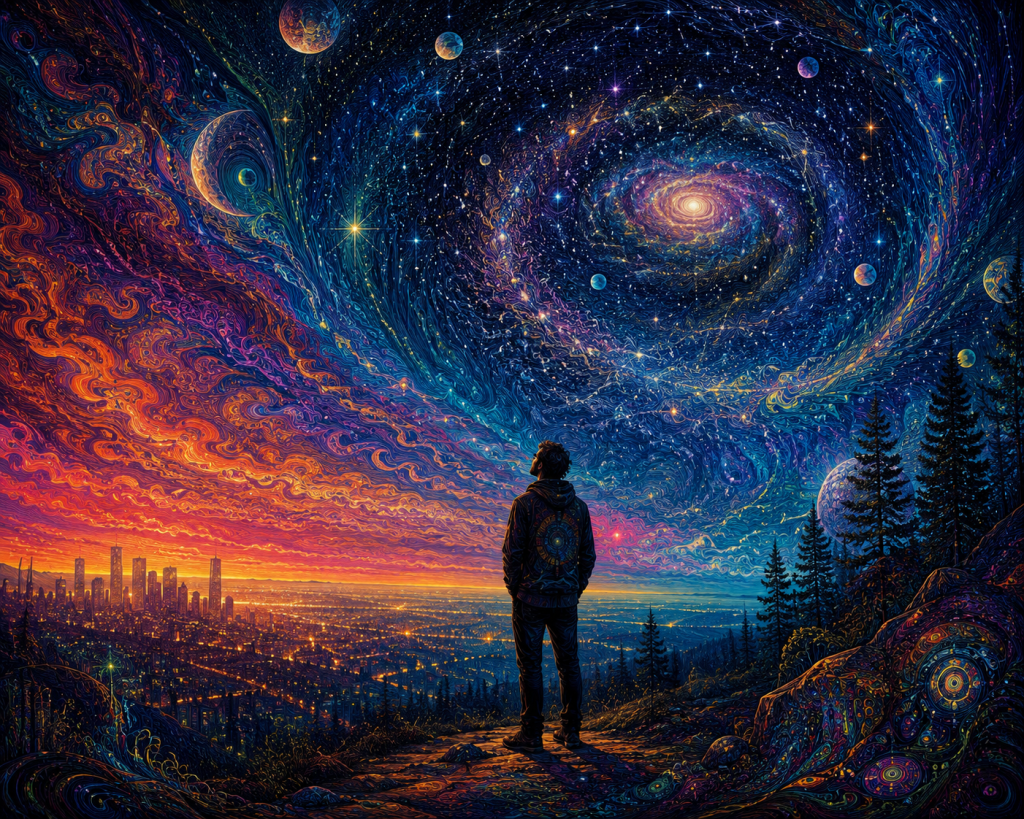
There is something strangely humbling about looking up at a sky full of stars.
Not through a screen. Not through a photograph someone took from the middle of nowhere. Actually standing outside, surrounded by darkness, and realizing that those tiny points of light are scattered across distances our minds can barely comprehend.
For most of human history, this experience was ordinary.
Our ancestors lived beneath the stars. They navigated by them, created stories about them, tracked seasons through them, and wondered what existed beyond them. The night sky wasn’t simply a beautiful background—it was part of being human.
Today, many of us barely see it.
When the Stars Started Disappearing
The stars haven’t gone anywhere. We’ve simply made them harder to see.
Cities, parking lots, billboards, businesses, stadiums, streetlights, and neighborhoods produce enormous amounts of artificial light. The glow from populated areas can spread far beyond the places creating it, washing out the darkness of the night.
This is light pollution.
And unlike other forms of pollution, it can be surprisingly easy to overlook.
We notice trash beside a road. We notice polluted water. We notice smoke filling the air. But when another star disappears behind the glow of civilization, most of us never realize we’ve lost anything.
We simply become accustomed to a brighter night.
Imagine Seeing What Our Ancestors Saw
Think about standing outside thousands of years ago.
There are no buildings glowing in the distance. No headlights. No phones. No illuminated signs.
Just darkness.
You look upward and see a sky overflowing with stars.
Imagine experiencing that every night.
Perhaps this helps explain why the sky became so deeply connected to mythology, religion, philosophy, navigation, and storytelling across human cultures. When something that enormous appears above you every night, it becomes difficult not to wonder about your place within it.
What is all of this?
Why am I here?
What exists beyond what I can see?
Those questions haven’t disappeared.
But one of the environments that naturally encouraged us to ask them has.
We May Be Losing More Than Stars
Light pollution is an environmental issue, but there may also be something philosophical hidden inside it.
We are becoming increasingly separated from darkness.
Our bedrooms glow from televisions and phones. Our streets remain illuminated throughout the night. When darkness finally appears, many of us immediately reach for another source of light or stimulation.
Yet darkness creates a very different psychological environment.
There is less to look at.
Less demanding your attention.
And when you finally look upward, there is suddenly something enormous waiting for you.
A truly dark sky can make your everyday problems feel strangely small—not because they don’t matter, but because you’re reminded of their scale.
You are standing on a planet.
That planet is moving through space.
Above you are stars whose light has traveled unimaginable distances before reaching your eyes.
And somehow, for this brief moment, you’re here to witness it.
Awe Is Good for the Soul
There are experiences that temporarily pull us outside ourselves.
Standing beside the ocean.
Walking through an ancient forest.
Watching lightning move across the horizon.
Seeing mountains towering over you.
Looking into a sky filled with thousands of stars.
These moments produce awe.
Awe reminds us that reality is larger than our individual lives. We spend so much time trapped inside our own little worlds—deadlines, money, relationships, notifications, arguments, insecurities, plans.
Then nature occasionally reminds us:
Look how much bigger this is.
The night sky might be one of humanity’s oldest sources of that feeling.
And we’re slowly covering it with light.
Go Find the Darkness
Maybe appreciating the night sky now requires intention.
Drive away from the city sometime.
Find somewhere safe where the artificial glow begins to disappear. Put your phone away for a few minutes. Give your eyes time to adjust.
Then look up.
Don’t worry about identifying constellations.
Don’t worry about taking the perfect picture.
Just look.
There is something powerful about realizing that people thousands of years ago looked upward with the same curiosity.
They wondered what was out there.
We still do.
We have discovered galaxies, black holes, planets, nebulae, and an unimaginably large universe—and somehow the mystery has only become greater.
Maybe that’s why protecting dark skies matters.
It isn’t only about seeing more stars.
It’s about protecting one of humanity’s oldest relationships: the relationship between a conscious person standing on Earth and the enormous mystery above them.
Sometimes we need darkness to remember just how much light is actually out there.