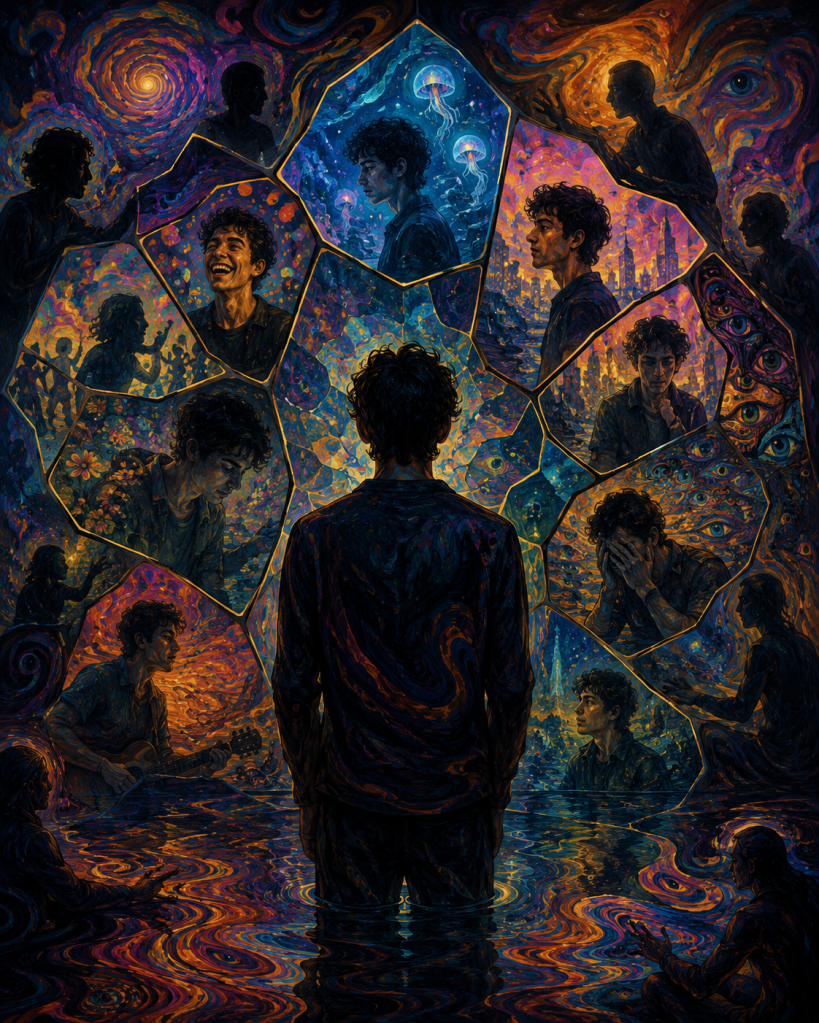
Have you ever noticed how you become a slightly different person depending on who walks into the room?
Around one person, you can’t stop talking. Around another, you’re strangely quiet. Someone else brings out a ridiculous sense of humor you almost forgot you had. And then there are people who somehow make you question yourself, even when you felt completely confident five minutes before seeing them.
It raises an uncomfortable but fascinating question:
Which one of those people is actually you?
We like to imagine that somewhere underneath everything exists one solid, permanent version of ourselves—the “real me.” But maybe identity doesn’t work that way.
Maybe we’re more like mirrors constantly changing depending on what we’re reflecting.
People Are Environments
We usually think about environments as physical places.
Your bedroom is an environment. Your workplace is an environment. A crowded city street is an environment.
But people can be environments too.
Every person carries an emotional atmosphere with them. Some people make it feel safe to be strange. Some make vulnerability feel natural. Others make you instinctively guard yourself.
And without consciously deciding to, you adapt.
Think about someone you’ve known for years. There are probably jokes, expressions, stories, and behaviors that almost exclusively exist when you’re around them.
Then imagine never seeing that person again.
Where does that version of you go?
Technically, you’re still the same person. But an entire little world within your personality might suddenly have nowhere to exist.
That’s one of the quieter forms of loss we don’t talk about very often.
Sometimes when we miss someone, we aren’t only missing them.
We’re missing who we were when we were with them.
The People Who Unlock Rooms Inside You
Imagine your personality as a massive house.
There are rooms you enter every day: your humor, habits, responsibilities, interests.
But there are other rooms you rarely visit.
Then someone enters your life and somehow has the key.
Suddenly you’re more adventurous.
More affectionate.
More creative.
More curious.
Maybe you’re dancing in the kitchen when you normally wouldn’t. Maybe you’re talking about ideas until three in the morning. Maybe you’re comfortable being completely stupid and playful without wondering how you look.
That person didn’t necessarily create those qualities.
They revealed them.
And that’s an important distinction.
When someone leaves our lives, we sometimes believe they took that version of us with them.
But if they were capable of bringing it out of you, then it had to exist somewhere inside you already.
The door may have closed.
The room is still there.
The Opposite Can Happen Too
Not everyone brings out something beautiful.
Some people introduce us to versions of ourselves we barely recognize.
Jealous.
Defensive.
Anxious.
Cold.
Desperate for approval.
We might look back and think, Why did I act like that? That’s not who I am.
But maybe introspection requires resisting the temptation to completely separate ourselves from those versions.
That was you too.
Not necessarily the person you want to remain—but still a reaction your mind was capable of producing under certain conditions.
Instead of shame, there can be curiosity.
What was that version of you protecting?
What did they fear losing?
What were they trying desperately to receive?
Sometimes our least favorite versions of ourselves reveal our deepest insecurities more clearly than our best versions ever could.
Maybe There Is No Final Version
We’re constantly encouraged to “find ourselves.”
It’s a beautiful idea, but it almost makes the self sound like a missing object.
As though somewhere deep inside your mind there’s a finished version of you waiting to be discovered.
But what if there isn’t?
What if you’re continually being created through interaction?
Every friendship changes you slightly.
Every relationship leaves fingerprints.
Every stranger who says something you remember for years becomes a tiny piece of your internal world.
You aren’t fake because you’re different around different people.
You’re multidimensional.
The quiet you is real.
The loud you is real.
The confident you is real.
The awkward you is real.
The person laughing uncontrollably with an old friend and the person sitting alone thinking about existence at 2 a.m. are somehow occupying the same life.
Maybe maturity isn’t choosing which one is the “real” version.
Maybe it’s learning which environments allow the versions of yourself you respect most to emerge.
Pay Attention to Who You Become
There is an interesting question we could ask about every important person in our lives:
Who am I when I’m around them?
Not whether they’re impressive.
Not whether everyone else likes them.
Not even whether you’ve known them for a long time.
Who do you become?
Do you become curious?
Do you become smaller?
Do you create more?
Do you constantly explain yourself?
Do you laugh?
Do you feel like you’re performing?
Do you feel peaceful enough to say nothing at all?
The answer might tell you something important about the relationship.
But more importantly, it might tell you something about yourself.
Because perhaps the people we meet aren’t simply characters entering our story.
They’re also doors.
Some lead toward parts of ourselves we’ve known forever.
Some reveal places we’d rather not return to.
And every once in a while, someone opens a door inside us that we didn’t even know was there.
When they leave, we might think that door disappeared with them.
But it didn’t.
They just showed us where it was.