We often talk about protecting our energy.
We say certain people drain us. Certain places feel heavy. Some experiences leave us feeling alive, while others leave us completely exhausted.
But what if one of the most important forms of energy we possess isn’t something mysterious at all?
What if it’s our attention?
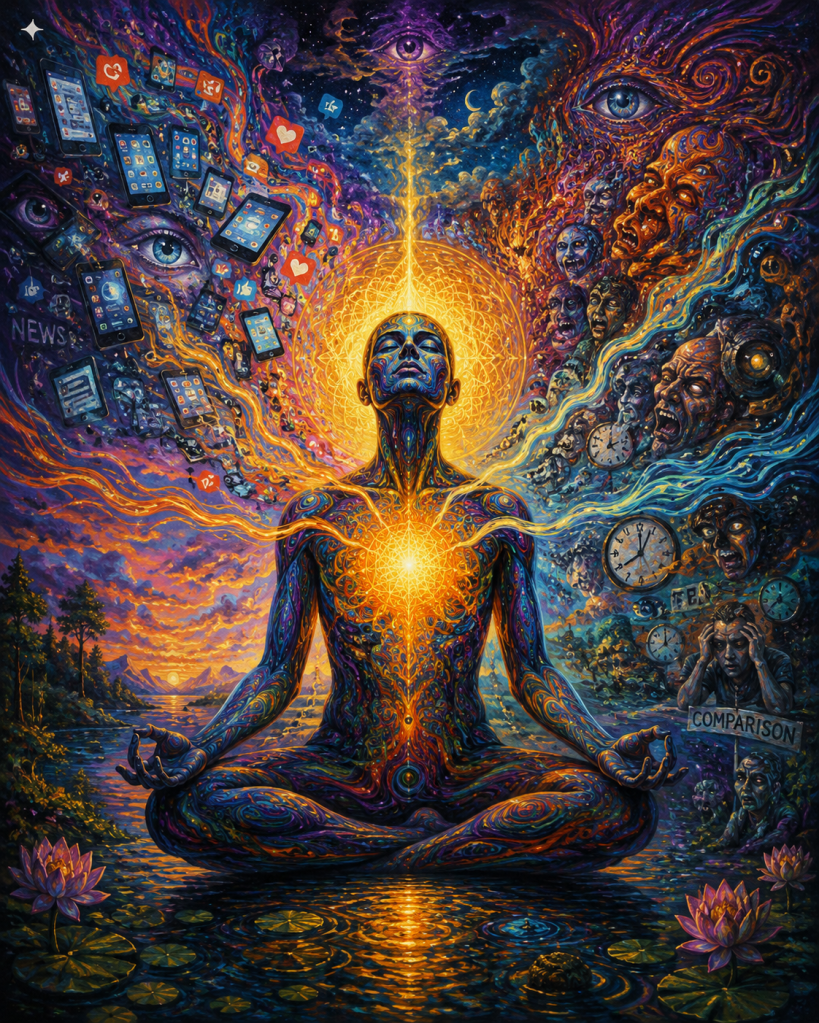
Every day, you wake up with a limited amount of awareness to spend. From the moment you open your eyes, something is competing for it. Your phone. Notifications. Work. Other people’s opinions. Advertisements. Memories. Worries about tomorrow. Thoughts about yesterday.
And little by little, you spend it.
The strange thing is that we carefully think about where we spend our money, yet we rarely question where we’re spending our consciousness.
Attention Shapes Your Reality
Imagine two people walking down the exact same street.
One notices the sunlight reflecting through the trees, someone laughing across the street, the architecture of an old building, and the feeling of the wind against their skin.
The other notices traffic, someone who looked at them strangely, an annoying sound, and everything they need to accomplish later.
Same street.
Different reality.
Neither person necessarily has the “correct” experience. The point is that what we repeatedly pay attention to becomes the material from which our experience is constructed.
This becomes even more powerful over time.
If you constantly search for reasons you’re behind, your mind becomes incredibly talented at finding evidence that you’re behind.
If you constantly compare yourself to others, you’ll discover endless people who seem richer, happier, more attractive, or more successful.
But the opposite can happen too.
Practice noticing beauty and suddenly beauty appears everywhere.
Practice gratitude and ordinary things begin feeling valuable again.
Practice presence and moments you previously would’ve ignored start becoming part of your life.
Attention doesn’t just observe your world. It participates in creating your experience of it.
Everyone Wants a Piece of Your Mind
There has probably never been another period in human history where so many things were intentionally designed to capture our attention.
Scroll.
Refresh.
Click.
Watch.
React.
Repeat.
An entire economy exists around keeping our eyes on screens for another few seconds.
There’s nothing inherently wrong with technology. It can connect us, educate us, entertain us, and give ordinary people creative opportunities that would’ve seemed impossible generations ago.
The problem begins when we stop choosing where our attention goes.
You open your phone to check one message.
Twenty minutes later, you’re watching a stranger argue with another stranger about something you didn’t even know existed twenty minutes ago.
And somehow, their anger is now living inside your mind.
That’s the hidden cost.
Whenever something captures your attention, you’re giving it temporary access to your internal world.
Where Does Your Mind Go When Nobody Is Directing It?
This might be one of the most revealing questions we can ask ourselves:
Where does my attention naturally go?
Does it travel toward the future?
The past?
Someone who hurt you?
Someone you miss?
Things you don’t have?
Things you’re afraid of losing?
Other people’s lives?
Or does it occasionally land right here?
The sound in the room.
Your breathing.
Your body.
The strange fact that you’re conscious and experiencing existence at all.
Meditation teaches something fascinating about attention: you don’t have to follow every place your mind wants to go.
A thought can appear without becoming a destination.
You can notice anxiety without feeding it.
You can remember something without living inside the memory.
You can want something without allowing the desire to consume the present.
That’s where attention starts becoming a spiritual practice.
Take Your Consciousness Back
Protecting your attention doesn’t require abandoning your phone, disappearing into the mountains, or meditating for six hours every morning.
It can start incredibly small.
Sit somewhere without immediately reaching for stimulation.
Walk without constantly checking your phone.
Create something before consuming something.
Listen completely when someone you love is speaking.
Notice when you’re scrolling because you actually want entertainment versus scrolling because silence feels uncomfortable.
Spend five minutes watching your breath.
Look at the sky.
Listen to an entire song without doing anything else.
These things sound almost ridiculously simple.
That’s exactly why they’re easy to overlook.
Spirituality doesn’t always have to involve extraordinary experiences. Sometimes it is simply the practice of becoming fully available for the ordinary experience happening directly in front of you.
Spend It Wisely
Your attention is constantly becoming something.
Give enough of it to fear, and fear grows.
Give enough of it to resentment, and resentment develops roots.
Give enough of it to comparison, and your own life starts feeling insufficient.
But give attention to creativity, relationships, curiosity, gratitude, nature, self-understanding, and the present moment—and those things grow too.
You cannot control everything that enters your awareness.
But you can become more conscious of what you’re repeatedly feeding.
Because your attention isn’t infinite.
Your days aren’t infinite.
Your life isn’t infinite.
Maybe that’s what makes attention so valuable.
Every moment you truly give your attention to something, you’re giving it a tiny piece of your life.
Spend it on something worthy of you.