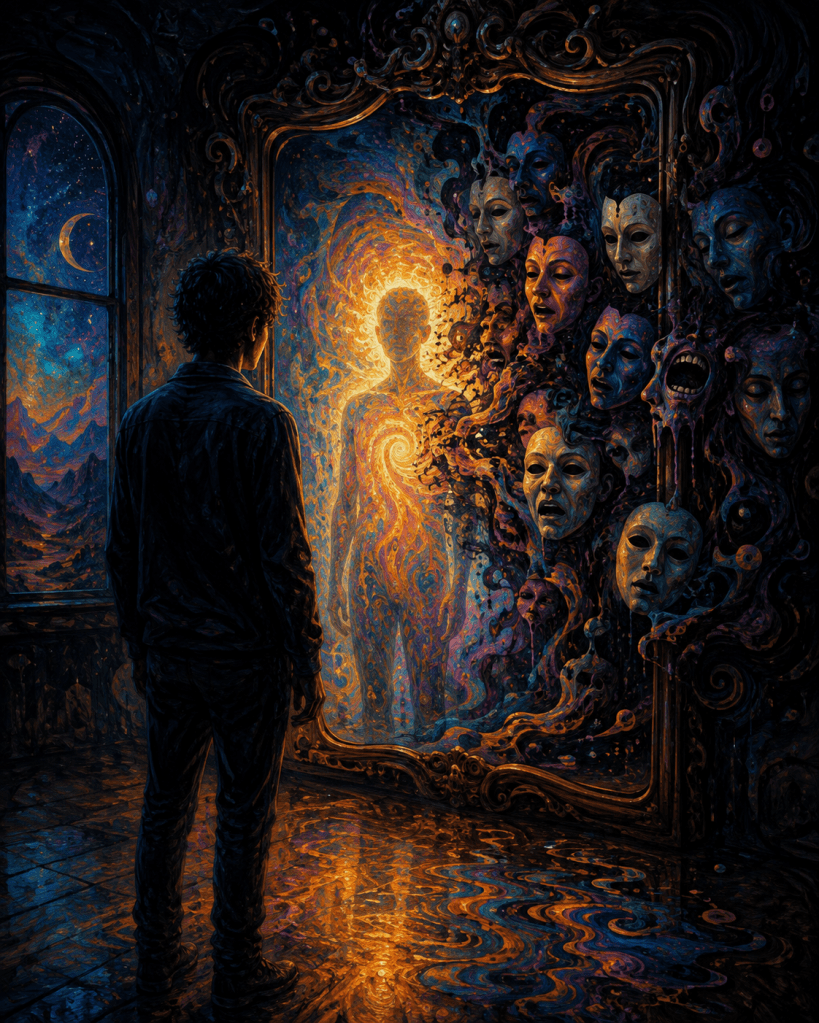
We spend a surprising amount of our lives being seen.
At work, we have a version of ourselves that knows how to behave. Around family, another version appears. With friends, we might become louder, funnier, quieter, or more confident. Online, we can carefully choose the photograph, the thought, the song, the outfit, or the moment that represents who we want people to believe we are.
None of this necessarily means we’re being fake. Human beings are social creatures, and some degree of self-presentation seems to be a normal part of how we navigate relationships and society. Research into authenticity has even complicated the idea that authentic people simply stop caring how they appear to others; people who consider themselves authentic can still consciously or unconsciously present an identity to an audience. (ScienceDirect)
But there is another version of you that rarely gets discussed.
The person you are when nobody is watching.
No audience. No likes. No expectations. Nobody to impress and nobody to disappoint.
Who is that person?
The Identity We Perform
Imagine removing everything you normally use to explain yourself.
Your job title disappears.
Your social media accounts disappear.
Nobody knows what you own, what you wear, how much money you make, what music you listen to, who you’ve dated, what you’ve accomplished, or what mistakes you’ve made.
You can’t tell anyone your story.
You’re simply there.
It becomes surprisingly difficult to answer the question, Who am I?
We often build identity through external reference points. We say, I’m a musician. I’m successful. I’m spiritual. I’m attractive. I’m funny. I’m different. I’m a good person.
But many of those identities require somebody else to recognize them.
If nobody could ever hear your music, would you still create it?
If nobody knew you meditated, would you still meditate?
If nobody saw the clothes you bought, would you still want them?
If nobody could congratulate you for an accomplishment, would you still pursue it?
These aren’t accusations. They’re experiments.
They reveal the difference between what genuinely pulls us forward and what we have learned to perform.
Your Private Self Knows Things Your Public Self Doesn’t
There are moments when you catch glimpses of yourself without the performance.
Driving alone late at night.
Sitting quietly after everyone has gone home.
Walking without headphones.
Creating something you never intend to show anyone.
Looking into the mirror before you’ve prepared yourself for the outside world.
There is something powerful about these moments because there is nothing to maintain.
You don’t have to appear intelligent.
You don’t have to appear spiritual.
You don’t have to appear happy.
You don’t even have to appear like you have everything figured out.
Interestingly, research comparing people’s ideas of their authentic and presented selves found that the authentic self wasn’t simply the prettier version. People were more willing to acknowledge negative characteristics as belonging to their authentic selves, suggesting authenticity can include the parts of ourselves we’d rather not advertise. (PubMed)
Maybe knowing yourself isn’t about discovering some flawless person underneath everything.
Maybe it’s about becoming willing to meet the entire person.
What Happens in the Dark Matters
There is an old idea that character is revealed by what someone does when nobody is watching.
I think that idea can go even further.
Your private life doesn’t only reveal your character.
It builds it.
Every small decision becomes a vote for the person you’re becoming.
You clean something even though nobody would know if you didn’t.
You keep a promise you made to yourself.
You create something terrible because you’re still learning.
You admit privately that you were wrong.
You choose kindness when there is no reward attached.
You sit with an uncomfortable emotion instead of immediately escaping it.
Nobody applauds.
Nobody posts about it.
Nobody even knows it happened.
But you know.
And perhaps that’s where genuine spiritual growth happens—not during the moments when we look enlightened, but during the invisible moments when we have nothing to prove.
Stop Trying to Find a Perfect “True Self”
There’s another trap hidden inside this conversation.
We can become obsessed with discovering our “real self.”
We peel away identities hoping that eventually we’ll uncover some permanent person underneath everything.
But what if there isn’t one final version?
Psychologists have studied our tendency to believe in a deep “true self,” and research suggests people commonly treat this inner identity almost like an underlying essence that explains who someone fundamentally is. (PubMed)
Maybe that’s partly true.
But I like another possibility.
Maybe the self isn’t something buried inside you waiting to be discovered.
Maybe it’s something you’re continuously creating.
The person you are alone today doesn’t have to be the person you are alone five years from now.
You can notice what you’ve been performing.
You can notice what you’ve been avoiding.
You can decide what actually matters.
And slowly, your public and private selves can move closer together.
When Nobody Is Watching
Spend some time alone without immediately filling the silence.
Don’t grab your phone.
Don’t put something on.
Don’t worry about making the moment productive.
Just observe.
What thoughts appear when nobody needs anything from you?
What interests do you naturally move toward?
What are you pretending not to care about?
What do you secretly want?
What parts of yourself only exist because somebody else is watching?
And maybe most importantly:
Do you like the person you are when nobody is watching?
If the answer is yes, protect that person.
If the answer is no, don’t run from them.
Get to know them.
Because beneath the profiles, titles, relationships, aesthetics, accomplishments, failures, and stories we tell about ourselves, there is still someone experiencing all of it.
And when the room becomes quiet, the phone goes dark, and there is nobody left to impress, you finally get the opportunity to meet them.