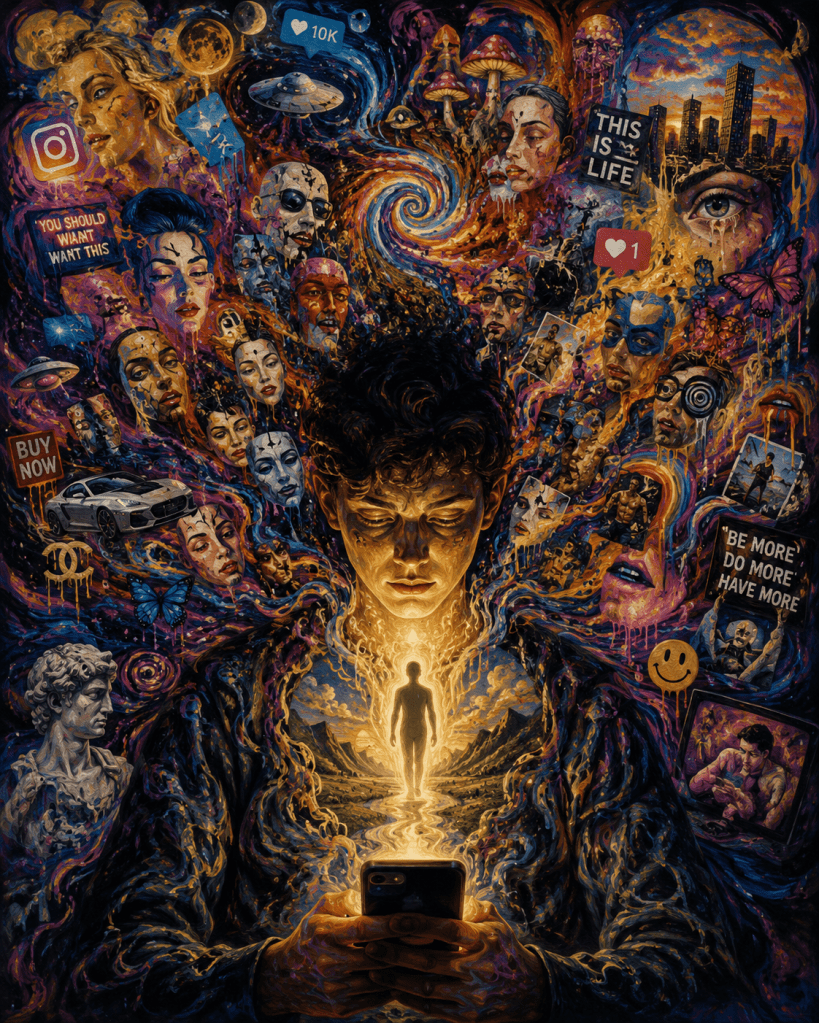
There is a strange question hiding underneath modern life:
How much of who you are actually came from you?
Think about your music taste, the clothes you wear, the things you believe, the people you admire, the way you speak, what you consider attractive, what you think success looks like—even the ideas you have about spirituality and happiness.
We like to believe we carefully chose these things. But every day, we absorb thousands of little pieces of the world around us.
And eventually, some of those pieces start feeling like us.
The Algorithmic Mirror
Social media has made this question even more complicated.
Algorithms learn from tiny signals: what you watch, what you skip, what you search for, what you replay and what keeps you staring at the screen.
Then they give you more of it.
Over time, this can create a strange feedback loop. You show interest in something, the algorithm shows you more of it, you become increasingly interested in it, and eventually it becomes part of how you describe yourself.
Researchers have even begun describing versions of this phenomenon as the “steered self”—the idea that repeated algorithmic exposure can subtly influence the identities we develop. (MDPI)
The algorithm isn’t necessarily deciding who you are.
But it might be deciding which possibilities you encounter most often.
And repetition is powerful.
Consumption Doesn’t Stop at Products
When we hear the word consumption, we usually think about buying things.
But we consume much more than products.
We consume opinions.
We consume aesthetics.
We consume lifestyles.
We consume outrage.
We consume other people’s relationships.
We consume definitions of masculinity, femininity, beauty, spirituality, wealth and success.
Research into social media and identity has found that the relationship isn’t simply about how many hours someone spends online. What people actually do online—such as comparing themselves with others or presenting themselves authentically—appears to matter considerably for identity development and self-concept. (PubMed)
That makes me wonder whether the modern spiritual practice isn’t only becoming more conscious of our thoughts.
Maybe we also need to become conscious of what we’re feeding those thoughts.
When Inspiration Becomes Imitation
There is nothing wrong with being influenced.
Human beings have always learned through imitation. We borrow ideas from our parents, friends, artists, teachers and cultures. Inspiration is part of becoming a person.
The danger begins when we stop realizing we’re being influenced.
You discover someone’s lifestyle and think:
That’s who I want to be.
Then another.
Then another.
Eventually, your personality can become a collage of things you’ve consumed.
The problem isn’t the collage.
The problem is forgetting there was ever a canvas underneath it.
Who Are You Without the Feed?
Imagine something impossible for a moment.
No Instagram.
No TikTok.
No YouTube recommendations.
No influencers.
No advertisements.
No trending aesthetics.
Nobody telling you what is cool.
Nobody telling you what kind of life you should want.
You wake up tomorrow and none of it exists.
What would you still care about?
What music would you search for?
What would you wear?
What would you create?
What would you believe?
Who would you want to become if nobody could see you becoming them?
Those questions aren’t about abandoning technology. They’re about separating genuine preference from constant suggestion.
Your Attention Is Building Something
Every piece of content probably isn’t dramatically changing you.
But thousands of small exposures can create an environment around your mind.
And environments shape things.
Research has explored social networking as a cyclical process in which people don’t simply express an already-finished identity online; creating and consuming content can participate in the ongoing production of that identity. (ScienceDirect)
That’s why attention deserves to be treated as something valuable.
Whatever repeatedly receives your attention gets another opportunity to enter your internal world.
That doesn’t mean becoming afraid of everything you consume.
It means becoming intentional.
Sometimes ask yourself:
Do I actually like this, or have I simply seen it enough times to think I do?
Becoming Yourself Requires Space
Maybe discovering yourself isn’t about adding another philosophy, aesthetic, routine or identity.
Maybe sometimes it requires subtraction.
Turn everything off.
Sit somewhere quiet.
Walk without headphones.
Make something you never intend to post.
Listen to music nobody recommended.
Write thoughts you would never upload.
Allow yourself to become bored enough that your own mind has to produce something.
Because beneath everything you’ve consumed, there is still something experiencing all of it.
The observer.
The part of you capable of saying:
I like this.
I don’t believe that anymore.
This matters to me.
This doesn’t.
Perhaps becoming yourself isn’t about escaping influence completely. That’s probably impossible.
It’s about becoming conscious enough to recognize influence before mistaking it for identity.
The world will always offer you another version of who you could become.
The deeper question is whether you’re choosing that person—
or simply consuming them.