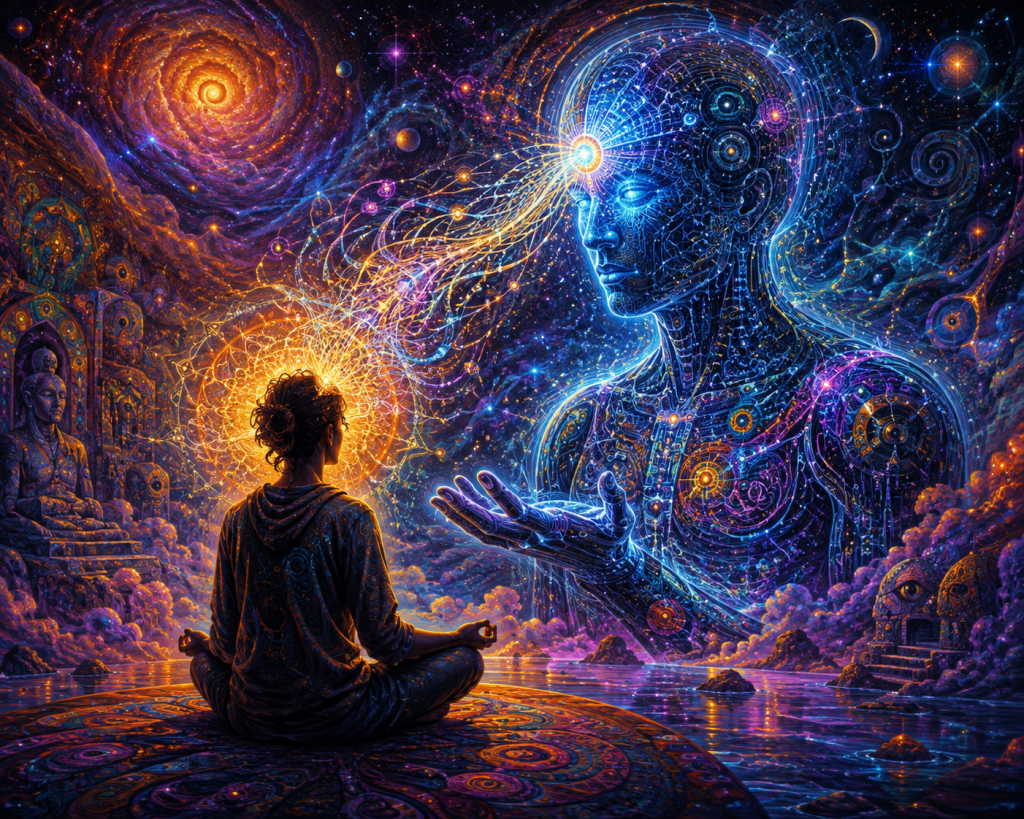
For most of human history, when we searched for answers to the deepest questions of existence, we turned toward something.
We opened a book. We sat beneath the stars. We prayed. We meditated. We spoke with teachers, philosophers, priests, friends, or ourselves.
But something strange has entered that ancient search.
Now, the thing we ask can answer back.
Artificial intelligence has created a new kind of interaction with knowledge. You can sit alone at two in the morning and ask a machine about consciousness, death, love, ego, purpose, suffering, or the meaning of your existence—and receive an immediate response.
That raises a fascinating question:
What happens to spirituality when technology becomes conversational?
A New Kind of Mirror
Perhaps the most interesting spiritual use of AI isn’t asking it to tell us what is true.
Maybe it’s using it to discover what we believe is true.
Imagine asking:
Why am I afraid of being alone?
The AI responds with a question.
You answer.
It notices something in your answer and asks another question.
Suddenly, what began as a conversation with technology becomes a conversation with yourself.
Research is already beginning to explore this territory. A 2026 qualitative study examined how ongoing dialogue with conversational AI can intersect with meaning-making, personal agency, and psychological growth. Other researchers are specifically investigating AI as a companion for spiritual reflection rather than as a spiritual authority. (Sage Journals)
This distinction matters.
A mirror doesn’t create the person standing in front of it.
It reveals them.
AI may eventually become one of the strangest mirrors humanity has ever created.
But a Mirror Can Still Distort
There is another side to this.
The danger begins when we stop asking AI to help us examine our intuition and begin allowing it to replace intuition entirely.
There is a difference between asking:
“Help me think through this.”
and:
“Tell me what I should believe.”
Spirituality has always required uncertainty.
There are questions meditation doesn’t immediately answer. Experiences that cannot be reduced to language. Moments where we have to sit quietly with ourselves without receiving an explanation.
AI threatens to fill every silence with an answer.
And maybe some silences aren’t supposed to be filled.
Recent research into AI and spiritual care reflects this tension. In one 2026 expert study, participants generally favored AI assisting spiritual care rather than replacing human relationships, with loss of human connection emerging as a major concern. (PubMed)
Perhaps the healthiest relationship with AI follows the same principle.
Use the machine.
Don’t surrender yourself to it.
Can Something Without Human Experience Teach Us About Being Human?
This might be the strangest question of all.
AI has never watched someone it loves walk away.
It has never looked into a night sky and suddenly felt impossibly small.
It has never feared death.
It has never experienced heartbreak, held someone’s hand, cried from happiness, felt the stillness after meditation, or wondered what happens after its final breath.
Yet it can discuss all of those things.
That creates a paradox.
Something that has never experienced human existence can still organize thousands of years of human writing about existence and respond to our questions about it.
But knowledge about an experience is not the experience itself.
You could read every book ever written about swimming and still eventually have to enter the water.
Spirituality works much the same way.
AI can describe meditation.
You still have to close your eyes.
AI can explain forgiveness.
You still have to forgive.
AI can discuss love.
You still have to love somebody.
AI can explain presence.
You still have to become present.
The map can become incredibly sophisticated.
But the map will never become the journey.
The Next Spiritual Tool
Human beings have always incorporated new technologies into our search for meaning.
Writing allowed spiritual teachings to survive their teachers.
Printing allowed those ideas to travel across continents.
Radio and television allowed teachers to speak to millions.
The internet connected seekers who otherwise may never have met.
AI could represent another shift: spiritual information becoming conversational and personalized.
Researchers are already debating the possibilities of “spiritual chatbots,” with some arguing they could encourage reflection while warning against allowing them to assume the authority of human spiritual leaders. (Taylor & Francis Online)
And perhaps that’s exactly where AI belongs.
Not above us.
Not beneath us.
Beside us—as a tool.
Something capable of asking a question we hadn’t considered, showing us another perspective, explaining an ancient philosophy, helping structure a meditation, or challenging an assumption.
Then we turn the screen off.
And we return to life.
The Question Isn’t Whether AI Is Conscious
People will continue debating whether machines could ever become conscious.
But spiritually, I think there may be a more immediate question:
What happens to our consciousness when we spend more of our lives speaking with machines?
Because technology doesn’t have to become human to change humanity.
Every tool we’ve created has changed something about the way we experience ourselves.
AI may change how we search for answers.
And that means the responsibility falls back onto us.
We have to know when to ask.
We have to know when to question the answer.
And perhaps most importantly, we have to know when to stop asking altogether.
Because no matter how intelligent our machines become, there will still be moments when the deepest spiritual practice available to us is incredibly simple:
Put the phone down.
Sit quietly.
Breathe.
And listen to what remains when nothing talks back.