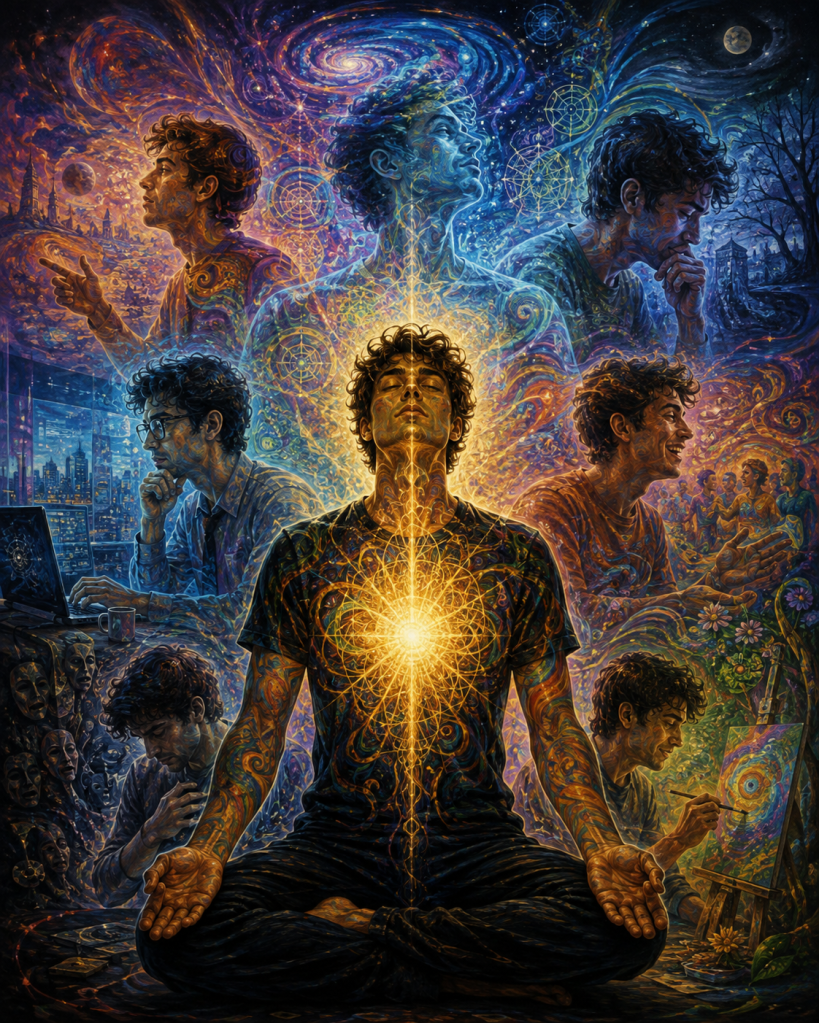
Have you ever noticed that you become a slightly different person depending on who is standing in front of you?
There is the version of you that exists around your family. The version that shows up at work. The version that comes alive around close friends. The version that appears when you fall in love. Then there is the quieter version—the person who exists when the door closes, the phone goes down, and nobody else is around.
They are all you.
But if they are all you, then which one is the real you?
That question opens up one of the strangest parts of exploring ourselves spiritually: maybe the self isn’t as solid as we imagine it to be.
We Are Constantly Changing
We tend to think of identity as something permanent.
We say things like, “That’s just who I am.”
But look closely enough and that idea starts falling apart.
Think about who you were five years ago. Your beliefs may have changed. Your relationships changed. Your priorities changed. Things that once felt incredibly important might barely matter anymore.
Even within a single day, different parts of you appear.
At work, you might be responsible and controlled. Around someone you trust, you might become ridiculous and playful. Around someone who intimidates you, you might become quiet. When you’re creating something, another personality can emerge entirely.
None of these versions are necessarily fake.
They are different expressions of the same consciousness moving through different environments.
Other People Become Mirrors
One of the fascinating things about relationships is that people seem to pull different versions of us to the surface.
Some people make us feel confident.
Others expose our insecurities.
Some make us softer.
Some make us defensive.
Some people make us feel like we’re finally able to be ourselves.
This is why relationships can become powerful tools for self-discovery. Every interaction gives us another mirror.
Instead of only asking, “What do I think about this person?” we can ask:
“Who do I become around this person?”
That question can reveal a lot.
Maybe someone brings out a version of you that constantly seeks approval. Maybe another person brings out your curiosity. Someone else might awaken your creativity.
People don’t necessarily create these parts of us. Sometimes they simply reveal what was already there.
So Which Version Is Authentic?
We hear constantly that we should “be our authentic selves.”
But what does that actually mean if we’re always changing?
Maybe authenticity doesn’t mean discovering one perfect personality hidden underneath everything else.
Maybe it means becoming aware of all the different parts of yourself without being controlled by them.
You can recognize:
This is the part of me that’s scared.
This is the part that wants to be accepted.
This is the part that wants to create.
This is the part that loves.
Instead of saying, “This is who I am,” you begin saying, “This is something I’m experiencing.”
That small shift creates space between awareness and identity.
The Observer Behind the Identities
This is where the idea becomes spiritual.
If your personality changes, your thoughts change, your emotions change, your body changes, your relationships change, and even your beliefs change…
What notices all of those changes?
There seems to be something within us capable of observing the different versions of ourselves.
You can notice yourself being angry.
You can notice yourself feeling insecure.
You can notice yourself remembering the past.
You can even notice yourself thinking.
That awareness is interesting because it doesn’t need to immediately define what it observes.
A thought can appear and disappear.
An emotion can appear and disappear.
An identity can appear and eventually disappear too.
Yet awareness continues watching.
Maybe spiritual exploration isn’t always about building a better identity.
Maybe sometimes it’s about loosening our grip on identity altogether.
You Are Allowed to Outgrow Yourself
There’s also something freeing about realizing that identity isn’t permanent.
You don’t have to remain someone simply because you’ve been that person for years.
You can change your mind.
You can discover new interests.
You can become softer.
You can become stronger.
You can admit that something you once believed no longer makes sense to you.
Sometimes we remain trapped inside old versions of ourselves because we’re afraid changing will make us inconsistent.
But growth requires inconsistency.
The person learning cannot remain identical to the person who didn’t know.
Perhaps that’s why certain stages of life feel so uncomfortable. An old identity is disappearing, but the next one hasn’t completely formed yet.
We call that feeling being lost.
But maybe you’re not lost.
Maybe you’re simply between versions of yourself.
Who Are You Without the Labels?
Try a strange thought experiment.
Imagine removing your name.
Then remove your job.
Remove your possessions.
Remove your relationship status.
Remove your accomplishments.
Remove what other people think about you.
Remove your plans for the future.
Remove the story you’ve created about your past.
For a moment, remove every label you normally use to explain who you are.
What’s left?
There may not be an easy answer.
And perhaps there isn’t supposed to be.
Spirituality doesn’t always give us another identity to hold onto. Sometimes it asks us to become comfortable with the mystery underneath all of them.
Maybe you aren’t one fixed self traveling through life.
Maybe you’re something much stranger and more beautiful: an awareness continuously experiencing, changing, learning, losing, loving, creating, and becoming.
And perhaps the goal isn’t to finally figure out exactly who you are.
Perhaps it’s to remain curious enough to keep discovering who you can become.