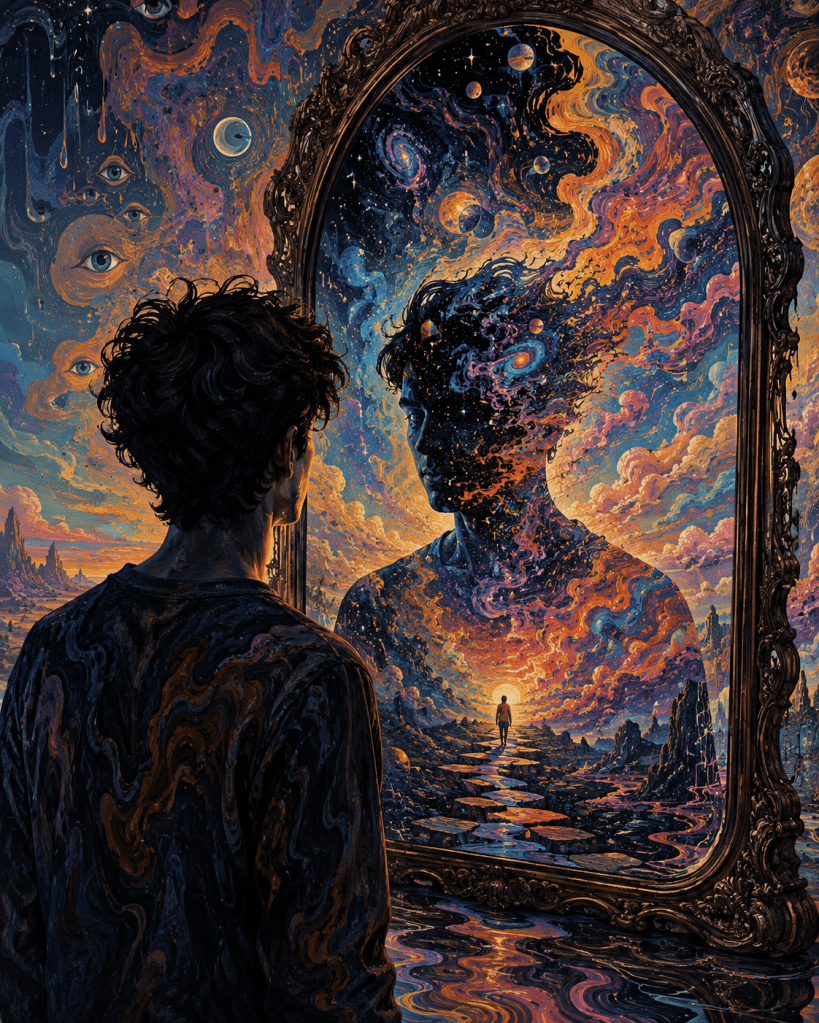
There’s a phrase we hear constantly when life starts feeling confusing:
“I just need to find myself.”
Maybe you’ve said it after a breakup. During a career change. While sitting alone wondering how you somehow became disconnected from the person you thought you were.
We imagine there’s a real version of ourselves hidden somewhere underneath everything—the right personality, the right purpose, the right path—and if we search long enough, eventually we’ll discover them.
But what if there’s nothing to find?
What if the better practice is simply learning to notice yourself?
The Myth of the “Real You”
We tend to think of identity as something permanent.
This is who I am.
But look at yourself five years ago.
You probably believed things you no longer believe. You cared about things that barely cross your mind now. Certain people felt incredibly important. Certain problems felt enormous.
And yet, at the time, that person felt completely like you.
That’s because you weren’t necessarily wrong about who you were.
You changed.
The problem with constantly trying to “find yourself” is that it can make life feel like a scavenger hunt with some final answer waiting at the end.
Spiritual growth may be almost the opposite.
Instead of discovering a permanent identity, you become comfortable watching yourself change.
Start Paying Attention
There are tiny moments throughout the day when you reveal yourself to yourself.
Notice what makes you unexpectedly happy.
Notice what makes you angry.
Notice the conversations that energize you and the ones that leave you exhausted.
Notice what you think about when nobody else is around.
Notice what you’re constantly chasing.
And maybe most importantly, notice what you’re avoiding.
You don’t have to immediately judge any of it.
Just observe.
There is something powerful about becoming curious about yourself without immediately trying to improve yourself.
Meditation teaches a similar lesson.
A thought appears.
You notice it.
A feeling appears.
You notice it.
Then it changes.
You don’t have to grab every thought and declare, “This is who I am.”
You can simply witness it.
You Are Allowed to Contradict Your Past
Sometimes we stay trapped in identities because we’ve repeated them for too long.
I’m an introvert.
I’m not creative.
I’m bad at relationships.
I’m the responsible one.
I’m the weird one.
I’m the person who doesn’t care.
Eventually these descriptions stop being observations and become instructions.
We begin making decisions based on who we’ve decided we’re supposed to be.
But you’re allowed to surprise yourself.
You’re allowed to suddenly love something you used to hate.
You’re allowed to walk away from something you once thought you wanted forever.
You’re allowed to become softer.
Stranger.
More confident.
More spiritual.
Less certain.
You don’t owe your past self consistency.
Identity Can Be a Verb
Maybe identity isn’t a noun.
Maybe it’s closer to a verb.
You’re not simply someone.
You’re continuously becoming someone.
Every experience changes you slightly. Every person you love leaves something behind. Every mistake gives you information. Every difficult season forces you to see parts of yourself you might never have encountered otherwise.
And that’s why there may never be a morning when you wake up and confidently announce:
“Finally. I found myself.”
There will always be another layer.
Another experience.
Another question.
Another version of you.
That doesn’t mean you’re lost.
It means you’re alive.
Notice Who You Are Today
You don’t need to have your entire identity figured out.
Instead, ask smaller questions.
What matters to me right now?
What am I curious about?
What am I holding onto that doesn’t feel like me anymore?
What feels peaceful?
What feels forced?
Who am I when I’m not performing for anyone?
You don’t need perfect answers.
The questions themselves make you pay attention.
And perhaps that’s the point.
Life isn’t necessarily about traveling somewhere far away—physically or spiritually—to uncover the person you were always supposed to become.
Sometimes the deepest form of self-discovery happens when you stop searching long enough to notice the person who’s already here.
So maybe stop trying so hard to find yourself.
Pay attention to yourself.
You might realize you were never actually lost.