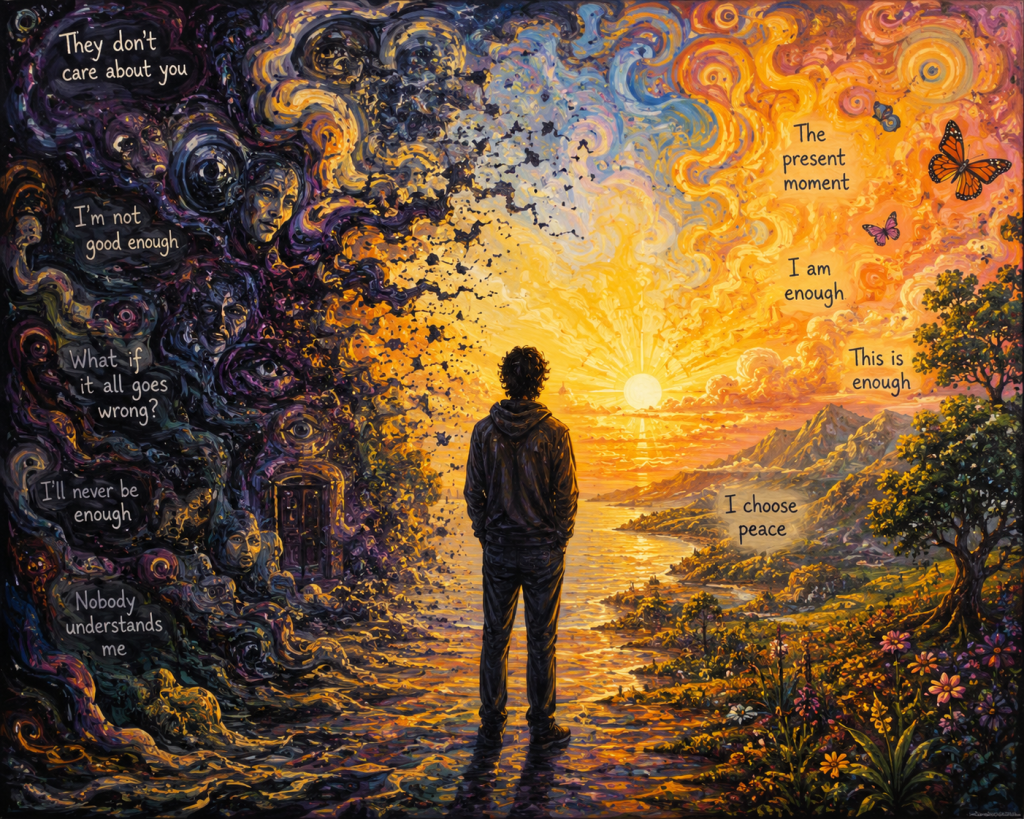
Have you ever noticed how quickly the mind can create a story?
Someone doesn’t text back, and suddenly the story becomes, “They must be upset with me.”
You make a mistake at work, and the story becomes, “I’m not good enough.”
A relationship ends, and the story becomes, “I’ll never find love again.”
The interesting thing is that these stories often feel completely real. They trigger emotions, shape our behavior, and influence our decisions. Yet many of them are built on assumptions rather than facts.
The human mind is a powerful storyteller. It’s constantly trying to make sense of the world around us. When information is missing, it fills in the blanks. When uncertainty appears, it creates explanations. This ability helped our ancestors survive, but in modern life it often becomes a source of unnecessary suffering.
The problem isn’t that we have thoughts. The problem is that we believe every thought we have.
Most anxiety begins with a story.
We imagine future scenarios that haven’t happened. We assume what other people think about us. We replay conversations and convince ourselves we know what someone meant. Before long, we’ve built an entire reality based on interpretation rather than evidence.
Think about how many times you’ve worried about something only to discover later that it wasn’t true. The promotion you thought you wouldn’t get. The friendship you thought was ending. The situation you thought would go terribly. Often, reality ends up being far less dramatic than the story the mind created.
This doesn’t mean we should ignore our thoughts. Thoughts can contain valuable information. They can reveal fears that need healing, patterns that need attention, and opportunities for growth. The key is learning to observe thoughts without automatically accepting them as truth.
A simple practice is to ask yourself:
“What are the actual facts?”
Not the assumptions.
Not the fears.
Not the story.
Just the facts.
This question creates space between you and your thoughts. It allows you to step out of the mental movie and return to reality.
The truth is that most of life happens in the present moment, but many of us spend our days trapped in stories about the past or worries about the future. We suffer not because of what is happening, but because of what we’re imagining.
Peace begins when we stop arguing with reality and start questioning the stories that keep us stuck.
The next time your mind starts writing a dramatic narrative, pause for a moment. Take a breath. Ask yourself what you actually know to be true.
You may discover that the story isn’t reality at all.
It’s just a story.
And stories can be rewritten.