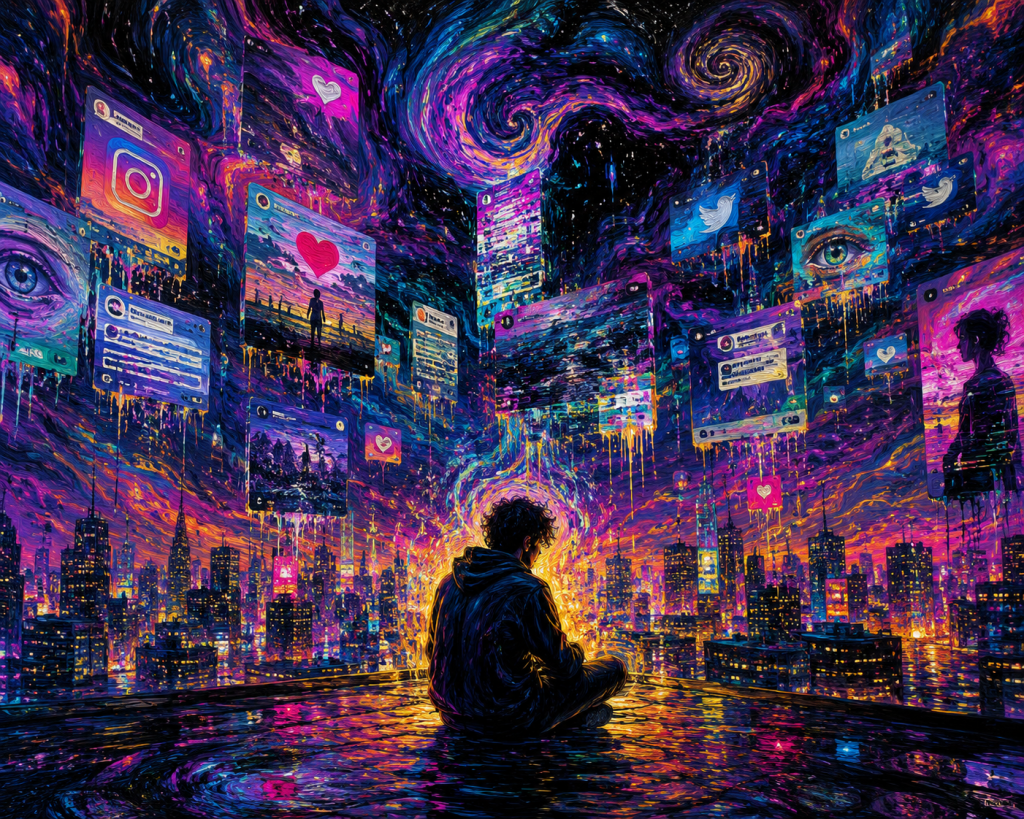
There was a time when people didn’t know everything about each other.
You didn’t know what someone was thinking every hour of the day. You didn’t see their breakfast, their arguments, their emotional breakdowns, or their entire personality condensed into temporary stories and algorithm-friendly captions.
People existed in fragments.
And somehow, that made them feel more real.
Now everything is immediate. Every thought is uploaded before it’s fully processed. Every experience becomes content before it becomes memory. We document life so aggressively that we barely experience it anymore.
And because of that, something important is disappearing:
Mystery.
Not secrecy. Not manipulation.
Mystery.
The natural depth that exists when everything isn’t instantly explained.
Years ago, fascination lasted longer because discovery took time. Songs felt bigger because you replayed them for months instead of skipping after fifteen seconds. Relationships unfolded slowly. People revealed themselves in layers instead of dropping their entire identity online within a week.
Even art carried mystery.
Albums had hidden meanings. Movies left room for interpretation. Artists weren’t constantly accessible. You couldn’t instantly search every opinion they had ever posted. There was distance between the audience and the creator, and that distance allowed imagination to exist.
Now everything is overexposed.
We live in a culture that rewards constant access. The more visible you are, the more valuable you appear to become. People feel pressured to explain themselves constantly — where they are, how they feel, what they’re doing, who they’re with, what they believe.
But the strange thing is:
the more we reveal, the less interesting we become.
Not because people are boring, but because overexposure removes emotional tension.
There’s no space left for curiosity.
Nothing gets a chance to breathe.
When every moment is uploaded instantly, life starts feeling flat. Predictable. Disposable. Experiences stop feeling sacred because they are interrupted by the need to share them before they are fully lived.
Even relationships suffer from this.
People now meet each other through fully curated digital identities before they ever truly connect in person. You already know their favorite songs, their opinions, their trauma, their routines, their selfies, their political views, and sometimes even their entire relationship history before hearing their voice face-to-face.
The mystery is gone before intimacy even begins.
And without mystery, fascination struggles to survive.
Not everything beautiful needs instant explanation.
Some things become more powerful when they remain partially untouched.
A person who doesn’t constantly broadcast themselves often feels magnetic now. Not because they are “playing games,” but because they still possess rarity in a world addicted to exposure.
Silence has become rare.
Privacy has become rare.
Depth has become rare.
Modern culture treats visibility like existence itself. If it isn’t posted, people almost act like it didn’t happen. But some of the most meaningful moments in life are the ones that never become public.
The late-night conversations.
The quiet breakthroughs.
The moments of healing.
The art nobody sees yet.
The love that grows away from an audience.
Those things still matter.
Maybe even more now.
Because in a world where everyone is trying to be seen constantly, there is something powerful about preserving pieces of yourself.
Not everyone deserves full access to your mind, your energy, your emotions, or your evolution.
Mystery protects individuality.
It gives your inner world room to develop without outside interference.
And maybe that’s what many people are truly starving for now — not more stimulation, not more content, not more noise…
But depth.
Real depth.
The kind that can only exist when everything isn’t immediately consumed.