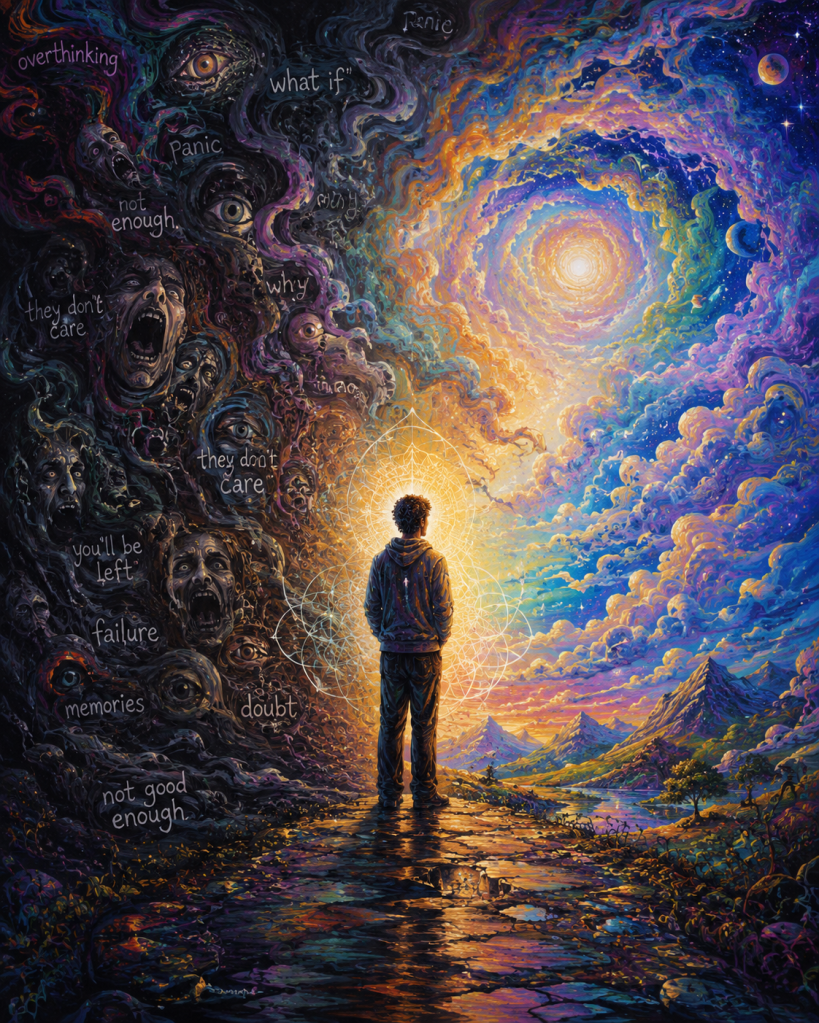
There are moments in life where your mind can become your worst narrator.
A delayed text suddenly feels personal.
A shift in someone’s energy feels like abandonment.
Silence becomes rejection.
Distance becomes proof that something is wrong.
But most of the time, the story anxiety creates is not the full reality.
That’s why emotional regulation matters so much.
A lot of people think emotional regulation means suppressing emotions or pretending not to care. It doesn’t. Emotional regulation is the ability to feel emotions deeply without immediately letting them control your behavior, assumptions, or perception.
Because anxious thoughts are convincing. They arrive with urgency. They make you feel like you need to react immediately. Like you need answers right now. Like your fears are facts.
But emotions are temporary states, not permanent truths.
One of the hardest lessons to learn is that your internal panic does not always reflect the actual trajectory of a relationship, opportunity, or situation. Sometimes your nervous system is reacting to old wounds, past disappointments, fear of abandonment, or uncertainty—not what’s actually happening in front of you.
And in today’s world, people are constantly overstimulated emotionally.
We analyze response times.
We overread wording.
We compare ourselves to strangers online.
We look for hidden meanings in everything.
Most people are not experiencing reality anymore. They are experiencing their interpretation of reality.
That’s an exhausting way to live.
Real emotional maturity begins when you stop treating every feeling as an emergency.
Not every uncomfortable emotion requires action.
Not every fear deserves your energy.
Not every anxious thought deserves your belief.
Sometimes the healthiest thing you can do is pause.
Breathe before reacting.
Observe before assuming.
Regulate before responding.
Because when you constantly react from fear, you start damaging things that may have actually been healthy. Anxiety can make people self-sabotage connections that only needed patience, communication, and consistency.
And consistency is what truly matters.
Not temporary intensity.
Not emotional highs.
Not dramatic declarations.
Consistency.
Who keeps showing up?
Who communicates over time?
Who remains present even after emotions settle down?
That tells you more than anxiety ever will.
Healthy connections often feel quieter than toxic ones. That’s because chaos creates adrenaline, while stability creates peace. If your nervous system is used to emotional turbulence, calmness can almost feel suspicious at first.
But peace is not boredom.
Calmness is not lack of love.
Stability is not absence of passion.
Sometimes it’s the first sign you are finally experiencing something real.
Your mind will always create stories when it feels uncertain. That’s part of being human. But growth happens when you stop immediately identifying with every fearful thought that appears in your head.
You are not every anxious thought you experience.
You are the awareness observing it.
And the more emotionally regulated you become, the more clearly you begin to see reality without fear distorting it.