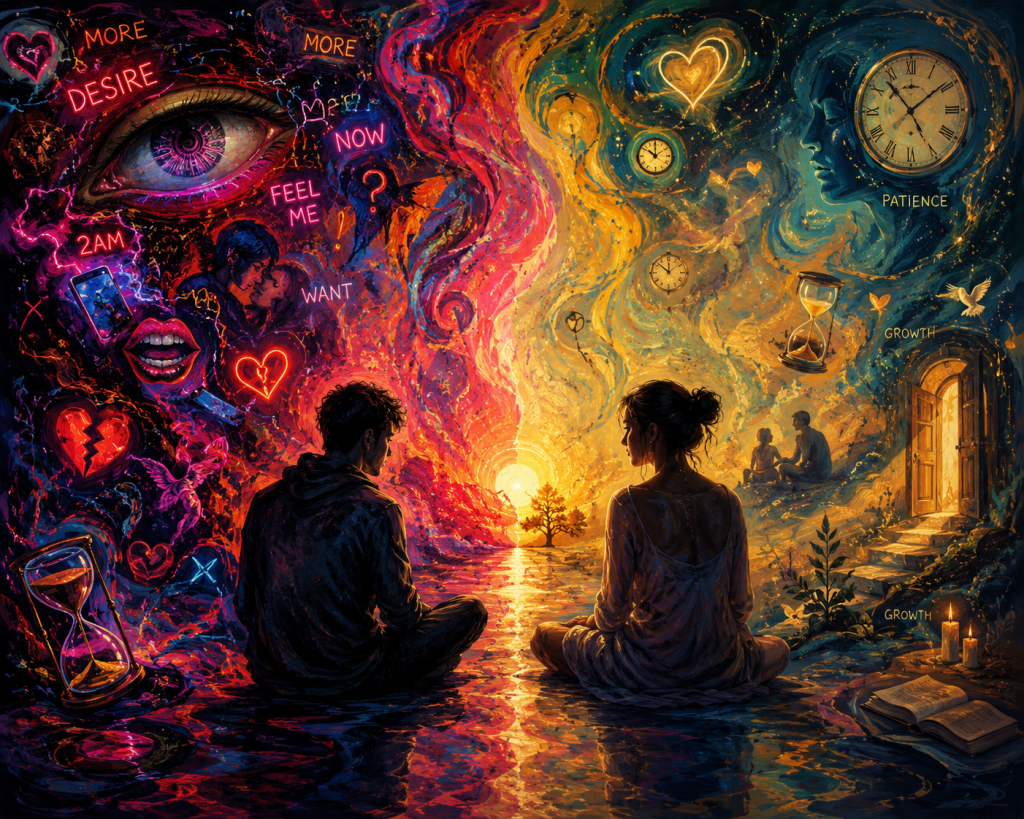
There’s a reason lust feels overwhelming.
It’s designed to.
Lust is fast. Immediate. Consuming. It floods your mind at 2 a.m., makes your chest tighten when a notification appears, and convinces you that intensity must mean something important. In a world addicted to instant gratification, lust fits perfectly into the rhythm of modern life. Fast replies. Fast attraction. Fast attachment. Fast disappointment.
But love moves differently.
Love does not scream for attention every second of the day. It does not force urgency where understanding hasn’t been built yet. Love is patient enough to let someone reveal themselves slowly. And in today’s culture, patience has become rare.
We often mistake emotional intensity for emotional depth. Someone becomes unavailable, inconsistent, unpredictable — and suddenly our emotions become louder. We think about them more. We crave reassurance. We replay conversations in our head. The uncertainty creates emotional noise, and we confuse that noise with connection.
But confusion is not intimacy.
Lust often thrives in fantasy. It fills in gaps with projections and imagination. It focuses on how someone makes us feel in brief moments rather than who they consistently are over time. That’s why some connections burn incredibly bright at the beginning and disappear just as quickly. The foundation was built on emotional speed, not emotional substance.
Love is different because love pays attention.
Love notices the small things. The change in someone’s tone. The stress hidden behind their silence. The habits, fears, and emotional patterns most people overlook. Lust seeks stimulation, but love seeks understanding. One consumes. The other learns.
Real love also survives ordinary life.
That may sound simple, but it’s one of the hardest things for a relationship to do. Anyone can feel obsessed during perfect moments. Anyone can feel attached during excitement, chemistry, or escape. But love reveals itself in routine. In difficult conversations. In patience during stressful seasons. In choosing someone not only when emotions are high, but also when life becomes repetitive, exhausting, or uncertain.
That’s the part people rarely romanticize.
Patience is not passive. Patience is emotional discipline. It’s the ability to build something slowly without demanding constant proof that it already exists. Lust wants certainty immediately. Love understands that trust takes time.
And maybe that’s why genuine love feels quieter at first.
Not because it’s weaker, but because it’s steadier.
Lust often creates emotional highs and lows that feel addictive. One moment you feel desired, the next you feel anxious. The unpredictability keeps you emotionally engaged. But healthy love tends to feel calmer. Safer. More grounded. And for people used to emotional chaos, peace can initially feel unfamiliar — even boring.
But peace is not boredom.
Peace is what happens when your nervous system no longer has to fight for reassurance.
Love is not built through dramatic moments alone. It’s built through consistency. Through showing up repeatedly. Through honesty when dishonesty would be easier. Through choosing communication over emotional games. Through presence instead of performance.
The loudest feelings are not always the deepest ones.
Sometimes the deepest love is found in the quiet ways someone stays.
In a generation trained to chase intensity, patience has become revolutionary. And maybe the strongest relationships are not the ones built on obsession, but the ones built on understanding.
Because lust may create sparks.
But patience is what keeps the fire alive.