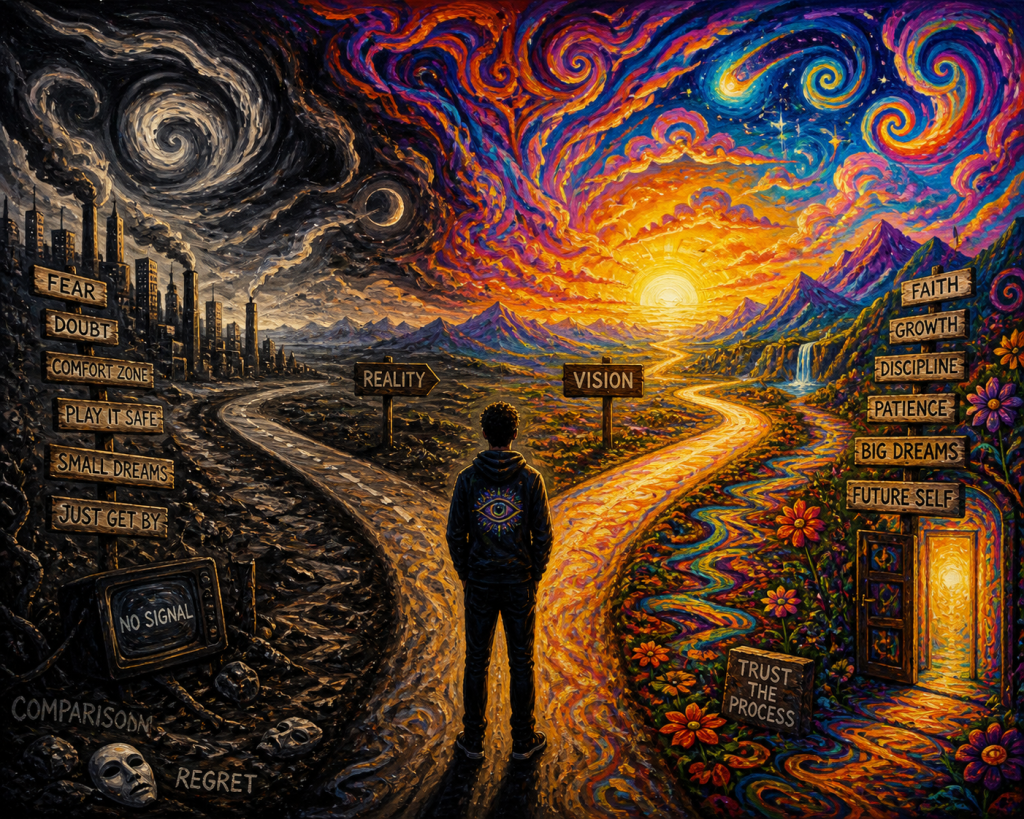
There’s a quiet pattern most people don’t notice until it’s already shaped their life.
You start with a big idea of what you want—freedom, success, stability, impact, love that actually feels right. Your vision is clear at first. Sharp. Almost impossible to ignore.
Then time passes.
Things don’t move fast enough. Results don’t show up when you expected them to. People don’t validate the direction you’re taking. And slowly, without even realizing it, you begin to shrink the dream to fit what feels “realistic.”
Not because you stopped wanting more.
But because believing in more started to feel uncomfortable.
That’s where most people get stuck—not in failure, but in compromise.
Why We Start Shrinking Our Dreams
Downgrading your dreams rarely happens in one decision. It happens in small adjustments.
You say things like:
- “Maybe I’m aiming too high.”
- “I should be more practical.”
- “At least I have something stable.”
And on the surface, that sounds responsible. Mature, even.
But underneath it is usually something quieter: fear.
Fear of disappointment. Fear of looking foolish. Fear of putting everything into something that might not work out.
So instead of holding your vision steady, you begin reshaping it to match your current reality.
Not because your vision was wrong—but because your patience is being tested.
The problem is, when you lower your dreams to match your present circumstances, you don’t feel relief. You feel contraction. Like your life is getting smaller instead of expanding.
The Cost of Playing Small
There’s a difference between being grounded and being limited.
Grounded means you understand where you are while still moving toward where you want to be.
Limited means you start convincing yourself that where you are is where you’re supposed to stay.
And once that mindset sets in, something subtle happens: your decisions begin to reflect it.
You stop taking risks that could actually move you forward.
You stop investing energy into long-term goals.
You stop expecting more from life—and from yourself.
The danger isn’t just that your dream gets delayed.
It’s that you slowly become someone who no longer believes they’re allowed to have it.
Upgrading Your Faith Instead of Downgrading Your Vision
Faith, in this context, isn’t about blind optimism or pretending everything is fine.
It’s about maintaining belief before evidence shows up.
It’s the ability to hold a vision steady even when your current reality hasn’t caught up yet.
When people say “upgrade your faith,” what they’re really pointing to is this:
Stop letting your current situation be the authority on what your future can become.
Because your present is not a verdict. It’s just a snapshot.
And snapshots change.
Upgrading your faith means you start acting like the version of you who already has what you want—even if you can’t fully see the path yet.
Not in a delusional way. In a disciplined way.
You don’t wait for certainty. You build consistency.
How People Actually Bridge the Gap
The gap between where you are and where you want to be isn’t closed by wishing harder.
It’s closed by alignment.
That means your daily behavior starts to match your long-term vision.
Not perfectly. But intentionally.
If your vision requires growth, you stop feeding habits that keep you stagnant.
If your vision requires stability, you stop making decisions rooted in chaos.
If your vision requires confidence, you stop abandoning yourself every time things get uncomfortable.
Faith without action becomes fantasy.
Action without faith becomes burnout.
You need both.
The Pressure to “Be Realistic”
One of the biggest reasons people downgrade their dreams is because they confuse realism with limitation.
They think being realistic means accepting what is.
But real realism includes understanding that everything you see now was once someone else’s unrealistic idea.
Every life you admire was once “too much” for someone’s current situation.
The only difference is someone refused to reduce their vision just because it wasn’t immediately supported by evidence.
They stayed with it long enough for the evidence to catch up.
Discipline Is What Faith Looks Like in Motion
Faith isn’t passive.
It doesn’t just sit and wait.
It shows up when it’s inconvenient. When progress is slow. When doubt is loud.
That’s where discipline comes in.
Discipline is what keeps you aligned with your vision when motivation disappears.
It’s what you do when no one is watching.
It’s what you repeat when nothing feels like it’s changing.
It’s what protects your dream from your emotions.
Because emotions will always fluctuate.
But direction doesn’t have to.
Stop Negotiating With Your Potential
At some point, you have to stop negotiating with what you know you’re capable of.
That negotiation sounds like:
- “Maybe I’ll try later.”
- “Maybe I’m not ready yet.”
- “Maybe this is asking for too much.”
But behind all of those is the same idea: shrinking yourself to feel safe.
And safety is comfortable—but it’s not always aligned with growth.
Upgrading your faith means you stop treating your potential like something you need permission for.
You don’t wait for perfect conditions. You build within imperfect ones.
Final Thought: Don’t Reduce What You Were Meant to Expand Into
Your dream doesn’t need to be downgraded to fit your current reality.
Your reality needs time, consistency, and belief to rise toward your dream.
That gap you feel right now? It’s not a sign you should quit.
It’s a sign you’re still in the process.
And the process only works if you don’t abandon the vision halfway through it.
So instead of asking, “Should I lower my expectations?”
Ask a better question:
“What would change if I fully believed this was still possible for me?”
Because sometimes the difference between staying stuck and moving forward…
isn’t ability.
It’s faith you’re willing to act on.