There’s a strange kind of tired that doesn’t go away with sleep.
You rest. You take breaks. You do what you’re “supposed” to do to recover. And yet, nothing really changes. The days still feel flat. Time still feels blurred. Everything works on paper, but something inside feels slightly disconnected from it all.
The common assumption is burnout. But that label doesn’t always fit.
Sometimes you’re not burnt out at all. Sometimes your life has just become too repetitive to feel alive.
Burnout and Repetition Are Not the Same Thing
Burnout usually comes from overload. Too much pressure, too many demands, too little recovery. It feels heavy. Exhausting. Like you’re running on empty because you’ve been pushed past your limits for too long.
Repetition fatigue is different.
It doesn’t feel like collapse—it feels like dullness.
You’re not necessarily overwhelmed. You’re under-stimulated in a very specific way. The structure of your days is so predictable, so familiar, that your brain stops registering anything as meaningful.
Nothing is “wrong,” but nothing is registering as new either.
And the brain has a problem with that.
The Brain Doesn’t Like Repetition Without Variation
Human attention is built to notice change.
New environments. New problems. New inputs. New challenges.
When those things are missing, the mind doesn’t exactly shut down—it just lowers engagement. You can still function, still perform, still move through your responsibilities. But internally, everything starts to feel like it’s happening on autopilot.
That’s when people start describing life as:
- “Same thing every day”
- “I don’t feel anything anymore”
- “Time is moving weirdly fast”
- “I’m tired but I didn’t really do much”
It’s not always exhaustion. It’s lack of contrast.
Without contrast, experience loses shape.
How Routine Becomes a Trap Without You Noticing
Routine isn’t the problem. In fact, it’s necessary. It gives structure, stability, and predictability.
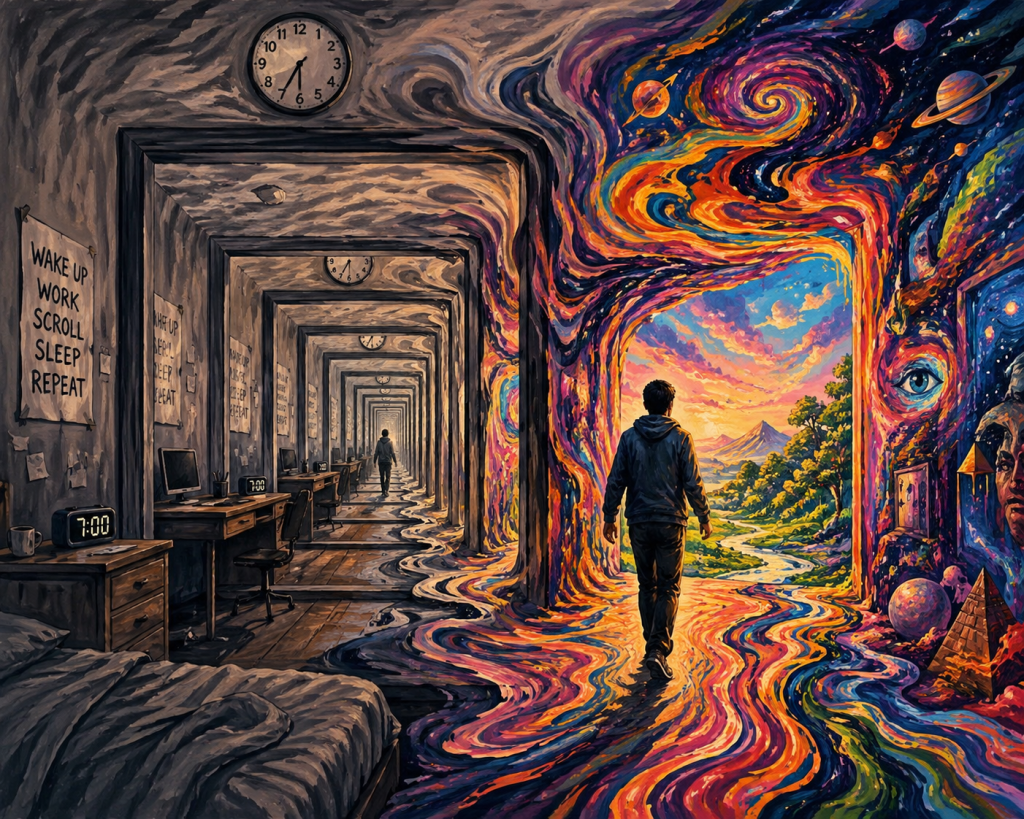
But when routine becomes too rigid, something subtle happens: your days stop having distinguishable edges.
One day blends into the next. Then a week. Then a month.
Not because life is terrible—but because nothing interrupts the pattern.
And the mind starts to interpret that lack of variation as stagnation.
This is where people often misdiagnose themselves. They assume they need more rest, more time off, more recovery. But even after that, the feeling doesn’t shift—because the issue wasn’t depletion.
It was repetition without novelty.
Signs You’re in Repetition Fatigue
It doesn’t always show up loudly. It’s usually subtle.
You might notice things like:
- Your days feel identical, even when small details change
- You’re not excited or interested in things you normally would be
- Rest doesn’t feel refreshing, just like pausing the same loop
- You’re mentally present, but emotionally flat
- Time feels like it’s moving faster than it should
None of these are dramatic on their own. But together, they point to something important: your environment has stopped giving your brain new information to engage with.
And without new input, the mind starts coasting.
Comfort Can Quietly Turn Into Stagnation
Comfort is often treated like the goal. And in many ways, it is. Stability matters. Predictability matters. A life that isn’t constantly chaotic is a good thing.
But there’s a point where comfort stops being nourishing and starts becoming numbing.
Not because anything is wrong—but because nothing is different.
The same routes. The same conversations. The same screens. The same thoughts. The same rhythm.
It’s not that your life is bad.
It’s that your experience of it has become too uniform.
And uniformity, over time, flattens perception.
How to Break Out of Repetition Without Overhauling Your Life
The solution isn’t to destroy your routine or start over. It’s much smaller than that.
What you need is variation—not chaos.
A few ways this can look:
- Change your physical environment, even slightly (different coffee shop, different walking route, different room setup)
- Introduce small challenges that aren’t required, just new (learning something random, trying unfamiliar tasks, breaking patterns intentionally)
- Add controlled discomfort (doing things without optimizing comfort every time)
- Interrupt autopilot behaviors (like using the same apps at the same times, or following identical daily sequences)
The goal isn’t to make life harder.
It’s to make it less identical.
Because the mind doesn’t need intensity—it needs contrast.
Why Novelty Brings Energy Back
When something is new, your brain pays attention automatically.
You don’t have to force focus. You don’t have to manufacture interest. It’s just there.
That’s why even small changes can feel surprisingly refreshing. Not because they’re huge, but because they break the pattern.
Novelty doesn’t just “entertain” the mind—it reactivates it.
It reminds you that you’re not just repeating a loop, but actually experiencing something.
And that distinction matters more than people realize.
Final Thought
Not every low-energy phase is burnout.
Sometimes you’re not drained—you’re just under-stimulated by sameness.
And the fix isn’t always rest. Sometimes it’s variation. Sometimes it’s disruption. Sometimes it’s simply doing something slightly different enough to remind your mind that time is still moving forward, not in circles.
You don’t necessarily need a new life.
You might just need a different pattern inside the one you already have.
 TheSpiritualExplorer