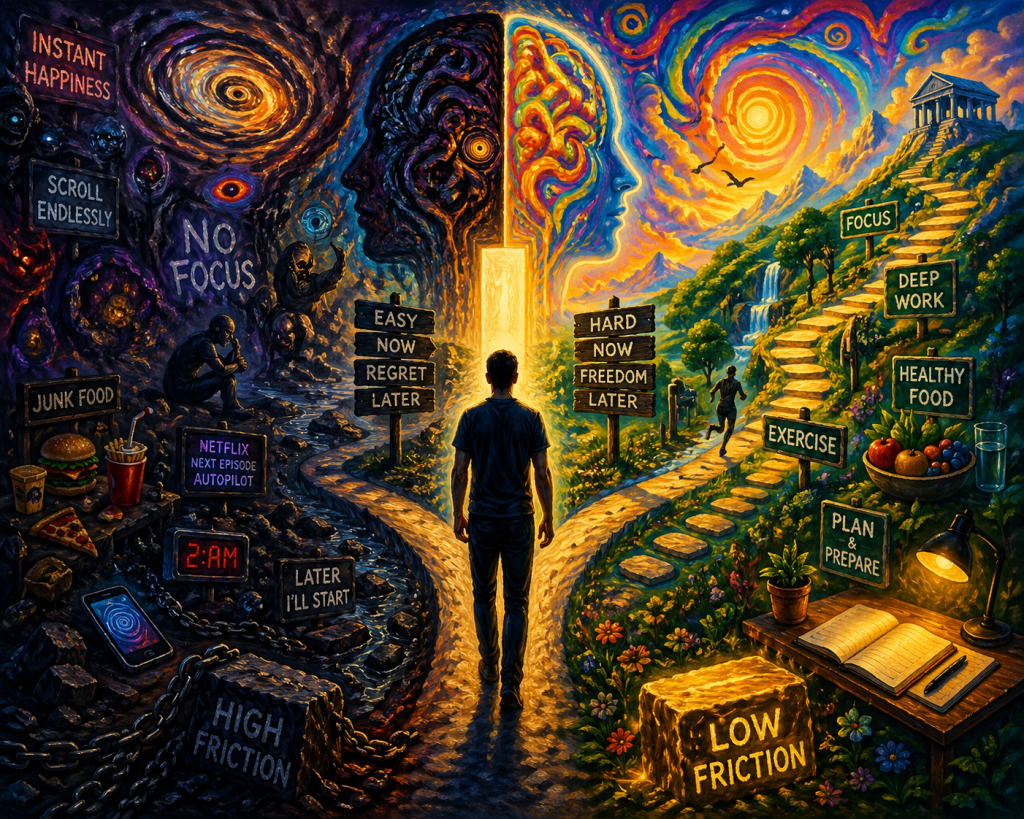
If discipline were the real problem, most people would have solved their lives by now.
Think about it. You already know what you should be doing—wake up earlier, eat better, work out, focus more. The information isn’t missing. The motivation shows up in bursts. And yet, consistency still slips through your fingers.
So what’s actually going on?
The issue isn’t that you’re weak. It’s that your environment is quietly working against you.
The Discipline Myth
We’ve been taught to treat discipline like a personality trait—something you either have or you don’t. So when things fall apart, the default conclusion is simple: I need to try harder.
That sounds reasonable, but it ignores something fundamental.
Discipline is unreliable.
It fluctuates with your mood, your energy, your stress levels, even your sleep. Some days you feel unstoppable. Other days, even the smallest task feels like friction against your entire being. If your system depends on you always being “on,” it’s eventually going to fail.
Not because you’re incapable—but because you’re human.
What Friction Really Means
Friction is the hidden force behind your behavior. It’s the difference between something being easy versus slightly annoying.
And that small difference? It’s everything.
If a habit is easy, you’ll do it without thinking.
If a habit is inconvenient, you’ll avoid it—even if you want the outcome.
This is why people scroll for hours but struggle to read a book. One is frictionless. The other requires effort to start.
Your life isn’t just shaped by your decisions. It’s shaped by how easy those decisions are to execute in the moment.
The Invisible Influence of Your Environment
Look at your daily habits and you’ll start to notice a pattern.
If your phone is next to your bed, you’ll check it first thing in the morning.
If junk food is sitting out, you’ll eat it without thinking.
If your workout gear is buried in a drawer, you’ll “get to it later.”
None of these are deep moral failures. They’re design issues.
Your environment is constantly nudging you—either toward what you want, or away from it.
The problem is, most people never design it intentionally.
Why Trying Harder Doesn’t Work
When something isn’t working, the instinct is to apply more effort.
Wake up earlier. Push harder. Be stricter. Hold yourself accountable.
But if the system around you hasn’t changed, you’re fighting an uphill battle every single time.
That’s exhausting.
And eventually, exhaustion wins.
The people who look “disciplined” aren’t necessarily stronger than you. They’ve just reduced the number of decisions they have to fight through. Their environment does more of the work for them.
Make Good Habits Easier
If you want consistency, stop relying on motivation and start removing friction.
Make the action so easy that it almost feels automatic.
- Put your workout clothes out the night before
- Keep healthy food visible and accessible
- Set up your workspace so you can start immediately
- Break tasks into smaller, low-resistance steps
The goal isn’t to feel motivated. It’s to lower the barrier to starting.
Because once you start, momentum usually takes over.
Make Bad Habits Harder
This is the part most people ignore.
You don’t just need to make good habits easier—you need to make bad habits more annoying.
Add friction where it matters.
- Move distracting apps off your home screen
- Log out of accounts that pull your attention
- Keep temptations out of immediate reach
- Create small delays between impulse and action
You’re not trying to eliminate the habit overnight. You’re making it inconvenient enough that you pause—and that pause is where better decisions happen.
Design Over Willpower
The biggest shift is this:
Stop asking, “How can I be more disciplined?”
Start asking, “How can I make this easier to do?”
That one question changes everything.
Because when your environment is aligned with your goals, you don’t need to fight yourself all day. The right choices start to feel natural instead of forced.
Final Thought
You don’t need to become a different person to get better results.
You just need to change the conditions around your behavior.
Success isn’t always about becoming stronger.
Sometimes, it’s about making failure inconvenient—and progress effortless.