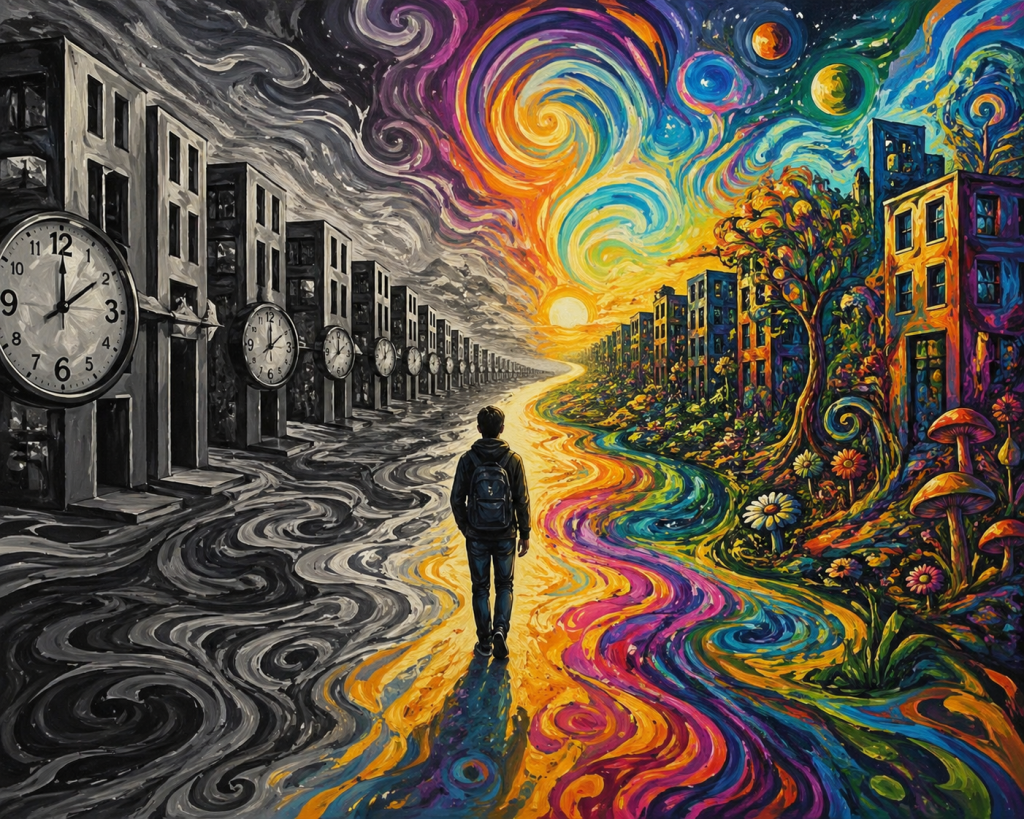
There’s a strange moment that sneaks up on you.
You look back at your week… and nothing stands out.
Monday feels like Tuesday. Tuesday blends into Thursday. The weekend shows up, disappears, and somehow you’re right back where you started—same routine, same thoughts, same version of the day on repeat.
It’s not that anything is wrong. It’s just that nothing feels different.
And that’s the problem.
The Loop You Didn’t Notice You Entered
Most people don’t consciously choose a repetitive life—it builds quietly.
You wake up at the same time, check the same apps, move through the same environment, talk about the same things, and wind down the same way. Even your thoughts start to follow familiar patterns.
Your brain, efficient as it is, begins to automate everything.
That’s when life starts to feel like it’s on autopilot.
Not because you’re lazy or stuck—but because your mind has stopped registering your days as something worth remembering.
Why Your Brain Makes Time Disappear
Here’s the part most people don’t realize: your brain compresses repeated experiences.
When you do the same things over and over, your mind stops paying close attention. It doesn’t need to. It already “knows” what’s coming next.
So instead of fully processing your day, it skims through it.
That’s why new experiences—traveling somewhere new, trying something unfamiliar, even small changes—feel longer and more vivid. Your brain has to slow down and take it all in.
But repetition?
Repetition gets fast-forwarded.
And before you know it, weeks feel like days.
Signs You’re Stuck in the Loop
You don’t need a dramatic life crisis to know something’s off. The signs are subtle:
- You struggle to remember what you did a few days ago
- Nothing recently feels memorable or exciting
- Your routine feels automatic, almost mechanical
- You feel a low-level boredom you can’t quite explain
It’s not burnout. It’s not even unhappiness.
It’s sameness.
Breaking the Pattern (Without Reinventing Your Life)
Most people think the solution is something extreme—move cities, quit your job, start over.
That’s not necessary.
The truth is, your brain doesn’t need a new life. It needs new input.
Small shifts can break the loop faster than big changes.
Take a different route somewhere you always go.
Spend time in a place you normally wouldn’t.
Do something slightly uncomfortable—start a conversation, try a new activity, change your environment.
Even something as simple as leaving your headphones behind on a walk can shift your awareness.
The goal isn’t chaos—it’s variation.
Why Small Changes Work Better Than Big Ones
Big life changes are rare. Small ones are daily.
And your brain responds more to frequency than intensity.
One new experience a day—even a small one—forces your mind to wake up, pay attention, and actually record what’s happening.
That’s how you stretch time.
That’s how you make life feel fuller again.
A Different Life Isn’t Far Away
It’s easy to think you’re stuck.
But most of the time, you’re not stuck—you’re just repeating.
And repetition, left unchecked, quietly erases the richness of your days.
The way out isn’t some distant, dramatic change.
It’s in the small decisions you make today.
A different choice. A different direction. A different experience.
Because a different life doesn’t come from doing more.
It comes from doing things differently.