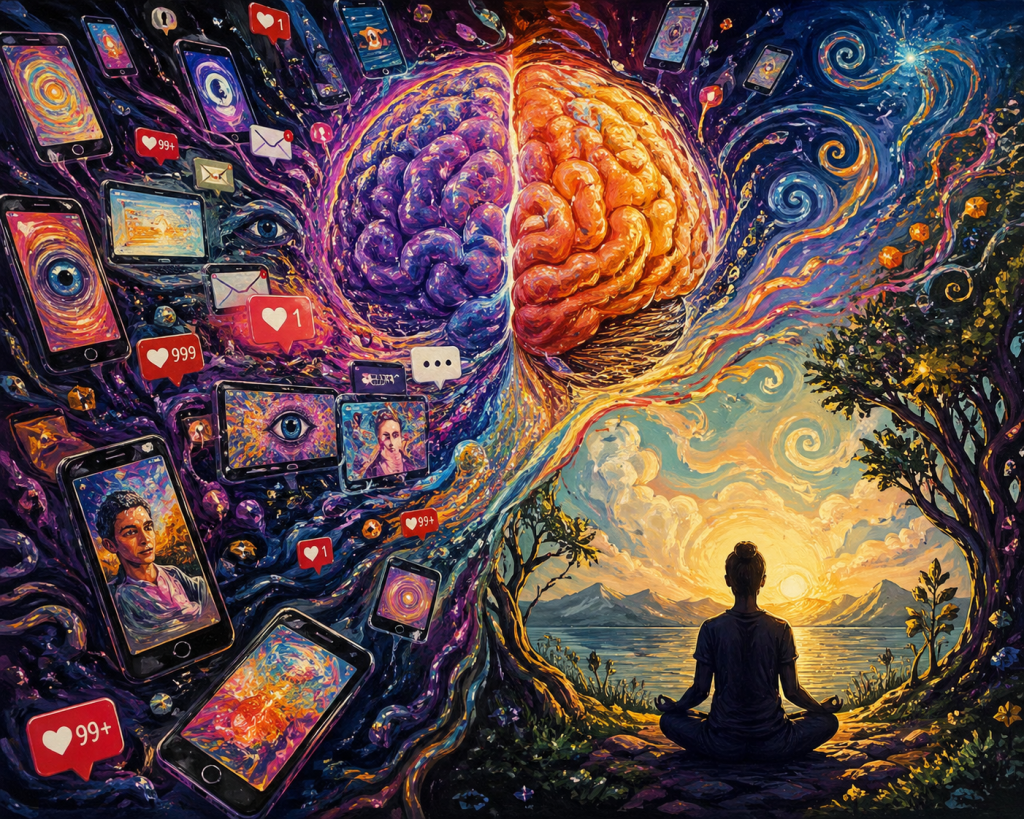
There’s a strange pattern a lot of people notice but don’t really talk about.
You sit down to do something simple—read, work, think, create—and within minutes your attention starts drifting. Not dramatically. Not in a way you immediately notice. Just a subtle pull away from whatever you’re doing.
You check your phone. You open a new tab. You switch tasks. You tell yourself you’ll get back to it in a second.
But that “second” turns into ten minutes. Then thirty. Then the day is somehow over and nothing really got your full attention.
It’s easy to label this as laziness or lack of discipline. But that explanation is outdated.
What’s actually happening is something deeper: your brain has been trained to crave novelty.
The Quiet Addiction You Didn’t Notice
Novelty isn’t bad. In fact, it’s one of the brain’s most useful survival tools. New information could once mean opportunity, danger, food, or threat. So the brain evolved to reward curiosity.
Every time something new appears—new message, new video, new thought—you get a small dopamine spike. Not enough to make you feel euphoric, but enough to make your attention shift.
The problem isn’t novelty itself.
The problem is constant novelty with no recovery period.
Short-form content, endless scrolling, rapid notifications, algorithmic feeds—these things don’t just entertain you. They condition your attention span to expect a new stimulus every few seconds.
So when real life asks you to sit still and focus on one thing for longer than a minute or two, your brain quietly resists.
Not because you’re broken.
But because it’s been trained otherwise.
Why Focus Feels Harder Than It Used To
There’s a reason deep work now feels unusually uncomfortable for many people.
It’s not that your ability to focus disappeared—it’s that it’s being constantly interrupted by micro-rewards.
Think about it:
- A quick scroll gives instant stimulation
- A notification gives instant meaning
- A new tab gives instant curiosity
- A new video gives instant novelty
Compared to that, reading a long article, writing, studying, or thinking deeply feels slow at first. Almost “empty.”
And the brain doesn’t like empty.
So it reaches for something else.
Over time, this creates a subtle shift: your attention stops being something you direct—and starts being something that gets pulled.
The Hidden Cost Isn’t Just Distraction
Most people think the issue is just productivity. Getting more done. Staying on task.
But the real cost goes deeper than that.
When your attention is constantly fragmented:
- Thoughts don’t fully develop
- Ideas don’t stay long enough to become meaningful
- Creativity becomes reactive instead of intentional
- Even enjoyment gets thinner, shorter, more scattered
You don’t just lose focus.
You lose depth.
And without depth, everything starts to feel slightly less satisfying—even things you used to enjoy.
That’s the strange part. Life doesn’t get worse in a dramatic way. It just becomes harder to feel fully present in anything.
The Relearning Process: Boredom Isn’t the Enemy
One of the most uncomfortable truths in all of this is that boredom is not a problem to solve—it’s a skill to rebuild.
Because boredom is where focus starts.
When you remove constant stimulation, your brain initially protests. It looks for escape routes. It wants something easier, faster, more engaging.
But if you don’t immediately give in, something interesting happens.
After a while, your attention starts to settle.
Thoughts get longer. Ideas get clearer. You stop jumping from thing to thing and start actually staying with one thread of thinking.
This is what modern attention has forgotten: the ability to stay.
A Simple Reset (No Extremes Required)
You don’t need to delete every app or retreat into the woods. This isn’t about punishment or restriction.
It’s about reintroducing space.
A few small shifts can help:
1. Start your day with low stimulation
No phone for the first 20–30 minutes. Let your brain wake up without input.
2. Do one thing without switching
Even if it’s just 10–15 minutes. No tabs, no multitasking.
3. Allow boredom without immediately filling it
Let yourself sit in the “urge to check something” without acting on it right away.
4. Reduce micro-interruptions
Turn off non-essential notifications. Not forever—just enough to notice the difference.
These aren’t productivity hacks. They’re attention repairs.
The Real Shift
The goal isn’t to become perfectly focused all the time. That’s unrealistic.
The goal is to regain choice.
Right now, most people don’t decide where their attention goes moment to moment. It gets pulled, redirected, hijacked by whatever is most stimulating.
But when you rebuild tolerance for stillness—even in small amounts—you start getting that choice back.
And once you have that back, something changes:
You can actually stay with a thought long enough for it to turn into something real.
You can actually enjoy something without immediately needing the next thing.
You can actually think deeply again.
Because the truth is simple:
Your brain didn’t lose focus.
It learned a different one.
And anything learned can be unlearned.