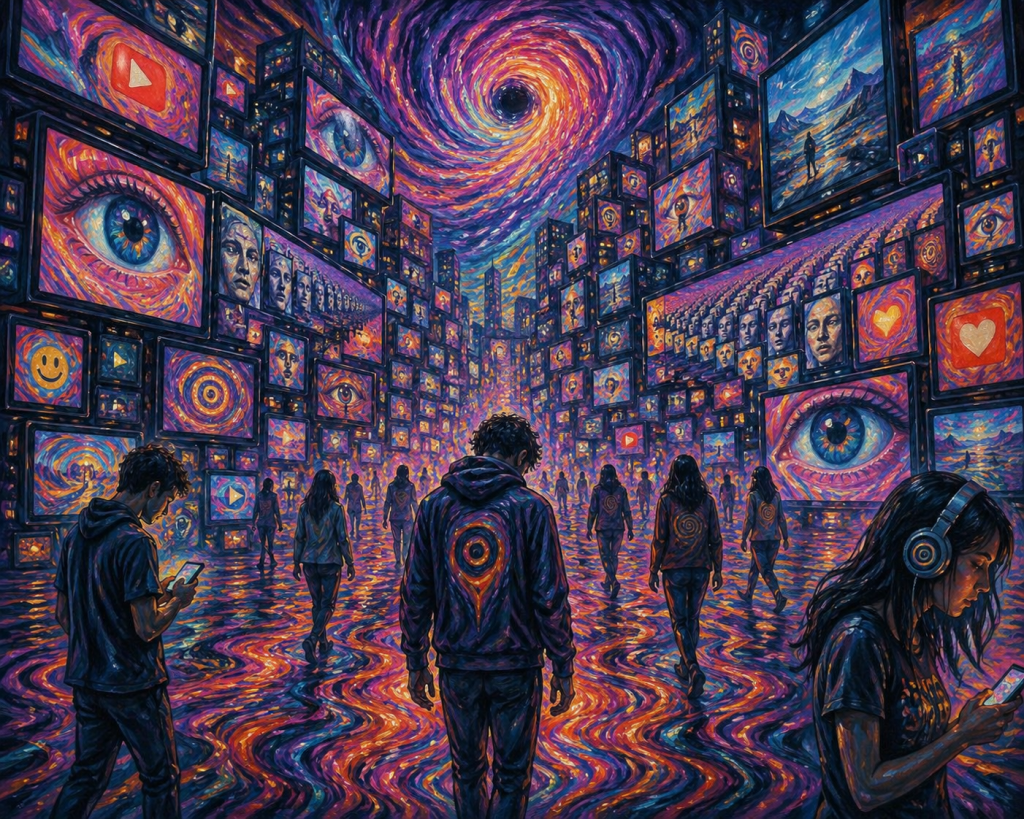
There’s a strange feeling a lot of people can’t quite explain. You open your phone, scroll for a bit, switch apps, maybe watch a video or two—and then it hits you. You’ve seen all of this before. Not exactly the same content, but the same feeling. The same jokes. The same aesthetics. The same ideas recycled in slightly different packaging.
It starts to feel like nothing is new anymore.
But that’s not because creativity disappeared. It’s because the environment we consume everything in has quietly changed how novelty works.
The illusion of endless variety
On the surface, we’ve never had more “variety” in human history. Millions of videos, songs, posts, and ideas are uploaded every day. You can jump from cooking tutorials to philosophical monologues to comedy skits in seconds.
But here’s the twist: most of it is filtered through the same systems.
Algorithms don’t care about originality—they care about retention. And what retains attention is usually what already worked before. So content gets shaped, intentionally or not, into repeatable patterns.
A trend appears, spreads fast, gets copied, slightly remixed, then diluted. By the time you see it, you’re not seeing the original spark—you’re seeing version 500 of it.
So even though the internet is massive, your experience of it becomes strangely narrow.
Why your brain starts recognizing everything
The human brain is built to detect patterns. It’s actually one of our greatest strengths. It helps us learn quickly and survive in complex environments.
But when everything starts following predictable templates—video pacing, humor styles, aesthetics, even emotional beats—your brain stops treating things as “new.”
Instead, it starts categorizing everything as:
- Seen this before
- Slight variation of something else
- Familiar structure, different face
That recognition creates a subtle kind of fatigue. Not boredom exactly—more like dull familiarity. The world doesn’t feel empty, it just feels repetitive.
The collapse of surprise
A big part of why things feel “the same” is because surprise used to be slower.
In the past, trends took time to spread. You could live in a local or niche culture without immediately being exposed to everything else. Discovery felt layered—you’d stumble into things gradually.
Now, anything interesting gets amplified instantly. And once it spreads, it gets replicated instantly too.
That speed removes the gap where uniqueness used to breathe.
By the time something reaches you, it’s already been adapted, optimized, and re-shared enough times that its original edge is gone.
So even “new” things feel pre-digested.
Creativity isn’t gone—it’s compressed
It’s easy to assume this sameness means creativity is dying. But that’s not really accurate.
Creativity is still everywhere. The issue is compression.
Ideas that used to stay distinct now get funneled into shared formats:
- Short-form video structures
- Viral audio trends
- Aesthetic templates
- Repeating storytelling arcs
So instead of thousands of separate creative ecosystems, you get one massive blended one.
It’s not that people stopped creating—it’s that everything is being shaped into the same container.
The quiet cost of constant exposure
There’s another layer people don’t talk about much: exposure overload.
When you see too much too quickly, your ability to feel novelty weakens. Even genuinely creative work can struggle to land because your baseline for “new” keeps getting reset.
That leads to a subtle mindset shift:
- “I’ve seen this before”
- “This reminds me of something else”
- “Nothing really stands out anymore”
Over time, that becomes your default lens.
And once that lens is in place, even good things can feel flat.
Breaking the sameness loop
The weird part is, the solution isn’t “find more content.” That only deepens the loop.
The shift happens when you change what you’re exposing yourself to—and how often.
Things that actually disrupt the sameness feeling:
- Consuming fewer but more intentional sources
- Exploring older media (where trends weren’t optimized for speed)
- Spending time without input at all (no scrolling, no background noise)
- Paying attention to slower experiences in general
It’s not about rejecting modern content. It’s about reintroducing contrast into your attention.
Because novelty doesn’t come from quantity. It comes from difference.
Final thought
The world hasn’t actually become the same. It’s just that our exposure to everything has become so fast, so filtered, and so repetitive in structure that it feels that way.
The challenge isn’t finding something new.
It’s giving your mind enough space to notice what’s already different.