Most people misunderstand peace.
They treat it like a destination—something you arrive at when life finally slows down, when problems stop showing up, when everything “falls into place.” A better job, more money, a stable relationship, fewer stressors. The assumption is simple: once life is calm, you will be calm.
But that version of peace is fragile. It depends on conditions you don’t fully control.
And conditions never stay still.
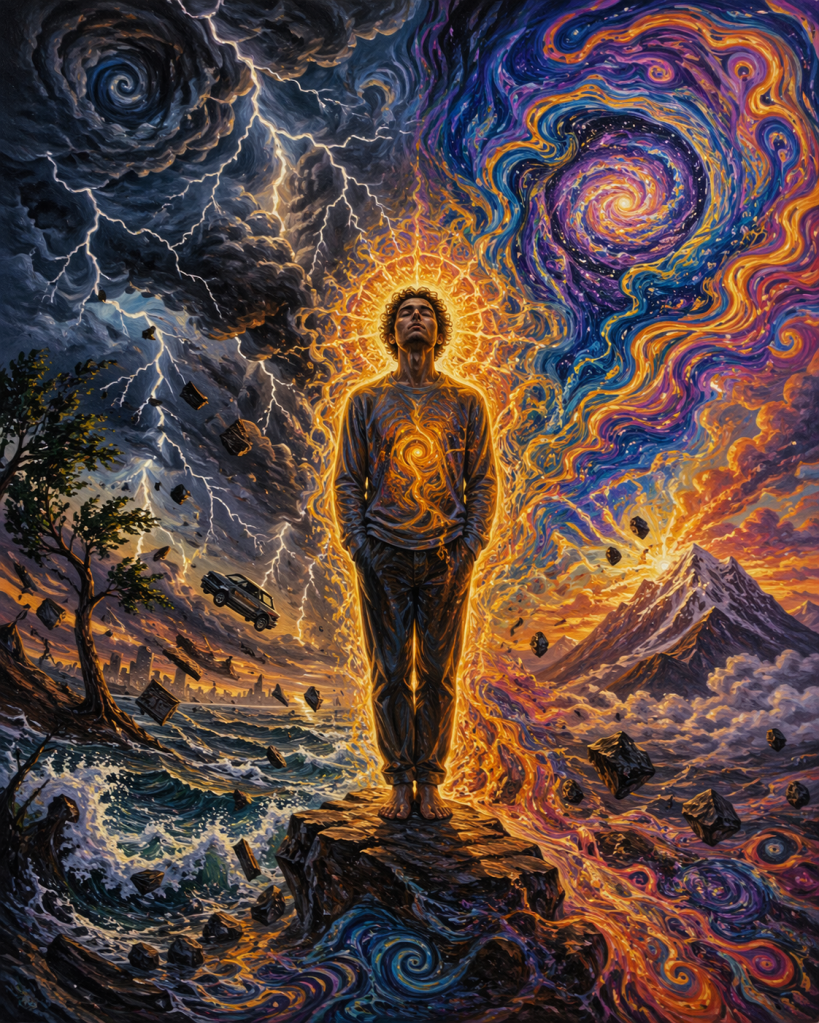
Real peace is not when life calms down. Real peace is when life cannot shake you anymore.
That distinction changes everything.
The Myth of External Peace
There’s a quiet trap most people fall into: waiting for the world to behave before they allow themselves to feel okay.
It shows up in small ways:
- “I’ll relax when work slows down.”
- “I’ll feel better when I fix my relationship.”
- “I’ll be at peace once I figure everything out.”
The problem is that life doesn’t cooperate with that timeline.
Work gets busy again. Relationships shift. Plans fall apart. New stress replaces old stress. Even when one problem disappears, another one quietly takes its place.
So if peace depends on external conditions, it’s always temporary.
You don’t actually get peace—you get brief pauses between disruptions.
That’s why so many people feel like they’re constantly chasing stability but never actually arriving there. They are trying to control a system that is designed to change.
What Real Peace Actually Looks Like
If external calm is unreliable, then peace has to be something else entirely.
Real peace is internal stability.
It’s the ability to remain steady even when things around you aren’t. Not because you don’t care, and not because life stops affecting you—but because you’re no longer mentally collapsing under every shift.
It looks like:
- Feeling stress without becoming consumed by it
- Facing uncertainty without spiraling into worst-case thinking
- Experiencing setbacks without losing your identity
- Letting emotions move through you instead of taking over you
This kind of peace doesn’t erase chaos. It changes your relationship to it.
Two people can go through the same situation and experience it completely differently. One is overwhelmed, reactive, and mentally scattered. The other is aware, grounded, and steady—even if uncomfortable.
The difference isn’t external circumstances.
It’s internal structure.
Why Most People Stay Shakable
If unshakable peace is possible, why don’t more people experience it?
Because most people are trained—without realizing it—to outsource their stability.
From early on, we learn to rely on external validation and conditions:
- Praise makes us feel good
- Rejection makes us question ourselves
- Success makes us feel worthy
- Failure makes us feel lost
Over time, your emotional state starts reacting to the world like a weather vane reacting to wind. Every external shift creates an internal one.
That’s what being “shakable” really is: a system where your mind is constantly responding instead of stabilizing.
And the more reactive you are, the more exhausting life becomes. Not because life is more difficult than it used to be, but because your internal system never settles.
You don’t get rest. You get reaction after reaction after reaction.
Becoming Unshakable: What Actually Changes
Becoming unshakable doesn’t mean becoming emotionless or indifferent. It means becoming less controlled by your immediate emotional reactions.
It starts with one shift: separating what happens from how you interpret it.
Most suffering doesn’t come directly from events. It comes from the meaning layered onto them:
- “This shouldn’t be happening.”
- “This always happens to me.”
- “I can’t handle this.”
- “This means everything is falling apart.”
The event is one thing. The interpretation is another.
Unshakable people don’t avoid difficulty—they stop turning difficulty into identity collapse.
They feel the emotion, but they don’t become it.
Training Stability Instead of Chasing Calm
Internal stability isn’t something you “figure out” once. It’s something you train.
And like any training, it starts small.
- Pause before reacting
Most instability comes from immediate emotional reaction. Learning to pause—even for a few seconds—creates space between event and response. - Notice the story you’re telling yourself
When something happens, your mind instantly builds a narrative around it. Start noticing that narrative instead of blindly following it. - Stop treating discomfort as danger
Discomfort is not the same as harm. Much of what destabilizes people is not the situation itself, but the resistance to how it feels. - Anchor yourself in the present moment
The mind constantly pulls you into the past or future. Peace only exists where you actually are, not where you are imagining yourself to be.
Over time, these small shifts change your baseline. You stop being pulled around as easily by every situation.
Not because life gets easier—but because your internal structure gets stronger.
The Real Definition of Strength
We tend to think of strength as control—controlling outcomes, controlling people, controlling circumstances.
But that kind of control is always limited. There’s too much happening outside your reach.
A deeper form of strength is stability without control.
It’s the ability to remain steady while life does what it does.
That doesn’t mean you stop caring. It means you stop collapsing.
You still feel things. You still move through challenges. You still respond to life. But you are no longer defined by every shift in it.
Final Thought
Life will always move. It will expand, contract, disrupt, and surprise you. That will never stop.
So the question was never “How do I make life calm?”
The real question is:
Can you stay calm inside a life that isn’t?
Because when nothing can shake you, everything changes—not outside of you, but within you.