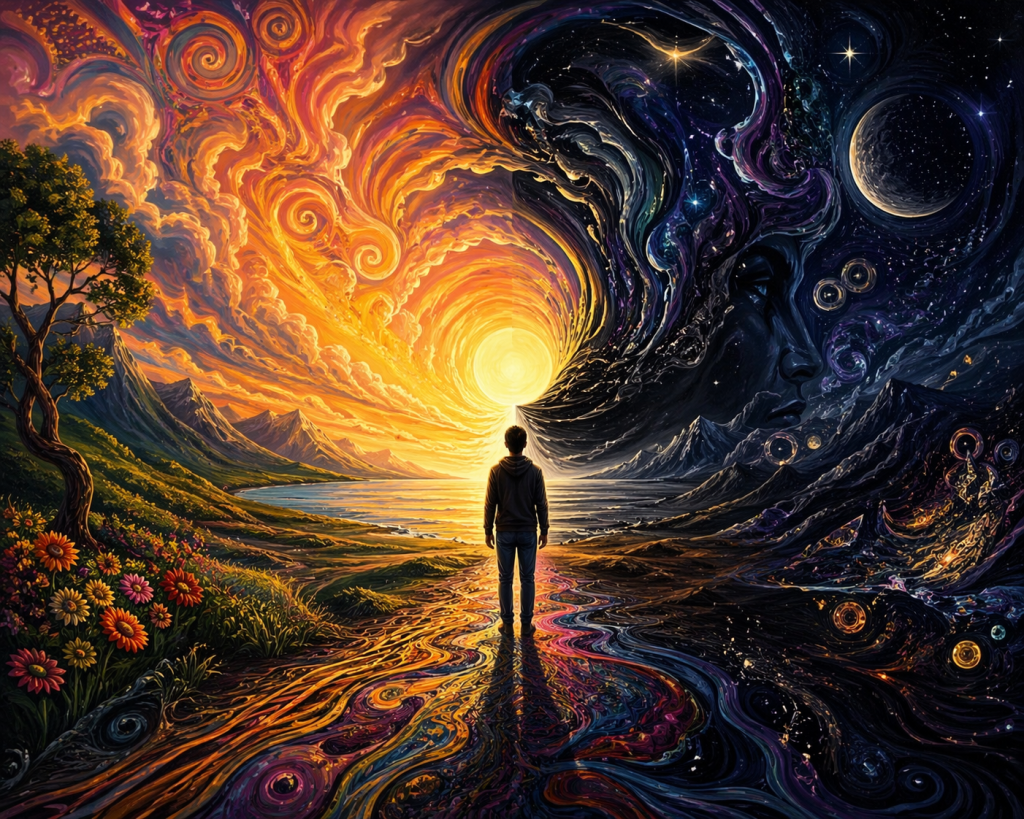
Life has a way of teaching us that nothing is one-sided for long. The moments we label as “good” and “bad” rarely stay in their separate corners. Over time, they start to blend, overlap, and reveal something deeper: growth doesn’t come from avoiding one side of life—it comes from learning how both light and dark shape who we become.
There’s a tendency to chase light. We associate it with peace, love, clarity, and ease. And naturally, we try to stay there as long as possible. But life doesn’t work like a permanent sunrise. Eventually, the shadows show up. Loss, uncertainty, rejection, and failure all arrive whether we invite them or not.
The question is not whether darkness will come—it’s what we do when it does.
The Lesson of Light
Light represents the parts of life we naturally gravitate toward. It’s connection, understanding, joy, and emotional warmth. In these moments, things feel aligned. We feel seen, supported, and open.
But light also has a subtle trap: comfort. When everything feels good, we can start avoiding anything that disrupts that feeling. We protect it. We try to preserve it. We build identities around it.
Yet even light has a deeper purpose than comfort. It teaches us how to love without fear, how to appreciate presence, and how to recognize meaning in small moments. It shows us what we’re capable of feeling when we’re open instead of guarded.
But if we only lived in light, we’d never develop depth.
The Lesson of Dark
Darkness is often misunderstood. It’s not just pain—it’s pressure, change, and the breaking of expectations. It’s the experience of losing something you thought would stay. It’s the silence after things don’t go the way you planned.
At first, darkness feels like interruption. Something went wrong. Something ended too soon. But over time, it reveals a different kind of education.
Darkness builds strength in ways comfort never can. It teaches patience when answers don’t come quickly. It forces reflection when distraction is no longer available. It strips away illusions we didn’t realize we were depending on.
Without dark moments, resilience never forms. You don’t learn how to stand unless something has already tried to knock you down.
Integration: Becoming Whole
The mistake many people make is trying to choose one side permanently. Stay in the light. Avoid the dark. Or, on the other end, become hardened by darkness and disconnect from softness.
But neither extreme leads to wholeness.
Growth happens in the integration—the ability to carry both experiences without being destroyed by either. Light without dark can make you fragile. Dark without light can make you closed off. Together, they create perspective.
You start to understand that joy means more because you’ve known absence. And struggle becomes more meaningful because you know it is not permanent.
Wholeness isn’t about having a perfect life—it’s about not rejecting parts of it.
Closing Reflection
Life will keep shifting between expansion and contraction, clarity and confusion, connection and solitude. The more you resist this rhythm, the more exhausting it becomes.
But when you stop trying to hold one state forever, something changes. You begin to move with life instead of against it.
And maybe that’s the real lesson hidden inside both light and dark:
You don’t need to escape either one.
You just need to learn from both.