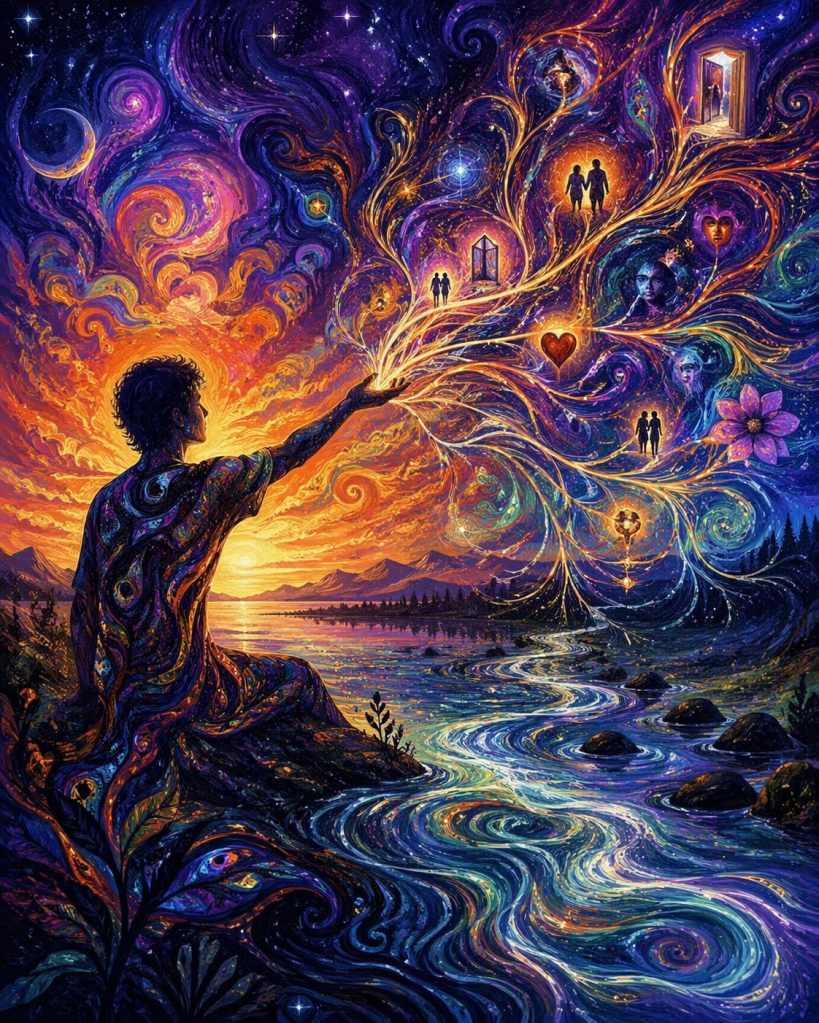
There’s a quiet truth life keeps circling back to, whether you’re ready for it or not: nothing really belongs to you. Not people. Not moments. Not success. Not even the version of yourself you think you are right now.
At first, that idea can feel cold. Almost unfair. But the deeper you sit with it, the more it starts to feel like relief instead of loss. Because a lot of suffering doesn’t come from life itself—it comes from trying to hold onto it like it’s supposed to stay still.
The Illusion of Ownership
From early on, we’re taught to attach meaning to possession. “Mine” becomes a way of grounding identity—my relationships, my goals, my future, my past, my story. It feels stabilizing. Like if we can just hold tightly enough, things will stay the same.
But life doesn’t work like that.
People change. Situations shift. Feelings evolve. Even the things we swear we would never lose eventually slip into memory or distance. And when we treat these things as permanent possessions, we set ourselves up for constant friction with reality.
Most emotional suffering doesn’t come from change itself—it comes from resistance to change.
The harder we try to lock life into place, the more unstable it feels.
When Life Starts Taking Things Away
There are moments where life doesn’t ask—it simply removes. A relationship ends. A door closes. A plan collapses. A version of the future you were attached to suddenly disappears.
And in those moments, the instinct is to fight it. To replay it. To ask why it happened and how to undo it.
But resistance has a cost.
Holding onto something that’s already gone doesn’t preserve it—it just prolongs the pain of losing it. It’s like trying to keep water in your hands by squeezing harder. The tighter the grip, the faster it runs through your fingers.
This is where a deeper pattern reveals itself: suffering often begins the moment we refuse to accept what is already true.
Not because acceptance means approval—but because acceptance means clarity. And clarity is what allows you to move again.
Learning to Flow Instead of Hold
Letting go doesn’t mean becoming indifferent. It doesn’t mean you stop caring or loving deeply. It means you stop trying to freeze life in place so it matches your expectations.
There’s a difference between loving something and clinging to it.
Clinging says: “I need this to stay the same for me to be okay.”
Love says: “I value this, even though I know it can’t stay the same forever.”
When you start living from that second place, something shifts. You stop treating life like a possession and start experiencing it like a flow. You stop trying to control every outcome and start responding to what’s actually here.
This is where peace begins—not in control, but in flexibility.
Because life is always moving. And anything that refuses to move with it eventually breaks under the pressure.
The Quiet Strength in Letting Go
Letting go is often misunderstood as weakness. But in reality, it takes more strength to release something than to hold onto it.
Holding on is instinct. Letting go is awareness.
It’s the moment you realize that your grip is costing you more than what you’re holding is giving you. It’s the decision to trust that your life doesn’t collapse just because something leaves it.
And strangely enough, once you stop forcing things to stay, life doesn’t feel emptier—it feels lighter. Space opens up. New experiences arrive without being chased. You begin to notice that what’s meant for you doesn’t require constant gripping to remain.
Nothing Was Ever Meant to Stay Frozen
A powerful shift happens when you stop expecting life to be permanent. You start to see that everything is in motion—relationships, emotions, identity, even your own desires.
Nothing is fixed.
And instead of that being unsettling, it becomes freeing.
Because if nothing is truly yours to hold forever, then nothing can truly be taken from you in the way you once feared. It all moves through you, not away from you.
Closing Reflection
Letting go isn’t about losing—it’s about stopping the fight with reality.
Life doesn’t ask you to hold everything. It asks you to experience it while it’s here, and release it when it changes.
The more you stop trying to own moments, the more fully you get to live them.
And in that space—where nothing is forced to stay—you begin to find something that doesn’t leave as easily: peace.