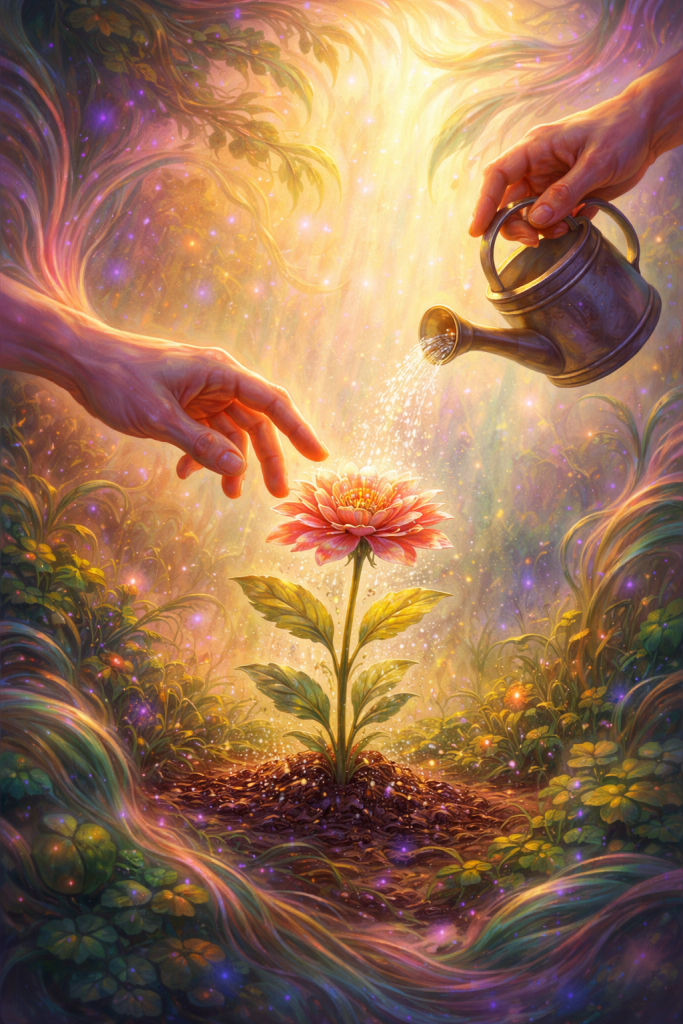
“If you like a flower, you pick it. If you love a flower, you water it.”
It’s a simple idea, but it cuts deeper the longer you sit with it. Most of us were never really taught the difference between liking, wanting, and truly loving. So we grow up thinking that intensity equals depth, that holding on tightly means we care more, and that needing someone constantly is a sign of something real.
But sometimes, what we call love is just attachment in disguise.
Attachment feels urgent. It wants reassurance, closeness, and certainty—right now. It craves responses, validation, and presence. It fears distance because distance feels like loss. When you’re attached, you’re not just enjoying someone—you’re depending on them to regulate how you feel. That’s why small things hit so hard. A late reply. A change in tone. A shift in energy. It all feels personal, like something is slipping away.
And in response, we reach. We grab. We try to secure what we’re afraid of losing.
That’s the moment we “pick the flower.”
It looks like love on the surface. It can even feel like love. But picking a flower is about possession. It’s about wanting something close enough that you don’t risk it disappearing. The problem is, the very act of grabbing it ensures it won’t last.
Real love moves differently.
Love doesn’t panic when things aren’t perfect. It doesn’t need constant proof to feel secure. It’s steady. It allows space without immediately assuming the worst. Loving someone isn’t about keeping them within arm’s reach at all times—it’s about wanting them to grow, even if that growth doesn’t always center you.
That’s what it means to “water the flower.”
You care for it. You show up consistently. You create an environment where it can thrive. But you don’t force it to stay. You don’t pull at it to make sure it’s still there. You trust the process of growth instead of trying to control the outcome.
For a lot of us, making that shift isn’t easy.
Attachment usually has roots. It comes from past experiences—times where love felt unstable, inconsistent, or conditional. Maybe you learned that attention could be taken away at any moment, so now you try to hold onto it tightly when you have it. Maybe you confuse emotional highs and lows with passion because calm feels unfamiliar.
So when something feels real, you cling to it—not because you want to control it, but because you’re afraid of losing it.
That’s human. But it’s also something you can outgrow.
The shift from attachment to love starts with awareness. You begin to notice when your reactions are coming from fear instead of care. You start asking yourself whether you’re trying to support something… or secure it. You learn to sit with uncertainty without immediately trying to fix it.
And slowly, you realize something important: real connection doesn’t need to be forced to stay.
When you stop grasping, you give things room to breathe. And what’s meant for you doesn’t disappear because you gave it space—it strengthens because you did.
Loving someone isn’t about how tightly you can hold on. It’s about how well you can show up without losing yourself in the process. It’s choosing patience over panic. Trust over control. Presence over possession.
Anyone can pick a flower and hold it for a moment.
But it takes growth to water it—and let it live.