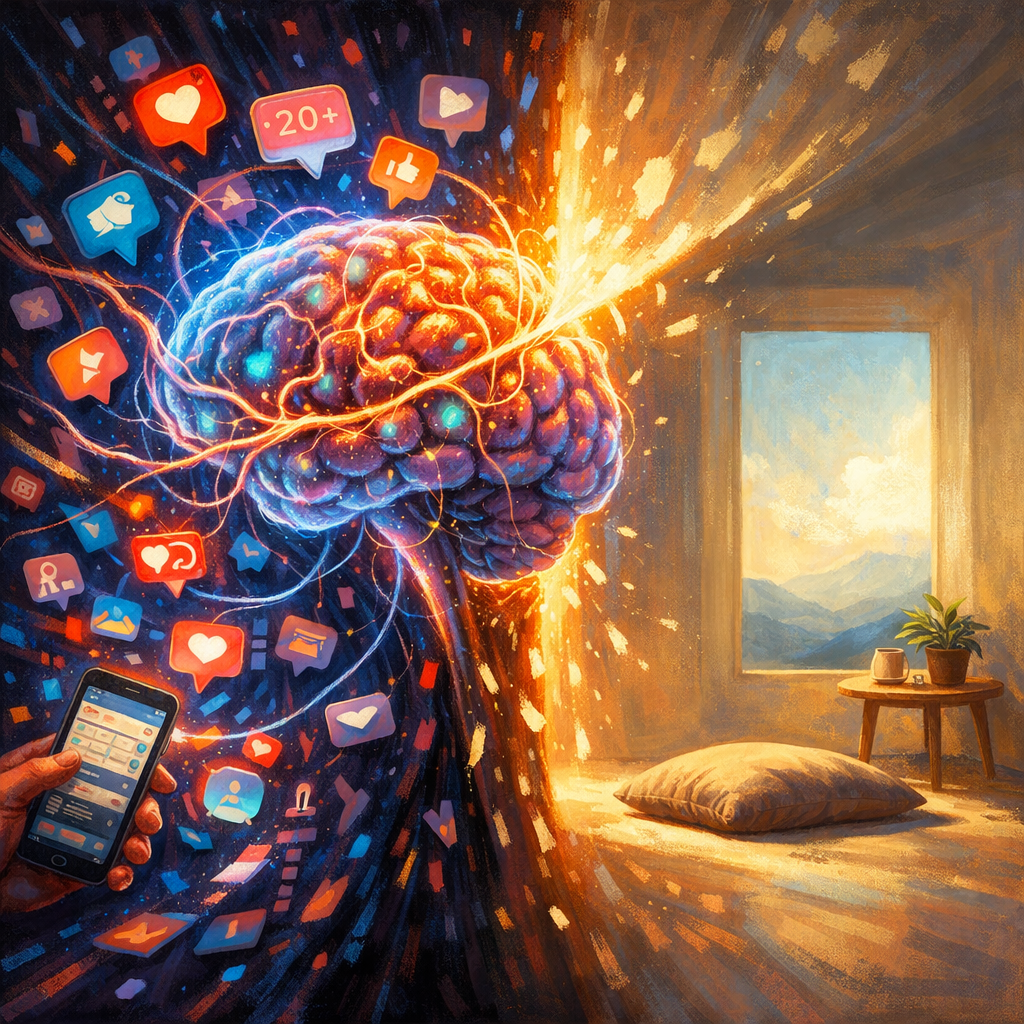
You open your phone to check one thing… and somehow you’re 20 minutes deep into scrolling. New video, new post, new notification—your brain just keeps saying “one more.” It feels harmless, even normal. But what if that constant craving for something new isn’t just a habit… it’s an addiction?
Not in the dramatic, life-falling-apart kind of way—but in a subtle, everyday way that’s quietly reshaping how you think, focus, and experience the world.
What Is Novelty Addiction?
Novelty addiction is your brain’s growing dependence on new stimuli—new content, new information, new experiences—at a rapid pace. It’s driven by dopamine, the chemical linked to motivation and reward.
Every time you see something new—especially something interesting or entertaining—your brain gives you a small dopamine hit. That’s not a bad thing. It’s actually how humans are wired to learn and explore.
The problem is volume and speed.
Instead of encountering novelty occasionally, you’re now exposed to it constantly. Endless scrolling, rapid-fire videos, infinite content. Your brain never fully processes one thing before jumping to the next.
Over time, “normal” starts to feel boring.
How It Shows Up in Your Daily Life
This isn’t just about social media. It leaks into everything:
- You skip songs halfway through
- You open multiple tabs and finish none
- You struggle to sit through a full movie
- You check your phone without thinking
- You feel restless doing “slow” tasks
Even moments that should feel engaging—reading, working, thinking—start to feel dull compared to the high-speed stimulation you’re used to.
It’s not that those things became boring.
It’s that your brain got used to something more intense.
The Dopamine Loop You’re Stuck In
Here’s how the cycle works:
- You seek something new (scroll, refresh, click)
- You get a quick dopamine reward
- It fades quickly
- You immediately look for the next hit
The faster you repeat this loop, the more your brain expects it. And when you’re not feeding it? You feel it—restlessness, boredom, even mild anxiety.
That’s the trap.
You’re not just consuming content anymore. You’re training your brain to need constant stimulation to feel okay.
Why This Is Dangerous Long-Term
The real cost isn’t obvious at first. It builds slowly.
- Your attention span shrinks
Deep focus becomes harder because your brain expects constant change. - Patience drops
Anything that doesn’t deliver instant reward feels frustrating. - You lose depth
You skim life instead of fully experiencing it—ideas, conversations, even your own thoughts.
And maybe the biggest one:
You lose control over your attention.
Instead of choosing what to focus on, your brain starts chasing whatever is fastest, newest, and easiest.
How to Take Back Control
You don’t need to quit your phone or disappear into the woods. But you do need to reset your brain’s relationship with stimulation.
Start small, but be intentional.
1. Practice “Boredom Training”
Let yourself be bored—on purpose. No phone, no music, no distractions. Even 5–10 minutes matters. It teaches your brain that it doesn’t always need input.
2. Slow Down Your Consumption
Finish things. Watch the full video. Listen to the whole song. Read without skipping. You’re rebuilding your ability to stay with something.
3. Create Friction
Make it slightly harder to access high-stimulation habits. Move apps off your home screen. Turn off non-essential notifications. Small barriers make a big difference.
4. Focus on One Thing at a Time
Multitasking feeds novelty addiction. Single-tasking fights it. Pick one thing and stick with it longer than feels comfortable.
A Simple Challenge
Try this:
Go one full hour with zero stimulation.
No phone. No music. No background noise. No quick hits of content.
Just exist, think, observe.
It might feel uncomfortable at first—that’s the point. You’re noticing the dependency.
Final Thought
Your brain isn’t broken. It’s just adapted to the environment you’ve given it.
But here’s the truth:
If you don’t control what you give your attention to, something else will.
Novelty will always be there—faster, louder, more addictive than ever.
The real skill now isn’t finding something new.
It’s learning how to stay.