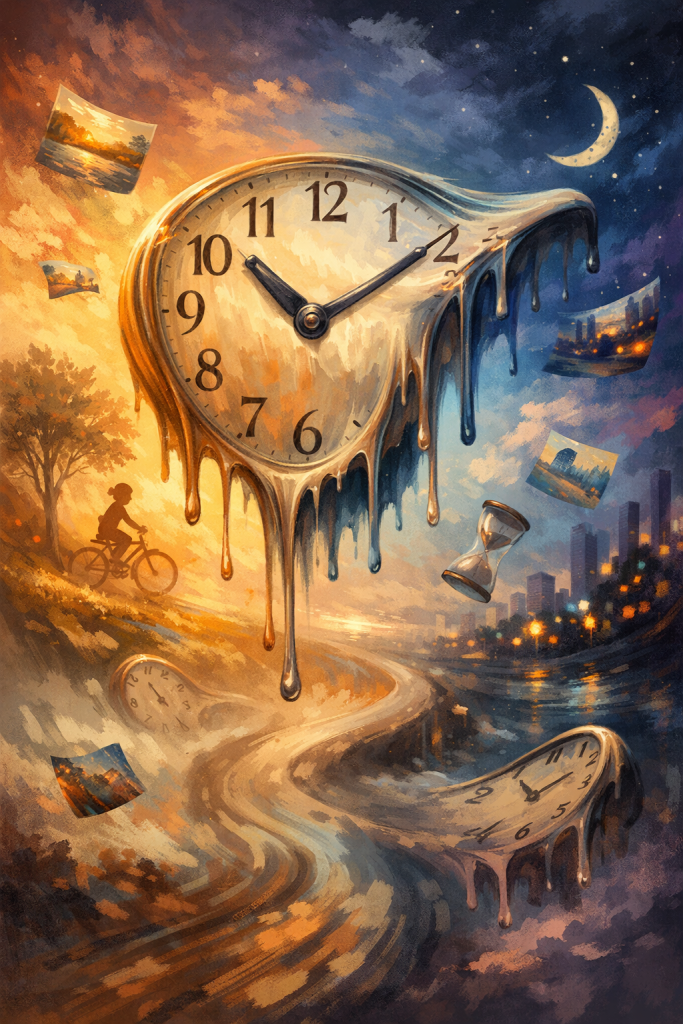
There’s a strange feeling most people notice at some point in life: time doesn’t feel the same anymore.
When you were younger, summers felt long. Days felt like they stretched on forever. You could live an entire “mini-life” during a single vacation. But now? Weeks blur together. Months pass in what feels like a blink. You look up and wonder where the time went.
The unsettling part is that nothing in the clock has changed—only your experience of it.
So what’s actually going on?
The illusion of “speeding time”
Time itself doesn’t speed up, but your perception of it does. Your brain doesn’t measure time like a clock—it measures it through memory, attention, and experience.
When life feels repetitive or routine, your brain compresses those memories. Instead of storing detailed snapshots, it files them away as “same as before.” The result is a kind of mental fast-forward effect when you look back.
So even though each day still has 24 hours, your brain records fewer distinct moments—making it feel like less actually happened.
Why childhood felt so slow
Think back to when you were a kid. Almost everything was new:
- First day at school
- New friendships
- New places
- New experiences constantly stacking on top of each other
Your brain pays special attention to novelty. When something is new, it creates a stronger memory imprint. That means more “mental footage” gets recorded.
More memory = more perceived time.
As you get older, fewer things feel brand new. You’ve already built patterns for most daily experiences, so your brain stops recording them in detail. That’s when time starts to feel like it accelerates.
Routine is the hidden accelerator
Routine is powerful—it makes life efficient, predictable, and easier to manage. But it also plays a role in this time illusion.
When your days look similar:
- Wake up
- Do familiar tasks
- See familiar places
- Repeat
Your brain stops marking each day as unique. Instead of storing “Monday, Tuesday, Wednesday…” it stores “this week happened.”
And that’s where the feeling of time loss comes from. Not from actual speed—but from compression.
Why your brain does this on purpose
This isn’t a flaw. It’s efficiency.
Your brain is constantly trying to save energy. It filters out repetitive information so it can focus on what it considers important or new. Without this feature, your mind would be overwhelmed by detail overload.
So in a way, the speeding-up of time is a side effect of a brain that’s trying to optimize your mental storage.
How to slow time down again
You can’t change time itself, but you can change how your brain records it. The key is increasing “memory density”—creating more distinct moments.
Here are a few ways:
1. Break your routine intentionally
Take a different route, try a new activity, or change your environment. Even small disruptions help your brain create new memory markers.
2. Add novelty into your week
It doesn’t have to be extreme. New food, new music, new places, or learning something unfamiliar all count.
3. Be more present in small moments
When you fully pay attention to something—sounds, visuals, sensations—it gets recorded more deeply in memory.
4. Avoid living on autopilot too often
The more unconscious your days become, the more they blur together later.
The bigger truth about time
Time isn’t actually speeding up. Your life isn’t disappearing faster than anyone else’s.
What changes is how much of it your brain decides to notice.
When life becomes predictable, time feels short. When life becomes rich with variation, time feels longer and fuller.
So the real question isn’t “why is time moving so fast?”
It’s:
How many moments am I actually letting myself experience?