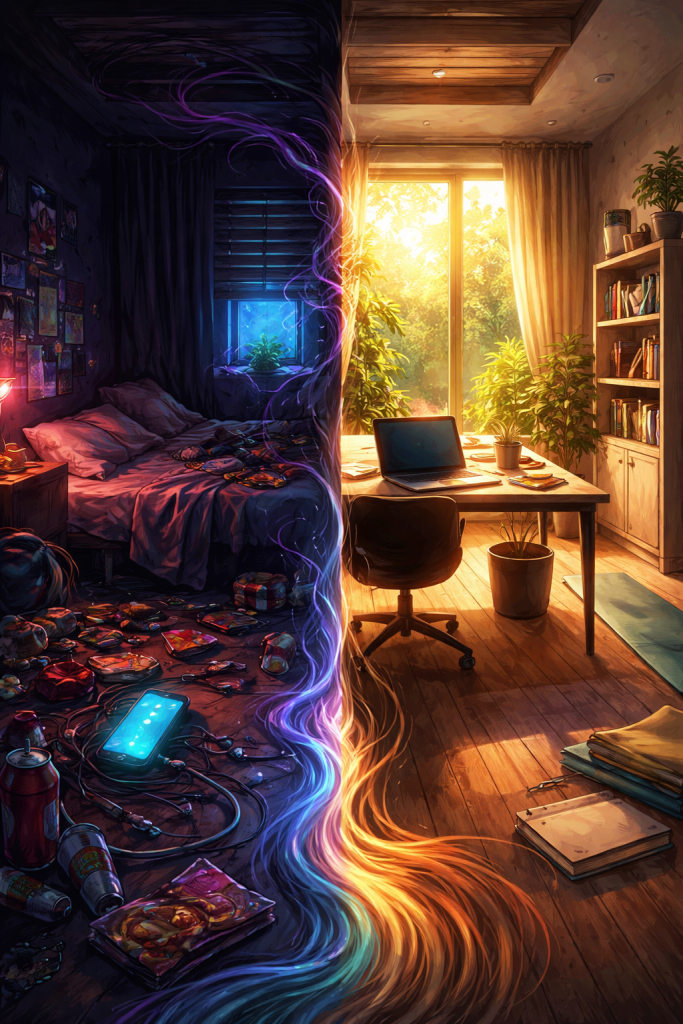
Take a look around you right now.
Your room, your desk, your phone, the people you talk to every day—none of it feels particularly powerful. It all just… exists. But what if I told you that these ordinary things are silently shaping your decisions, your habits, and ultimately, your entire life?
Most people think success or failure comes down to discipline. You either have it or you don’t. You either stay consistent or you fall off. But that’s only part of the truth. The reality is, your environment often matters more than your willpower—and it’s influencing you whether you realize it or not.
The Invisible Influence
Your brain is constantly looking for the easiest path.
If your phone is always within reach, you’ll check it without thinking. If junk food is sitting out, you’ll eat it. If your bed is right next to your workspace, you’ll feel tired even when you’re not. These aren’t personal failures—they’re environmental triggers.
Your surroundings create your “default settings.”
And most of us are living in environments that are designed—intentionally or not—to make us distracted, lazy, or stuck.
Small Details, Big Consequences
Think about how subtle changes affect behavior:
- A cluttered room can increase stress and reduce focus
- Notifications constantly pulling your attention break deep thinking
- The people you spend time with influence your standards and mindset
- Even lighting and noise levels can affect your energy and motivation
None of these things feel dramatic on their own. But stacked together, day after day, they quietly push you in a direction—either forward or backward.
That’s the danger: you don’t notice it happening.
The “Default Life” Trap
If your environment stays the same, your habits usually will too.
You wake up, check your phone, go through the same routine, talk to the same people, think the same thoughts—and then wonder why nothing changes. It’s not because you’re incapable of growth. It’s because your environment keeps resetting you back to your old patterns.
You don’t rise to your goals. You fall to your systems.
And your environment is the foundation of those systems.
Design Over Discipline
Here’s the shift most people never make:
Stop relying on motivation. Start designing your environment.
Instead of forcing yourself to be productive, make distraction harder:
- Put your phone in another room while you work
- Keep only what you need on your desk
- Use apps or settings that block time-wasting platforms
Instead of trying to “eat better,” make it automatic:
- Keep healthy food visible and easy to grab
- Hide or don’t buy junk food at all
Instead of chasing motivation, upgrade your surroundings:
- Spend more time with people who push you
- Change your workspace to feel intentional, not accidental
- Create spaces that match the person you’re trying to become
These changes sound simple—but that’s the point. Simple shifts, repeated daily, reshape your life without constant effort.
You Become What You’re Around
Your environment is either pulling you forward or holding you back. There’s no neutral.
Every space you spend time in is training you to think, act, and feel a certain way. The question is: is it training you into the life you actually want?
Because if you change your environment—even slightly—you change your defaults. And when your defaults change, your actions follow. Over time, those actions become your identity.
Final Thought
Discipline is powerful—but it’s unreliable.
Your environment, on the other hand, is constant. It’s always there, quietly influencing you in the background.
So if your life isn’t where you want it to be, don’t just look at your habits. Look at what’s shaping them.
You might not need more motivation.
You might just need a different room.