There’s a phrase people use a lot now: “I’m burnt out.”
And sometimes, that’s true. Real burnout is heavy. It comes from prolonged stress, emotional exhaustion, and pushing yourself past your limits for too long.
But what if that’s not what you’re feeling?
What if you’re not burnt out…
What if you’re just overwhelmed by too much input?
The Difference Nobody Talks About
Burnout and overstimulation can feel similar on the surface. Both leave you tired, unmotivated, and mentally foggy. But the causes—and the solutions—are completely different.
Burnout comes from doing too much.
Overstimulation comes from consuming too much.
One drains you because you’re constantly outputting energy.
The other drains you because your brain never gets a moment of silence.
And in today’s world, silence is rare.
The Real Problem: Constant Noise
Think about your average day.
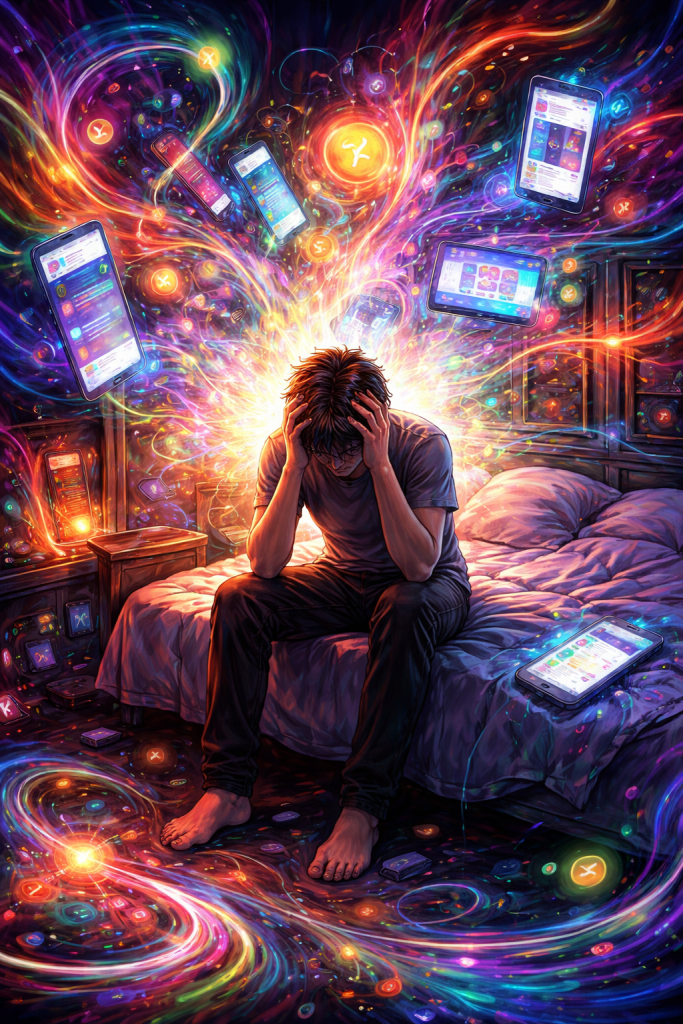
You wake up and check your phone. Notifications. Messages. Social media.
You scroll while eating. Watch videos while working. Jump between apps without even thinking about it.
There’s always something playing, something updating, something demanding your attention.
Your brain doesn’t get a break—it just switches lanes over and over again.
And the wild part?
You can feel exhausted without actually doing anything meaningful.
That’s overstimulation.
Signs You’re Overstimulated (Not Burnt Out)
If this sounds familiar, you might not be burnt out at all:
- You struggle to focus, even on simple tasks
- You feel tired but not in a “worked hard” kind of way
- You reach for your phone without thinking
- Rest doesn’t feel refreshing—it feels empty
- You get easily irritated or distracted
It’s not that you need a vacation.
It’s that your brain is overloaded with constant input.
Why Rest Isn’t Fixing It
Here’s where most people get stuck.
When you feel tired, you try to rest. You sit down, open your phone, scroll, watch something, maybe even “relax.”
But that’s not real rest.
That’s just different stimulation.
Your brain is still processing information, still reacting, still engaged. It never actually powers down.
So you wake up the next day feeling… the same.
How to Reset Your Mind
If overstimulation is the problem, the solution isn’t doing less—it’s consuming less.
Start simple:
1. Create moments of silence
No music. No videos. No scrolling. Just quiet. Even 10–15 minutes makes a difference.
2. Do one thing at a time
Multitasking is just rapid switching. Slow it down. Focus on one task fully.
3. Take breaks without your phone
Go for a walk. Sit outside. Let your mind wander without feeding it content.
4. Reduce unnecessary input
You don’t need to watch everything, read everything, or respond to everything.
The Truth Most People Miss
You don’t need to escape your life.
You don’t need to quit everything and start over.
You just need to lower the volume.
Because peace isn’t something you find somewhere else—it’s something you create by removing what doesn’t belong.
And right now, for most people, that’s not pressure…
It’s noise.
 TheSpiritualExplorer