There are versions of you that still exist… even if you’ve long stopped visiting them.
An old profile you forgot the password to.
A post you no longer agree with.
A photo that captures a mindset you’ve outgrown.
A comment thread that feels like it was written by someone else entirely.
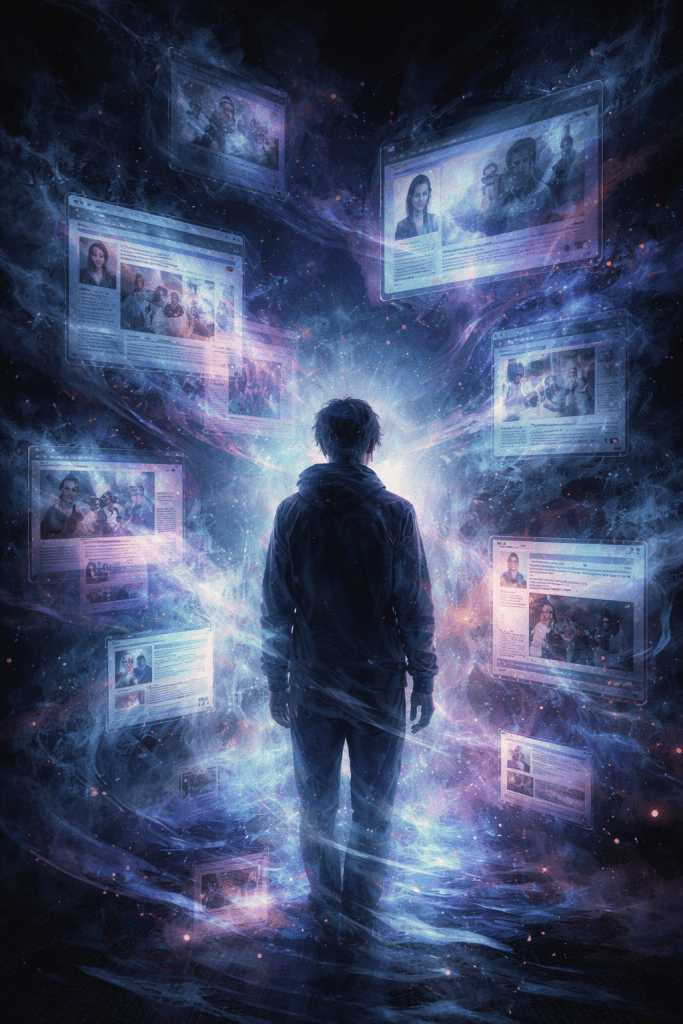
The internet has a way of preserving people in fragments—snapshots of who they were at a specific moment in time. And whether you realize it or not, you’ve left behind more than just data. You’ve left behind versions of yourself.
These are your digital ghosts.
Frozen Versions of You
Unlike real life, where people change gradually and privately, the internet freezes moments in place.
A social media post doesn’t evolve with your thoughts.
A profile doesn’t update itself to reflect your growth.
A message you sent years ago still exists exactly as you wrote it—unchanged, untouched, and permanent.
This creates a strange situation: parts of your identity are scattered across time, locked into versions of you that no longer exist in the same way.
You might look back at something you posted and think:
“That doesn’t even sound like me.”
And in a way, you’re right. It was you—but it was a previous iteration. A version shaped by different experiences, different emotions, different levels of awareness.
The internet doesn’t just store information—it preserves who you were when you created it.
The Discomfort of Seeing Your Past Self
There’s a reason old posts can feel uncomfortable to revisit.
It’s not just embarrassment—it’s recognition.
You’re seeing evidence of change.
Sometimes that shows up as cringe. Sometimes it’s subtle. A sentence that feels too naive. A belief that no longer aligns with how you think. A tone that feels overly emotional, overly confident, or completely misaligned with who you are now.
That discomfort often comes from comparison—not to other people, but to your past self.
And that comparison can trigger a mix of reactions:
- “I’ve grown a lot since then.”
- “I can’t believe I thought that way.”
- “Was I always like this?”
But growth is rarely linear or clean. Looking back can make it seem like your past self was a different person entirely, when in reality, they were just an earlier version of you operating with the knowledge and mindset they had at the time.
That version wasn’t wrong—they were just unfinished.
Growth vs. Cringe
It’s easy to label your past self as “cringe” and move on. But that reaction often hides something deeper.
What feels like cringe is usually just distance.
Distance between:
- Who you were
- And who you are now
The greater that gap, the more noticeable the contrast.
In some ways, cringe is a sign of progress. If nothing you created in the past makes you uncomfortable today, it could mean you haven’t changed much. Evolution naturally creates friction between past and present identities.
But there’s also a balance.
If you only view your past self with judgment, you miss the opportunity to understand the path that led you here. Every version of you contributed to your current perspective—even the ones you’d rather not revisit.
Your past self wasn’t a mistake. They were part of the process.
The Internet as an Archive of Identity
The internet functions less like a diary and more like an archive.
A diary is private. It’s edited. It’s often selective.
The internet, on the other hand, is fragmented but public.
Pieces of your identity may exist across:
- Old accounts you forgot about
- Messages saved in someone else’s inbox
- Comments on posts you no longer follow
- Content that still circulates even if you stopped sharing
These fragments create a kind of “digital footprint timeline” of who you’ve been over the years.
Unlike memory, which fades and reshapes itself, the internet doesn’t forget in the same way. It holds onto exact expressions of your thoughts, emotions, and perspectives at specific points in time.
In that sense, your online presence becomes a record—not just of what you shared, but of how you thought, felt, and presented yourself to the world.
Should You Delete or Keep Your Past?
At some point, many people face a choice:
Do you delete your past… or keep it?
There’s no universal answer, but the decision often reflects how you relate to your own history.
Deleting content can feel like reclaiming control. It allows you to remove versions of yourself you no longer identify with. It can also create a sense of starting fresh.
On the other hand, keeping your past intact can serve as a reminder of how far you’ve come. It can provide context for your growth and even help you appreciate your current mindset more fully.
Neither option erases who you were.
Even if something is deleted publicly, it still existed. It still shaped you. It still contributed to your development.
The real question isn’t just about storage—it’s about acceptance.
Can you acknowledge your past without needing to hide it?
Identity Isn’t Static
One of the most important realizations about digital ghosts is this:
You were never meant to stay the same.
Change is not a flaw in your identity—it’s a core feature of it.
The person you were five years ago didn’t have the same experiences, insights, or emotional depth you have now. The decisions you made, the things you said, and the way you expressed yourself were all based on the version of reality you understood at the time.
As you gain new experiences, your perspective shifts. Your priorities evolve. Your sense of self becomes more refined, more aware, more aligned with what matters to you now.
Your past selves weren’t mistakes—they were stages.
And each stage played a role in bringing you to where you are today.
Living With Your Digital Ghosts
You can’t fully escape your digital past. In some form, it exists.
But you don’t have to be defined by it either.
Instead of viewing those past versions of yourself as something separate or disconnected, it can help to see them as part of a continuous thread. Each version leading into the next, each moment building on the one before it.
Your digital ghosts aren’t here to haunt you.
They’re here to remind you that:
- You’ve changed
- You’ve grown
- And you’re still in the process of becoming
The internet may preserve fragments of who you were, but it doesn’t determine who you are now—or who you’ll become next.
Closing Thought
Somewhere online, there’s a version of you that still exists in its original form.
But that version isn’t the full story.
It’s just one chapter in an ongoing evolution—one that’s still being written, both in the real world and across the digital spaces you leave behind.
And as long as you’re still growing, there will always be new versions of you replacing the old ones.
Not because the old ones were wrong—but because you’re no longer finished.
 TheSpiritualExplorer