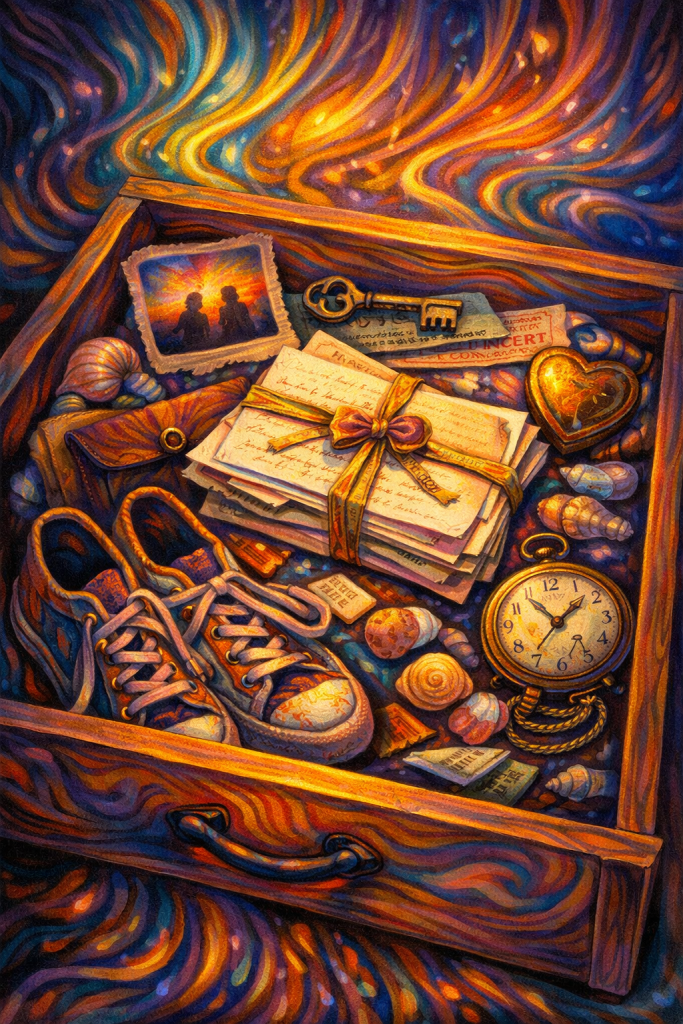
We all have them. That old concert ticket tucked in a drawer, a childhood toy collecting dust, a pen that doesn’t write but somehow can’t be thrown away. These objects serve no practical purpose. They take up space. Yet, we refuse to part with them.
Why do we hold onto things we’ll never use again?
It turns out, it’s not about the objects at all—it’s about memory, identity, and the stories we tell ourselves.
Memory Anchors: Objects as Time Machines
Think about the last time you found something from your past—a ticket stub from a first concert, a note passed in class, or a scarf you wore on a special trip. Instantly, you’re transported back.
Objects have this subtle, magical ability to act as memory anchors. They hold fragments of our past in a way that words or photos sometimes cannot. A crumpled piece of paper isn’t just paper—it’s the day you nervously scribbled your first poem, or the night you laughed until your cheeks hurt.
Keeping these objects isn’t about hoarding; it’s about keeping a tangible connection to moments that shaped who we are.
The Story Hidden in Everyday Items
Every object we cling to has a story attached, whether we consciously recognize it or not.
- That worn-out watch might have been your first “adult” purchase—a symbol of independence.
- Those scuffed sneakers may have carried you through your first marathon, your first heartbreak, or a night out with friends you haven’t seen in years.
- A stack of letters or birthday cards isn’t just paper; it’s evidence of people loving you across time.
We keep these items because they tell our stories in a way nothing else can. They’re proof that we lived, that we felt, that we existed in these fleeting moments.
The Fear of Losing the Past
Letting go of objects often feels heavier than it should. Why is that?
Throwing something away can feel like erasing a memory, or worse—erasing part of ourselves. We worry that without the physical reminder, the memory will fade. That old hoodie isn’t just fabric; it’s comfort, nostalgia, a tactile piece of our history.
Even minimalists—those who preach simplicity—admit that some items are untouchable. A photograph, a letter, a trinket—they’re too intertwined with identity to be discarded.
Minimalism vs. Sentiment: Finding Balance
There’s a fine line between sentimental keeping and clutter. Minimalism doesn’t demand that we erase our past; it asks us to choose what truly matters.
Some strategies:
- Memory boxes: Keep a small, curated selection of meaningful items.
- Photo archives: Photograph objects before parting with them.
- Story journaling: Write down why an object mattered—then decide if you can let it go.
The goal isn’t to discard everything but to honor memories without being trapped by them.
Creating Your Own “Memory Archive”
Instead of holding onto every item, consider creating a personal memory archive. Choose a few objects that genuinely tell your story, and reflect on what each represents. You’ll find that the value isn’t in the object itself, but in the emotions and stories it carries.
Take a moment today. Pick one object you’ve kept for years, dust it off, and ask yourself: Why can’t I let this go? Write its story. Relive the memory. Appreciate it. Then decide whether it stays—or if it’s time to release it, holding the memory in your heart rather than your drawer.
Because sometimes, the most powerful memories aren’t held in objects—they’re held in us.
CTA:
Challenge yourself: pick one object in your home and write a short story about it. Share it with a friend or keep it as a memory. You’ll be surprised how much one small item can reveal about who you are.
 TheSpiritualExplorer