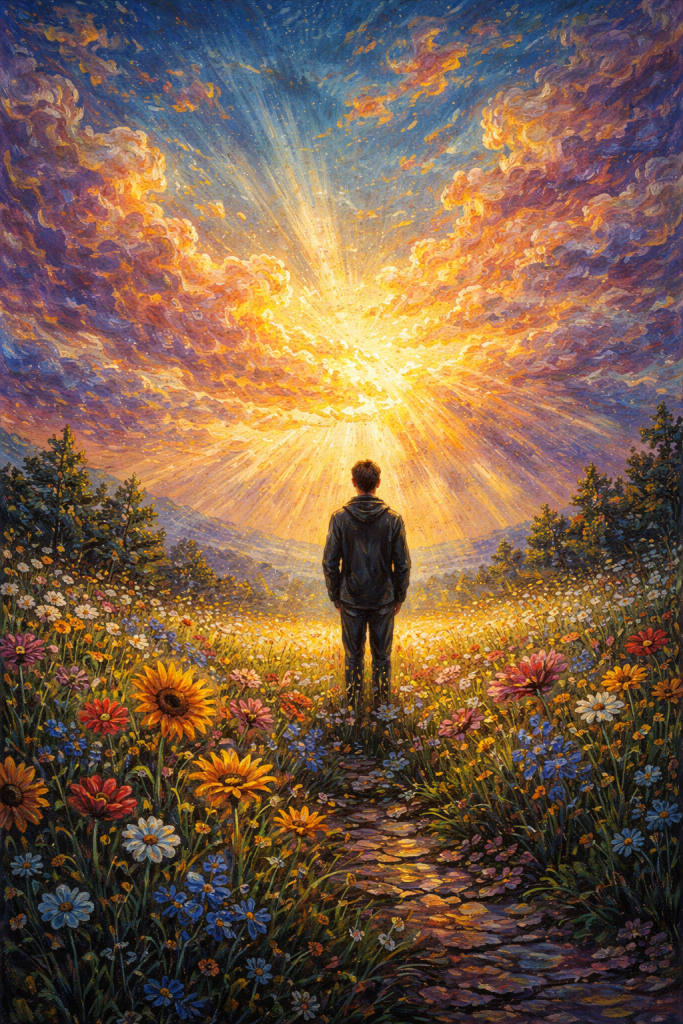
Inspired by Vincent van Gogh
“Find things beautiful as much as you can.
Most people find too little beautiful!”
We live in a world that trains our eyes to scan for problems.
We wake up and check notifications.
We scroll through headlines engineered to alarm us.
We replay conversations, looking for what went wrong.
We study our lives for flaws like inspectors hunting violations.
And then we quietly conclude:
There isn’t much beauty left.
But what if that’s not true?
What if beauty hasn’t disappeared…
What if we’ve just fallen out of the habit of seeing it?
The Mind Is Wired for Threat, Not Wonder
Biology favors survival over serenity.
Your brain is designed to notice danger faster than delight. It remembers criticism longer than compliments. It catalogs rejection more vividly than affection.
This is called negativity bias.
It kept your ancestors alive.
But today?
It keeps you anxious.
When the mind is left undisciplined, it becomes a problem-seeking machine. It will find something wrong even in a room full of blessings. It will highlight the crack in the wall instead of the sunlight pouring through the window.
The tragedy isn’t that beauty is rare.
The tragedy is that it goes unnoticed.
Trauma Narrows Vision
Pain doesn’t just hurt. It filters.
If you’ve been betrayed, you start scanning for betrayal.
If you’ve been abandoned, you start bracing for distance.
If you’ve been criticized, you begin hunting for disapproval.
Over time, your perception shrinks. You don’t just see reality — you see your wounds projected onto it.
This is how two people can live in the same world and experience completely different realities.
One sees opportunity.
The other sees threat.
One sees lessons.
The other sees injustice.
Neither is lying.
They are simply looking through different lenses.
And lenses can be changed.
Beauty Is a Discipline, Not an Accident
Most people think beauty is something you stumble upon.
A perfect sunset.
A mountain view.
A rare romantic moment.
But the truth is deeper.
Beauty is attention.
It’s the intentional act of noticing what is good, soft, subtle, alive.
You don’t “find” beauty.
You decide to look for it.
And what you look for begins to multiply.
When you focus on what’s wrong, problems expand.
When you focus on what’s beautiful, gratitude expands.
When you focus on growth, strength expands.
Attention is creative.
It builds the reality you experience.
Finding Beauty in Pain
This is where it becomes powerful.
Anyone can admire a clear sky.
But can you find beauty in the storm?
Not in a naïve way. Not in a “toxic positivity” way. But in a deeper way.
The beauty of resilience.
The beauty of becoming stronger than what tried to break you.
The beauty of clarity that only comes after loss.
There is something sacred about surviving what you once thought would destroy you.
There is beauty in realizing:
“I’m still here.”
Pain refines you if you let it.
And refinement is beautiful.
Micro-Beauty: The Forgotten Practice
We overlook small beauty because it doesn’t demand attention.
The way light hits the floor in the morning.
The silence before everyone else wakes up.
The way your breath steadies when you slow down.
The quiet satisfaction of finishing something difficult.
These moments don’t trend.
They don’t go viral.
They don’t interrupt you.
You must notice them.
Start small.
At the end of each day, ask yourself:
- What was one thing that felt peaceful?
- What was one moment that felt real?
- What was one thing that worked in my favor?
This isn’t about pretending life is perfect.
It’s about refusing to let beauty go unrecognized.
The Discipline of Perspective
Seeing beauty doesn’t mean ignoring darkness.
It means refusing to let darkness define everything.
It means choosing to widen your lens.
You can acknowledge pain without worshipping it.
You can feel disappointment without building a home in it.
You can recognize flaws without erasing goodness.
Perspective is power.
And power begins in the mind.
The disciplined observer sees:
- Lessons in failure
- Strength in vulnerability
- Growth in discomfort
- Humanity in imperfection
That kind of seeing transforms a life.
Beauty as Rebellion
In a culture addicted to outrage, choosing to notice beauty is radical.
In a world profiting from fear, cultivating wonder is rebellion.
When you decide to see what is good, you stop being easily manipulated. You stop being emotionally dragged by every headline. You become steadier. Softer. Stronger.
Beauty stabilizes you.
It reminds you that life is more than noise.
It grounds you in presence.
And presence is where peace lives.
Becoming the Person Who Sees Light
The goal is not to chase extraordinary moments.
The goal is to become someone who notices the extraordinary inside the ordinary.
That shift changes everything.
You become less reactive.
Less bitter.
Less hungry for chaos.
You start walking slower.
Listening deeper.
Appreciating more.
Your nervous system calms.
Your relationships soften.
Your inner dialogue shifts.
And slowly, without forcing it, your world begins to feel lighter.
Not because the world changed.
But because you did.
Maybe the World Isn’t Lacking Beauty
Maybe we’ve just been trained to overlook it.
Maybe we’ve been conditioned to critique instead of cherish.
Maybe we’ve mistaken cynicism for intelligence.
But what if intelligence is actually the ability to see fully?
To see pain and beauty at the same time.
To see imperfection and still call something meaningful.
To see a flawed world and still find something worth loving inside it.
As Vincent van Gogh reminded us, most people find too little beautiful.
You don’t have to be most people.
Today, look deliberately.
Look at your hands.
Look at the sky.
Look at how far you’ve come.
Look at the quiet strength it took to survive things no one applauded you for.
There is more beauty here than you think.
You just have to train your eyes to see it.
 TheSpiritualExplorer