In a world that never stops buzzing — notifications, deadlines, scrolling, thinking — silence can feel uncomfortable. Yet beneath the noise of modern life, something ancient waits patiently: vibration.
Long before wellness trends, before neuroscience, before podcasts and productivity hacks, humans understood something instinctively — sound has the power to heal.
From temple chants to tribal drums, from Tibetan singing bowls to Gregorian hymns, cultures across the world have used sound as medicine. Today, that ancient wisdom is resurfacing under a modern name: sound healing therapy.
But is it just another spiritual trend? Or is there something deeper happening when vibration meets the nervous system?
Let’s explore.
The Forgotten Language of Vibration
Everything in the universe vibrates. At the most fundamental level, even what appears solid is energy in motion. Our bodies are not separate from this truth. We are rhythmic beings — heartbeat, breath, brainwaves, circadian cycles.
When you listen to music that gives you chills, what’s happening?
When a song makes you cry, but you can’t explain why, what moved you?
Sound bypasses logic. It enters through sensation.
Ancient traditions understood this intuitively. In the East, monks used bowls, bells, and chanting to alter consciousness. In the West, cathedrals were built with acoustics that amplified sacred tones. Even indigenous cultures used repetitive drumming to induce trance states for healing and spiritual journeys.
In Herman Hesse’s Siddhartha, the river symbolizes wisdom through listening. The river does not lecture — it hums, flows, vibrates. The lesson is subtle: truth is often heard before it is understood.
Sound healing therapy taps into this principle.
What Is Sound Healing Therapy?
At its core, sound healing is the intentional use of vibration to restore balance in the body and mind.
It can include:
- Crystal or Tibetan singing bowls
- Gongs
- Tuning forks
- Chimes
- Drums
- Vocal toning and chanting
- Frequency-based music
The premise is simple: when the body is stressed or emotionally blocked, its natural rhythms become dysregulated. Sound acts like a tuning mechanism — helping your system return to harmony.
Think of it like tuning a guitar. If one string is off, the entire chord feels tense. When tuned properly, resonance returns.
The body works similarly.
The Science Behind the Vibration
While ancient traditions spoke in spiritual language, modern science offers complementary insight.
1. Brainwave Entrainment
Our brains operate in electrical patterns known as brainwaves:
- Beta – active thinking, stress, focus
- Alpha – relaxed awareness
- Theta – deep meditation, creativity
- Delta – deep sleep
Sound healing instruments often produce tones that encourage the brain to shift from high-frequency beta waves (associated with stress) into slower alpha or theta states.
This is called entrainment — when your brain synchronizes to external rhythmic stimuli.
In simpler terms: your mind slows down naturally.
2. Nervous System Regulation
Modern life keeps many of us in a constant fight-or-flight state. Emails, traffic, financial stress, social comparison — the nervous system rarely fully relaxes.
Low-frequency vibrations, like those from gongs or bowls, stimulate the parasympathetic nervous system — the “rest and digest” mode.
Heart rate slows.
Breathing deepens.
Muscles release tension.
The body shifts from survival into safety.
And healing can only happen in safety.
3. Physical Resonance
Sound travels through more than air — it travels through water. Since the human body is roughly 60–70% water, vibrations move through us efficiently.
Some practitioners describe this as “cellular massage.” Whether literal or metaphorical, many participants report sensations like:
- Gentle waves moving through the body
- Tingling in hands and feet
- Emotional release
- Feeling lighter afterward
Even if you approach it skeptically, the physiological relaxation response is measurable.
What a Sound Bath Actually Feels Like
If you’ve never experienced one, imagine this:
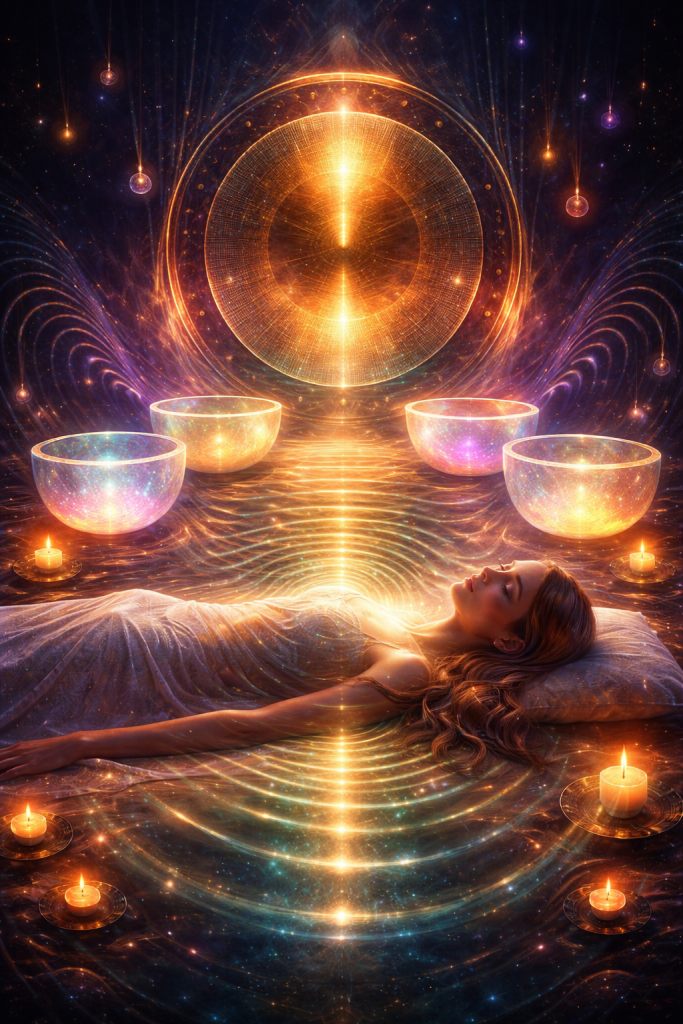
You lie down in a dim room. Maybe there’s soft candlelight. You’re wrapped in a blanket. No phone. No talking.
The practitioner begins softly — a single tone from a bowl.
It rings longer than expected.
Then another joins it.
The sounds layer — not chaotic, but immersive. Some tones feel high and crystalline. Others feel deep, almost oceanic. The gong vibrates like distant thunder rolling across a valley.
At first, your mind chatters.
Then something shifts.
You stop analyzing.
You start feeling.
Thoughts drift in and out like clouds. Time becomes irrelevant. For some, memories surface. For others, nothing dramatic happens — just profound stillness.
And that stillness is rare.
When the session ends, the room feels quieter than before — not because there is less sound, but because there is less internal noise.
Emotional Release and Stored Energy
Many people don’t realize how much emotion the body stores.
Unprocessed grief.
Unspoken anger.
Lingering anxiety.
When we suppress emotion, the nervous system holds tension. Sound vibrations can sometimes act as a key, unlocking subtle layers of stored energy.
Some people cry unexpectedly during sessions.
Some feel laughter bubble up.
Some simply feel deeply relaxed for the first time in months.
There is no “correct” reaction.
Sound doesn’t force anything — it invites.
Slowing Down to Reset
In a culture obsessed with speed, sound healing invites stillness.
And here’s the paradox:
Slowing down is secretly how you speed up.
When your mind is calmer:
- Decisions are clearer.
- Creativity flows easier.
- Focus sharpens naturally.
Instead of pushing harder, you recalibrate.
Sound healing isn’t about escaping reality — it’s about returning to yourself so you can meet reality with more clarity.
Can You Practice Sound Healing at Home?
Absolutely.
You don’t need a full ceremonial setup to begin.
Simple Starting Points:
1. Humming
Close your eyes and hum a single note for 2–3 minutes.
Feel the vibration in your chest and skull.
Notice how it changes your breathing.
2. Frequency Music
Search for 432Hz or 528Hz instrumental music.
Play it while journaling or meditating.
3. Mindful Listening
Instead of playing background music, sit and truly listen.
Notice layers, tones, subtle shifts.
4. Breath + Tone
Inhale slowly.
On the exhale, vocalize a soft “Ahhh.”
Repeat 10 times.
The goal isn’t perfection — it’s presence.
Is It Spiritual or Scientific?
It doesn’t have to be either/or.
Sound healing exists at an intersection:
- Ancient wisdom
- Modern neuroscience
- Personal experience
You can approach it spiritually, medically, or experimentally. What matters most is how your body responds.
The most powerful shifts often happen not because we believe something — but because we experience it.
Why This Matters Now
Burnout is common.
Anxiety is normalized.
Disconnection is widespread.
We scroll more.
We sleep less.
We move faster.
But we rarely pause long enough to listen.
Sound healing therapy reminds us that restoration doesn’t always require complexity. Sometimes it requires surrender.
In Siddhartha, wisdom emerges not through chasing enlightenment, but through listening deeply to the river.
Perhaps healing works the same way.
Not through force.
Not through overthinking.
But through attunement.
Final Reflection
Sound is more than something you hear — it’s something you feel.
It’s vibration touching vibration.
Energy meeting energy.
Stillness arising from resonance.
You don’t need to escape to a mountain retreat.
You don’t need to adopt a new identity.
You just need to listen.
And in that listening, you may discover something surprising:
The mind quiets.
The body softens.
And beneath the noise of life, harmony was always there.
 TheSpiritualExplorer