There has never been a time in history when so many people were healing.
Healing trauma. Healing inner children. Healing ancestral wounds. Healing money stories. Healing attachment styles. Healing their relationship to success, abundance, purpose, and self-worth.
And yet—
the world is unraveling at an accelerating pace.
Ecosystems collapse. Soil erodes. Species vanish quietly. Water systems fail. Communities fracture. Climate instability intensifies. The material conditions that sustain life grow more fragile by the year.
This is not coincidence. It is contradiction.
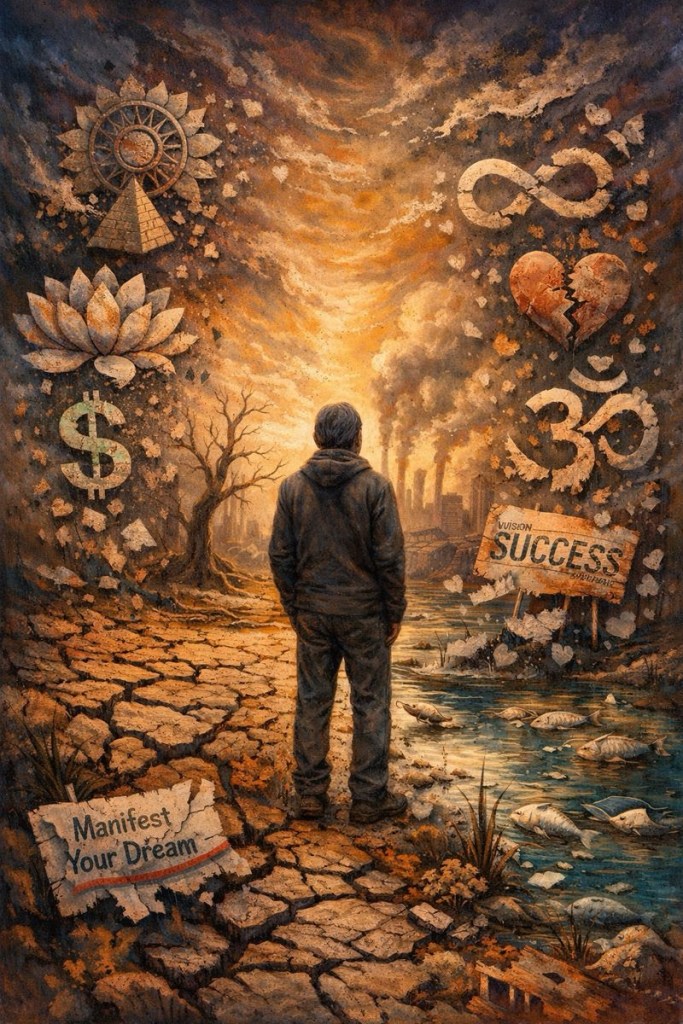
Somewhere along the way, “healing” became an inward-facing obsession—an endlessly renewable consumer product—largely severed from responsibility to the living world that makes our lives possible. Personal growth did not fail because it lacked insight. It failed because it stopped short of obligation.
When Healing Became a Lifestyle Instead of a Practice
What once described a necessary process of integration and repair has become an identity.
Healing is now something you are, not something you do—and certainly not something you complete. It is marketed as a journey with no destination, a path with infinite upgrades, a ladder with no top rung. There is always another layer, another certification, another revelation, another “deeper” version of yourself to unlock.
This isn’t accidental.
An economy has formed around the idea that you are never whole enough, never ready enough, never sufficiently aligned to step fully into the world as it is. The result is a soft paralysis disguised as progress. You are always preparing, never arriving. Always refining the self, rarely confronting the systems and conditions that shape collective reality.
Healing, in this form, is no longer oriented toward life. It is oriented toward consumption.
Spiritual Bypass Rebranded as Enlightenment
Much of what passes for spiritual or psychological maturity today is simply avoidance with better language.
We are told that anger indicates unhealed trauma, that urgency is misalignment, that grief is low vibration, that outrage reflects ego, that responsibility without joy is unconscious. We are coached to neutralize our responses rather than examine what provoked them. To regulate ourselves endlessly instead of responding proportionally to a world in crisis.
This creates a strange moral inversion.
Those who feel disturbed by ecological collapse, political violence, or systemic injustice are subtly framed as reactive, wounded, or insufficiently evolved. Meanwhile, detachment is mistaken for wisdom. Calm becomes proof of consciousness. Distance becomes spiritual authority.
But numbing oneself to reality is not transcendence. It is dissociation.
And dissociation—no matter how beautifully framed—does not protect life.
The Myth of Individual Success in a Collapsing World
At the heart of modern self-help culture lies a deeply embedded belief:
that if enough individuals become healed, successful, aligned, or awakened, the world will naturally improve.
This belief is comforting. It absolves us from confronting power, systems, infrastructure, and material responsibility. It allows us to imagine that personal excellence is inherently ethical, that self-optimization is a form of service, that prosperity is proof of contribution.
But individual success has never guaranteed collective survival.
You can be emotionally regulated while the river is poisoned.
You can manifest abundance while the soil dies.
You can be self-actualized while your lifestyle depends on extraction, exploitation, and displacement.
The planet does not respond to affirmations.
It responds to how we live.
And the harsh truth is this: no amount of inner mastery compensates for outer neglect.
Charismatic Voices and the Monetization of Meaning
Perhaps the most disturbing feature of healing culture is not its existence, but its hierarchy.
Charismatic figures rise quickly—offering certainty, coherence, and personal transformation in an increasingly unstable world. They speak fluently about consciousness while remaining curiously silent about land, labor, waste, or responsibility. Their platforms grow as ecosystems shrink. Their revenue increases as the commons erode.
This is not always malicious. Often, it is simply convenient.
The self is a far more profitable focus than the Earth. Personal transformation scales well. Environmental repair does not. One can be branded, packaged, and sold; the other requires time, humility, cooperation, and sacrifice.
So the message subtly shifts:
heal yourself first.
Then maybe later—if you feel called—you can engage with the world.
But “later” rarely arrives.
Healing That Never Leaves the Self Is Incomplete
This is not an argument against healing.
Healing is necessary. Trauma is real. Psychological repair matters. Emotional maturity matters. Inner work matters.
But healing that loops endlessly back to the self—without reorienting the individual toward participation in life—is not healing. It is self-referential regulation in a burning house.
If your healing never asks more of you than comfort, clarity, or personal fulfillment, it has been prematurely concluded.
Because genuine healing does not end in insight.
It ends in responsibility.
Reassociation With the Earth as the Missing Threshold
What would it mean to measure healing not by how peaceful we feel, but by how responsibly we live?
What if the true indicator of integration was not personal serenity, but restored relationship—to land, to community, to limits, to labor?
Reassociation with the Earth does not require spiritual language. It requires attention.
It means knowing where your food comes from and what it costs the soil.
It means understanding your dependence on water, energy, and extraction.
It means recognizing that convenience is often borrowed from elsewhere—paid for by ecosystems and people you never see.
It means getting your hands dirty. Literally or metaphorically.
Repairing. Tending. Maintaining. Participating.
This is not glamorous work. It does not trend well. It does not scale easily. It does not offer instant identity upgrades.
But it sustains life.
From Self-Realization to Life Obligation
The endless pursuit of self-realization promises transcendence but often delivers insulation. It refines the individual while leaving the world untouched.
At some point, maturity demands a different question.
Not: What am I still healing?
But: What is required of me now?
What does this moment—this place, this ecosystem, this community—ask of my time, energy, restraint, or care?
If healing does not eventually bring us back into contact with that question, then it has failed its most essential task.
Because the Earth does not need more enlightened individuals standing apart from it.
It needs participants.
Conclusion: A Different Measure of Growth
Perhaps the deepest paradox is this:
True healing does not make life easier.
It makes it more real.
It strips away the fantasy that we can perfect ourselves while remaining uninvolved. It dissolves the illusion that consciousness exempts us from consequence. It returns us—again and again—to the uncomfortable truth of interdependence.
The world is not dying because we have failed to heal ourselves deeply enough.
It is dying because we have mistaken self-focus for wisdom, comfort for consciousness, and personal success for collective care.
Healing is not complete until it carries us back into relationship—with the Earth, with limits, with responsibility, and with each other.
Anything less is just another product.
 TheSpiritualExplorer