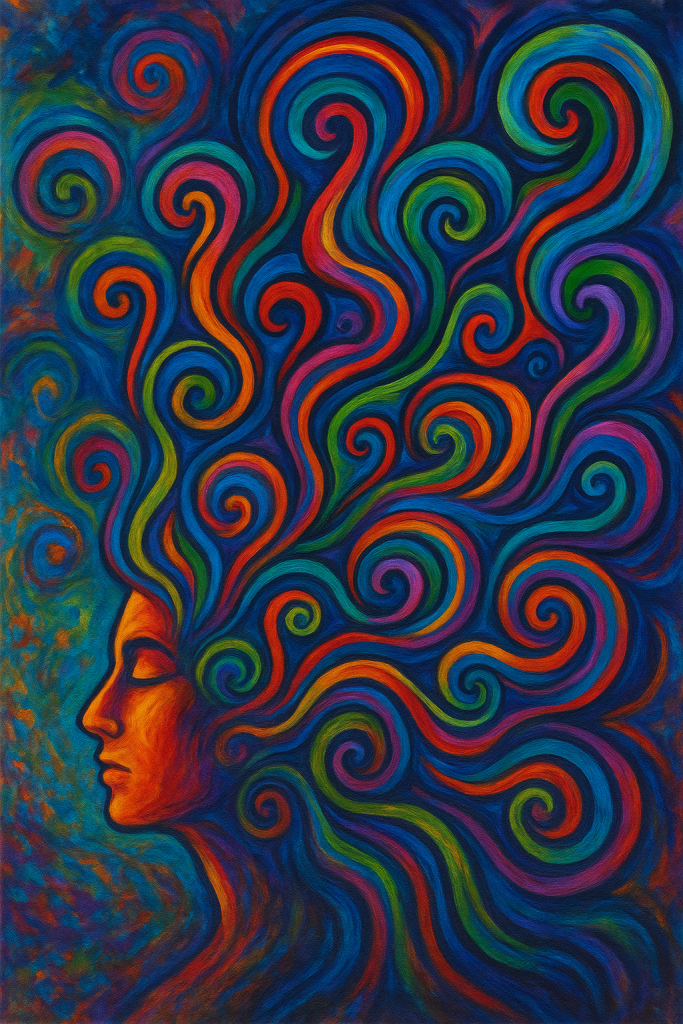
Have you ever felt your thoughts spinning like a kaleidoscope—patterns of worry, doubt, and “what ifs” endlessly reflecting off each other? It’s a sensation that can feel both mesmerizing and overwhelming. Our minds, when left unchecked, can become like a hall of mirrors, bouncing anxiety back and forth until clarity feels impossible. But there’s a way to step out of the maze: mindfulness.
The Mind as a Canvas
Imagine your mind as a blank canvas. Every thought is a brushstroke. Some are bold, vibrant, and creative; others are dark, heavy, and repetitive. Overthinking happens when we allow the darker strokes to dominate, creating a chaotic image that doesn’t reflect reality. Mindfulness isn’t about erasing these patterns—it’s about observing them. It’s about seeing your thoughts as art, not as absolute truth.
When you pause and watch your thoughts without judgment, a strange thing happens: the chaos softens. The edges blur. Suddenly, the loops of worry or self-criticism no longer control the painting—they’re just part of the bigger picture.
Practices to Clear the Mental “Paint”
Here are a few mindfulness practices that help turn mental clutter into clarity:
- Focused Breathing: Slow, intentional breaths anchor you in the present. Count each inhale and exhale, and notice how the swirling thoughts start to settle.
- Journaling: Spill your mind onto paper. Sometimes the act of writing down worries makes them tangible—and more manageable.
- Observation Without Judgment: Pick a thought, a feeling, or even a sound, and observe it as if you’re seeing it for the first time. The key is curiosity, not critique.
- Micro-Meditations: Even one minute of simply noticing your breath, posture, or environment can give your mind a reset.
Embracing Chaos as Part of Creativity
Interestingly, mindfulness doesn’t demand perfection or stillness. The “trippy” chaos of your thoughts is not your enemy—it’s a source of creativity. Artists, skaters, writers, and innovators often describe moments of inspiration coming from a mind that seems chaotic at first glance. By observing rather than reacting, you allow these patterns to inspire instead of consume.
Finding Your Trippy Clarity
Next time your thoughts feel like they’re spiraling, try stepping back and watching the kaleidoscope. Notice the shapes, the colors, the shifts. Breathe, write, observe. Accept that the chaos is part of the process. Through mindful attention, you can transform mental clutter into insight, stress into creativity, and noise into clarity.
The mind, like a canvas, can be trippy—and beautiful—if you learn to look at it with curiosity rather than fear.
 TheSpiritualExplorer