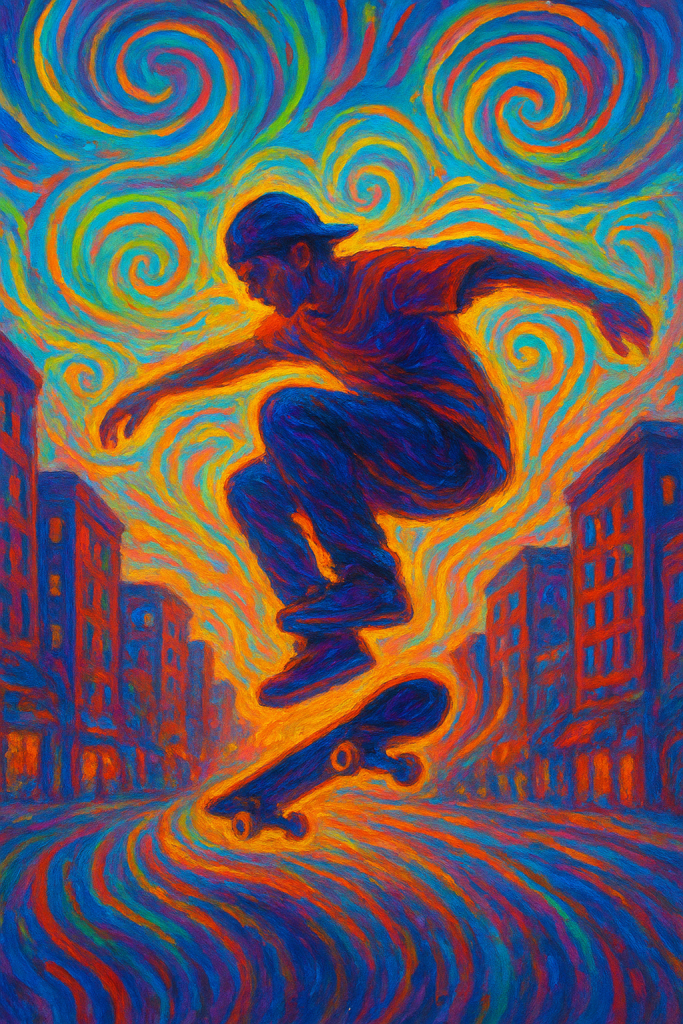
There’s a moment right before you land a trick — a small space in time where everything slows down. The sound of wheels fades, your breath syncs with your body, and all that exists is you, the board, and the motion. That’s the flow state — that effortless, razor-focused rhythm every skater chases without even realizing it.
Skating has a strange way of teaching you mindfulness without calling it that. You don’t meditate before you drop in, but your mind naturally tunes into the moment. You’re forced to — because one second of distraction means hitting the ground. And honestly, that’s where the best lessons come from.
1. Flow Comes from Letting Go
When you’re learning a new trick, your mind wants to control every piece of it. You overthink foot placement, angle, speed — until suddenly, you’re too tense to move right. You bail.
The best skaters know that flow doesn’t come from control — it comes from release. The trick starts to click the moment you stop trying to “force” it. Your body takes over, muscle memory guides you, and the movement becomes natural.
It’s the same with everything else in life. Creativity, conversation, work, relationships — they all get messy when you overanalyze them. Flow happens when you trust yourself enough to move without fear of the fall.
2. Falling Teaches You to Focus
Every skater has that one slam they’ll never forget. Mine was on a simple trick I’d done hundreds of times. I was distracted — thinking about my phone buzzing in my pocket, someone watching, whatever. My focus slipped for half a second, and the concrete reminded me why presence matters.
That’s the brutal beauty of skating: instant feedback. You can’t fake focus. The moment your mind drifts, the board throws you out.
But here’s the twist — falling doesn’t just teach you balance; it sharpens your attention. You start reading the smallest details: the texture of the ground, the timing of your pop, the sound of your wheels. You tune in completely.
After a while, that kind of awareness follows you off the board. You start noticing how often your mind wanders during conversations, work, or even while eating. You realize life, like skating, rewards presence.
3. The Calm Inside Chaos
Skating might look chaotic — the speed, the noise, the concrete flying past — but inside that chaos is deep calm. When you’re locked into a line or rolling toward a trick, your thoughts go silent. The noise of life disappears.
That’s the paradox of flow: it feels like effort, but it’s actually peace in motion.
People chase that calm through all kinds of things — painting, running, music, meditation. For skaters, it’s a moving meditation. You’re not sitting cross-legged trying to clear your thoughts; you’re doing it while dodging cracks and grinding rails.
Flow doesn’t need quiet surroundings — it needs full engagement.
4. Translating the Skater Mindset to Life
If you look closely, skating mirrors everything else we do:
- Persistence: You fail more than you succeed, but the only way to learn is to keep trying.
- Adaptability: Every surface, every board, every day feels a little different — you adjust without complaint.
- Resilience: You fall, get scraped up, and still go again. That’s growth disguised as play.
This mindset applies to anything creative or difficult. Artists, athletes, entrepreneurs — all of them chase flow through failure. They all find peace in repetition.
The trick isn’t to avoid falling — it’s to make falling part of your rhythm.
5. Flow Is a Skill, Not an Accident
People talk about flow like it’s magic — something that just “happens” when the conditions are perfect. But every skater knows: you earn it.
You get there by showing up every day, even when you’re not feeling it. You warm up, fail a few times, and slowly find the groove again. The mind learns to quiet itself through repetition and intention.
And when it clicks — when your board sticks to your feet like it’s part of you — there’s no better feeling. You’re not thinking about the past or worrying about the next trick. You’re just there.
That’s real focus.
6. Falling Is the Teacher, Not the Enemy
The older I get, the more I see falling differently. It’s not the opposite of progress — it is progress. Every fall rewires your brain a little, teaches your body where to adjust, shows you that failure isn’t fatal.
Most people avoid falling — on the board, in life, in love — because it hurts. But pain has information in it. It tells you what to fix, what to strengthen, and what really matters to you.
You can’t learn flow if you’re afraid to fall.
Closing Thoughts
Skating taught me focus in a way meditation never could. It taught me how to be here, now — not because someone told me to breathe deeply, but because the pavement demanded it.
Flow state isn’t about being perfect; it’s about being present. It’s the space between overthinking and instinct, where you stop trying so hard and start simply being.
Every time I push off, I chase that moment again — the calm inside chaos, the clarity that only comes from movement. And even when I fall, I’m still learning how to stay balanced, both on the board and off it.
 TheSpiritualExplorer