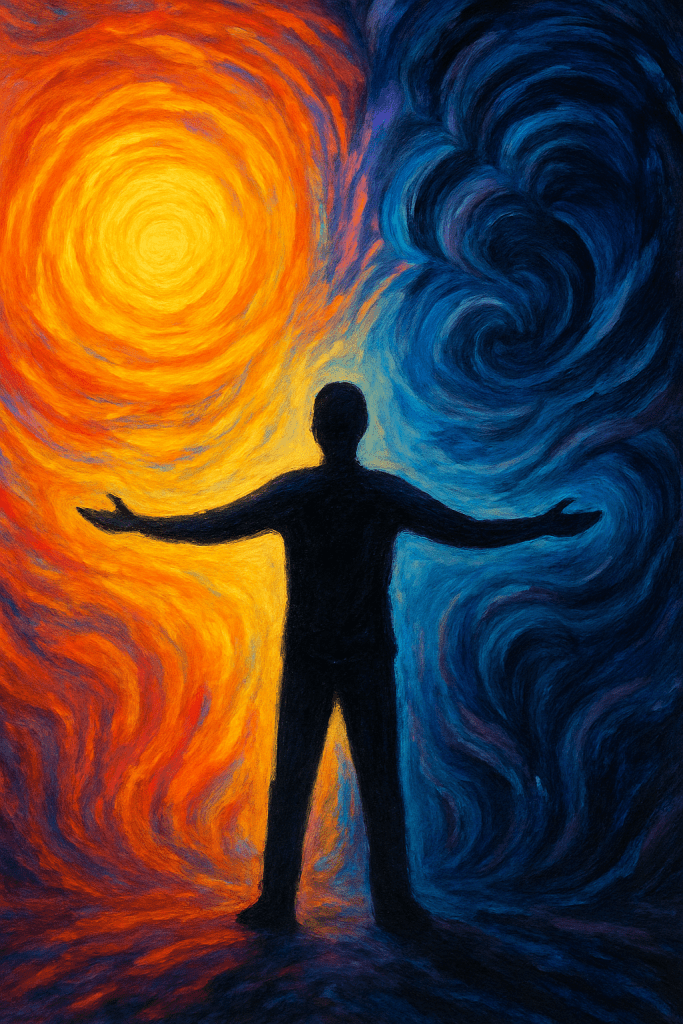
Life often asks us to choose sides. We’re told to be confident, not doubtful. To be happy, not sad. To be strong, not vulnerable. But what if the real wisdom of life isn’t in choosing one over the other—but in allowing both to exist at the same time?
Contradictions aren’t flaws in the human experience—they’re the fabric of it.
The Nature of Contradictions
Think about the sky. One moment, it holds sunshine. The next, storm clouds. Sometimes both at once. Does that make it broken? Of course not—it makes it whole.
We are the same way. You can feel gratitude for what you have while still longing for more. You can be deeply hurt and still love. You can be afraid and brave in the same breath. These paradoxes don’t cancel each other out—they prove that we are complex, layered beings.
Why Polarity Creates Growth
When we allow both ends of the spectrum, we stretch ourselves. Confidence without doubt can slip into arrogance. Joy without sorrow can feel shallow. Strength without softness can become rigidity.
It’s in the mix—in the tension between opposites—that we grow. Just as muscles build by resisting force, our spirit deepens by holding space for both/and living.
How to Practice Both/And Thinking
- Acknowledge complexity. Instead of saying, “I shouldn’t feel this way,” try: “I feel both excitement and fear—and that’s okay.”
- Reject the pressure to simplify. Life doesn’t have to be neat. Messy truths often carry the most power.
- Let contradictions teach you balance. If you feel torn, it doesn’t mean you’re weak—it means you’re alive to the full spectrum of experience.
The Takeaway
Living in the “both/and” is an act of courage. It’s refusing to split yourself into halves just to make life easier to explain. True wholeness doesn’t come from erasing contradictions—it comes from embracing them.
So the next time you find yourself pulled in two directions, remember: it doesn’t mean you’re broken. It means you’re human. And there is wisdom in the tension.
 TheSpiritualExplorer